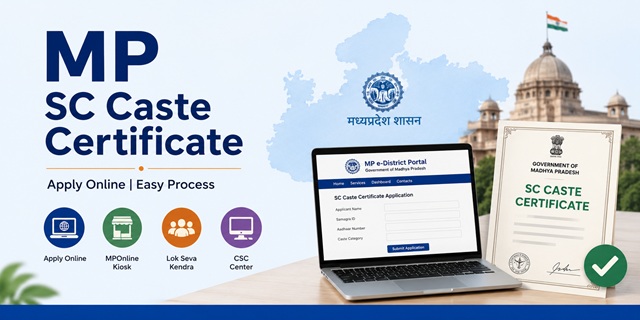
Madhya Pradesh handles caste certificate applications through its e-District portal with one feature that most other states do not offer: if any of your immediate family members (father, brother, or sister) already holds a valid SC certificate issued by the Sub-Divisional Officer, you can get your own certificate through a simplified family-based process. This, combined with the state's Samagra ID integration and a network of over 53,000 MPOnline kiosks, makes the MP caste certificate system among the most accessible in the country.
This guide covers the SC caste certificate process in Madhya Pradesh, including all application routes, what makes the MP system different, and what you need before you start.
Scheduled Castes Notified in Madhya Pradesh
Madhya Pradesh has 48 castes officially notified as Scheduled Castes under the Constitution (Scheduled Castes) Order, 1950. There is no income limit to apply. If your caste is in the MP SC notification, you are eligible regardless of your economic status.
Three Types of Backward Class Certificates in Madhya Pradesh
Before applying, it helps to know that Madhya Pradesh issues three separate categories of backward class certificates, not just SC/ST and OBC like most states. This is important so you apply for the right service:
- Service 6.3-A: Jati Praman Patra for Scheduled Castes and Scheduled Tribes
- Service 6.3-B: Jati Praman Patra for Other Backward Classes (OBC)
- Service 6.3-C: Jati Praman Patra for Vimukta Jati (Denotified Tribes), Ghumakkad Jati (Nomadic Tribes), and Ardha Ghumakkad Jati (Semi-Nomadic Tribes)
This guide covers Service 6.3-A for SC communities. The Vimukta Jati and Ghumakkad Jati categories (Service 6.3-C) are separate from OBC and represent historically nomadic and denotified communities. If your community belongs to one of these, select 6.3-C and not 6.3-A or 6.3-B when applying.
Issuing Authority in Madhya Pradesh
The SC Jati Praman Patra in Madhya Pradesh is issued by the Sub-Divisional Officer (Revenue), commonly referred to as the SDO. This is consistent across all districts in the state. The Patwari (village revenue officer, similar to Lekhpal in UP) plays a role in field verification before the SDO approves and issues the certificate.
Samagra ID: MP's Unique Family Database
Madhya Pradesh maintains the Samagra ID system, a state family database where every resident has a unique identification number. This is a key unique feature of MP's government services. Your Samagra ID is linked to your caste certificate in the MP system. If there is any discrepancy in your date of birth, Aadhaar, or caste entry in the Samagra database, you must get it corrected first. MP even has a dedicated service for "Correction in Date of Birth and Aadhaar and Samagra in caste certificate" confirming how tightly the systems are integrated.
Before applying for your SC certificate, ensure your Samagra ID is active and your family details are correctly recorded. Visit samagra.gov.in to check or update your Samagra profile if needed.
Documents Required
- Aadhaar Card
- Samagra ID (individual and family Samagra ID)
- Proof of caste: old SC certificate of father or grandfather, school record showing SC community, or any government record mentioning your caste
- Proof that the family was residing in Madhya Pradesh around 1950 or thereafter, such as educational records, government service records, voter records, or ancestral land/property records.
- Educational qualification documents such as school certificates, marksheets, or transfer certificate, wherever available.
- Ration Card
- MP Domicile Certificate (Niwas Praman Patra)
- Birth certificate or school leaving certificate
- Passport-size photograph
How to Apply for SC Certificate in Madhya Pradesh
Madhya Pradesh offers multiple ways to apply for an SC Caste Certificate. You can submit the application yourself through the MP e-District portal, visit a Lok Seva Kendra, use an MPOnline kiosk, or apply through a Common Service Centre (CSC). All applications are ultimately processed by the Revenue Department and approved by the Sub-Divisional Officer (Revenue).
Method 1: Apply Online Through MP e-District Portal
The quickest method is to apply directly through the official MP e-District Portal. This option is suitable if you have internet access and scanned copies of your documents ready.
- Visit mpedistrict.gov.in and sign in to your account. New users can create an account using their mobile number and basic details.
- Open the list of services and select Service 6.3-A - Caste Certificate for Scheduled Castes.
- Enter your personal information, including your name, address, Aadhaar Card, Samagra ID, and caste details.
- Upload the required supporting documents such as caste proof, residence proof, educational records, and declaration form.
- Check all information carefully before submission. Errors in Samagra details, caste information, or family records can delay verification.
- Submit the application and save the acknowledgement or application number generated by the portal.
- The application is sent to the concerned Patwari for local verification. The Patwari may verify your family records, residence details, and caste-related documents.
- After verification, the report is forwarded to the Sub-Divisional Officer (Revenue) for approval.
- Once approved, log in to the portal and download the digitally signed SC Caste Certificate.
Method 2: Apply Through Lok Seva Kendra (LSK)
If you do not want to fill out the online form yourself, visit the nearest Lok Seva Kendra. These centres provide government services and help citizens submit applications online.
- Carry all original documents along with photocopies and your Samagra ID details.
- The Lok Seva Kendra operator enters your information into the official MP e-District system and uploads the required documents.
- Pay the prescribed service charge and collect the acknowledgement receipt.
- Keep the receipt safe because it contains the application number needed for tracking your application.
- Your application is processed through the same Patwari verification and SDO approval process used for online applications.
- After approval, you can download the certificate online or obtain a printed copy from the centre.
Method 3: Apply Through MPOnline Kiosk
MPOnline kiosks are available across cities, towns, and villages throughout Madhya Pradesh. They are one of the most commonly used channels for government service applications.
- Visit your nearest MPOnline kiosk with all required documents.
- Provide your Aadhaar number, Samagra ID, caste proof documents, educational certificates, and residence-related records.
- The kiosk operator completes the online application on your behalf and uploads the necessary documents.
- Pay the notified service charge and collect the acknowledgement slip.
- Use the application number on the receipt to track the status of your application.
- Once the certificate is approved by the SDO, you can download it online or collect a printout from the kiosk.
You can locate a nearby MPOnline centre through mponline.gov.in.
Method 4: Apply Through Common Service Centre (CSC)
Common Service Centres (CSCs) also provide access to Madhya Pradesh government services and can submit caste certificate applications electronically.
- Visit an authorised CSC with all supporting documents.
- The CSC operator fills in the application form and uploads the required records through the official system.
- Pay the applicable service charge and obtain the acknowledgement receipt.
- The application is forwarded for Patwari verification and SDO approval.
- After approval, download the certificate online or obtain a printed copy from the CSC.
Special Facility for Family Members (Service 6.6-A)
Madhya Pradesh provides a special facility that many other states do not offer. If your father, real brother, real sister, uncle, or another eligible blood relative already holds an SC/ST certificate issued by the Sub-Divisional Officer (Revenue), you may be able to apply through Service 6.6-A.
Under this service, the existing SDO-issued caste certificate of your family member can be used as supporting proof for your application. This reduces the need to repeatedly establish the caste status of the same family and often makes the process easier for subsequent family members.
To use this facility, select Service 6.6-A on the MP e-District Portal and provide the details of the existing certificate issued to your eligible family member.
Getting a Digital Copy of Old Manual Certificate (Service 6.5-A)
If you have an old handwritten manual SC/ST certificate issued before the digital system was implemented, you can get it digitized through Service 6.5-A on the portal. This converts your paper certificate into a digitally verifiable document in the MP system. This is particularly useful when the original manual certificate is required for online submission at institutions that only accept digital or system-verifiable certificates.
Benefits of SC Certificate in Madhya Pradesh
- Reservation in Madhya Pradesh state government jobs under the SC quota
- 15% reservation in central government jobs and central educational institutions nationally
- Reserved seats in government medical, engineering, and other professional colleges in MP
- Pre-matric and post-matric scholarships through the National Scholarship Portal
- 5 years age relaxation in MPPSC, MPESB, and central competitive examinations
- Access to SC welfare schemes including post-matric scholarship, free coaching, and housing schemes run by the MP government
- Access to schemes under the Ministry of Social Justice and Empowerment
नई टिप्पणी जोड़ें