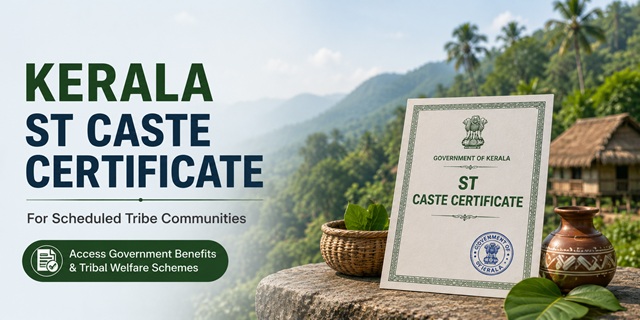
Kerala's tribal communities are concentrated in the forested highland districts of Wayanad, Palakkad, Idukki, and the Kasaragod coast. Many of Kerala's tribal groups are among the smallest and most isolated in India, with some communities numbering only a few thousand people.
Despite their small numbers, all notified tribal communities in Kerala are eligible for the ST Caste Certificate through the same e-District portal and Akshaya centre network that handles SC certificates. The key distinction to remember is that in Kerala, the document is called a Caste Certificate for ST - it is different from the Community Certificate which is for OBC communities.
Scheduled Tribes Notified in Kerala
The following communities are notified as Scheduled Tribes (ST) in Kerala under the applicable constitutional provisions:
- Adiyan
- Arandan
- Eravallan
- Hill Pulaya
- Irular
- Kadar
- Kanikaran
- Kanikkar
- Kattunayakan
- Kochuvelan
- Koraga
- Kudiya
- Melakudi
- Kurichchan
- Kurumans
- Kurumbas
- Maha Malasar
- Malai Arayan
- Malai Pandaram
- Malai Vedan
- Malakkuravan
- Malasar
- Malayarayar
- Malayekandi
- Mannan
- Mudugar
- Muduvan
- Muthuvan
- Palleyan
- Palliyan
- Palliyar
- Paniyan
- Ulladan
- Uraly
- Wayanad Kadar
Communities with Area Restrictions
- Kammara (Kollam, Pathanamthitta, Alappuzha, Kottayam, Ernakulam, Idukki, Thrissur and Palakkad districts only)
- Kondareddi (Palakkad district only)
Major Tribal Communities in Kerala
- Paniyan - The largest Scheduled Tribe community in Kerala, found mainly in Wayanad and parts of Malappuram district.
- Adiyan - A prominent tribal community concentrated in Wayanad district.
- Kattunayakan - A well-known forest-dwelling tribal community primarily found in Wayanad.
- Muthuvan - Concentrated in the high-range areas of Idukki district.
Important: Certain communities are recognised as Scheduled Tribes only in specific districts. Applicants belonging to such communities should verify the latest notification and area restrictions before applying for an ST Caste Certificate.
Kerala's Two Particularly Vulnerable Tribal Groups
Kerala has two communities classified as Particularly Vulnerable Tribal Groups (PVTGs):
- Cholanaikkan: One of the most isolated tribal communities in India, living deep in the Silent Valley forest area of Palakkad district. The Cholanaikkan are considered a "forest forager" community who have traditionally depended entirely on forest resources. Their population numbers only a few hundred.
- Kadar: Another highly marginalised community concentrated in the Parambikulam Tiger Reserve area of Palakkad district and forests of Thrissur district. Like the Cholanaikkan, the Kadar are classified as PVTG due to their extremely small population and pre-agricultural lifestyle.
Members of both PVTG communities are eligible for all standard ST benefits plus additional targeted support under central and state PVTG development programmes. An ST Caste Certificate is the primary document to access both standard and PVTG-specific benefits.
District-Specific Restriction: Kammara
The Kammara community is notified as ST in Kerala only in specific districts: Kollam, Pathanamthitta, Alappuzha, Kottayam, Ernakulam, Idukki, Thrissur, and Palakkad. Kammara community members living outside these specified districts are not eligible for the ST certificate under the Kerala notification. Before applying, confirm your home district is in the notified list.
No Religion Restriction for ST Certificate
There is no religion restriction for the ST Caste Certificate in Kerala or anywhere in India. Unlike the SC certificate which requires the applicant to profess Hinduism or Sikhism, the ST certificate applies regardless of religion. This is confirmed by the constitutional framework for Scheduled Tribes which has no religion requirement. Tribal community members who follow Christianity or any other faith are eligible to apply.
Portal, Issuing Authority, and Process
The ST Caste Certificate is issued by the Tahsildar or Village Officer of your Taluk. Applications are submitted through the edistrict.kerala.gov.in portal or through Akshaya centres.
Documents Required
- Aadhaar Card
- Proof of tribal community: old ST Caste Certificate of father or grandfather, school record showing tribal community, or any government document mentioning your tribe
- Kerala Ration card
- Residence proof (electricity bill, water bill, domicile/ nativity certificate or similar utility document)
- Birth certificate or SSLC marksheet
- Passport-Size photograph
How to Apply: Three Methods
Method 1: Online Through e-District Kerala Portal
- Visit edistrict.kerala.gov.in and create an Aadhaar-linked account (one account per person).
- Log in and select the ST Caste Certificate service. Do not select Community Certificate - that is a different service for OBC communities.
- Fill the form with your tribe name, Taluk, district, and personal details. Enter your tribe name exactly as it appears in the Kerala ST notification.
- Upload required documents and pay the applicable fee online.
- Submit and note your application number. You will receive SMS updates at each processing stage.
- Track your application on the portal using the "Track Application" feature.
- Download the signed certificate from your account once issued. The certificate can also be verified by anyone using the QR code verification feature at edistrict.kerala.gov.in.
Method 2: Through Akshaya Centre
Akshaya centres in all 14 Kerala districts provide the ST Caste Certificate service. Visit the nearest Akshaya centre with all original documents. The operator submits the application through the e-District portal. For the nearest Akshaya centre and for helpline support: visit akshaya.kerala.gov.in or call Toll Free 155300 (BSNL), 0471-2335523, or 0471-2525443.
Method 3: At the Taluk Office
Visit the Tahsildar's office at your Taluk headquarters with original documents. The Village Officer may conduct field verification before the Tahsildar issues the certificate.
Benefits of ST Certificate in Kerala
- Reservation in Kerala state government jobs under the ST quota
- 7.5% reservation in central government jobs and central educational institutions nationally
- Reserved seats in government medical, engineering, and professional colleges in Kerala
- Pre-matric and post-matric tribal scholarships through E-Grantz and the National Scholarship Portal
- 5 years age relaxation in KPSC, Kerala Police, and central competitive examinations
- Additional PVTG support for Cholanaikkan and Kadar communities
- Forest Rights entitlements under the Forest Rights Act 2006
- Access to tribal welfare schemes under the Ministry of Tribal Affairs
नई टिप्पणी जोड़ें