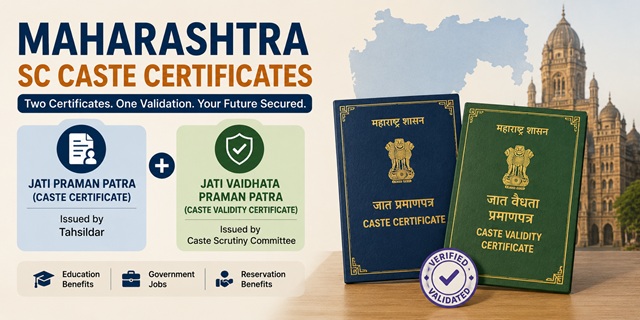
If you belong to a Scheduled Caste community in Maharashtra and need to apply for a caste certificate, there is one thing most people from other states do not know: Maharashtra requires two separate certificates, not one. You need the Jati Praman Patra (Caste Certificate) from the Tahsildar, and you also need the Jati Vaidhata Praman Patra (Caste Validity Certificate) from the district Caste Scrutiny Committee before you can use your caste status for a government job or college admission.
This is not optional in Maharashtra. It is mandated under the Maharashtra Scheduled Castes, Scheduled Tribes, De-notified Tribes, Nomadic Tribes, Other Backward Classes and Special Backward Category (Regulation of Issuance and Verification of) Caste Certificate Act, 2000. Skipping the validity certificate has led to many candidates losing their government jobs and college admissions years after selection, when the scrutiny committee eventually verified and found inconsistencies.
This guide covers both certificates, the full process, and everything specific to Maharashtra's SC community that you need to know.
Scheduled Castes Notified in Maharashtra
Maharashtra has 59 castes officially notified as Scheduled Castes. The list covers a wide range of communities spread across different regions of the state. Major SC communities in Maharashtra include Mahar (and sub-groups such as Taral and Dhegu Megu), Chambhar, Dhor, Mochi, Muchi, Mang (Matang), Minimadig, Bhangi, Mehtar, Olgana, Holiya, Hollar, Kaikadi, Mang Garodi, Mang Garudi, Kolhati, Nadia, Burud, and others.
The Mahar community is the largest SC community in Maharashtra and is historically associated with the legacy of Dr. Babasaheb Ambedkar. The Chambhar, Mang, and Holiya communities each have dedicated state corporations that provide loans, scholarships, and skill development support exclusively for their members.
If you are unsure whether your caste is in the Maharashtra SC list, visit the office of your local Tahsildar or check with the district Social Welfare Office before applying.
Two Certificates You Need in Maharashtra
Certificate 1: Jati Praman Patra (Caste Certificate)
This is the primary SC caste certificate issued by the Tahsildar of your taluka. It confirms that you belong to a caste notified as Scheduled Caste in Maharashtra. You apply for this through the Aaple Sarkar portal (aaplesarkar.mahaonline.gov.in) or at the Tahsildar's office directly. This certificate alone is sufficient for many state schemes, scholarships, and fee concessions at the time of initial application or admission.
Certificate 2: Jati Vaidhata Praman Patra (Caste Validity Certificate)
This is issued by the district-level Caste Scrutiny Committee after independently verifying that your Jati Praman Patra is genuine and that your family truly belongs to the notified SC community. For government job appointments, promotions in government service, and admission to government professional colleges in Maharashtra, this certificate is mandatory. Without it, your appointment or admission can be cancelled at any stage, including after years of service.
Apply for the Jati Vaidhata Praman Patra only after you receive your Jati Praman Patra. You submit the caste certificate along with supporting documents to the district Caste Scrutiny Committee. The Committee holds an inquiry, may call you for a hearing, and then issues the validity certificate if satisfied.
Documents Required
For the Jati Praman Patra from the Tahsildar, keep these ready:
- Aadhaar Card of the applicant
- Proof of caste: old caste certificate of father or grandfather, school leaving certificate showing caste as SC, or birth certificate showing caste
- Ration Card as residence and family proof
- Maharashtra Domicile Certificate
- Birth certificate or school leaving certificate of the applicant
- Passport-Size Photograph
- Self-declaration or affidavit about caste
- 7/12 extract or property record of ancestral village (if available, strengthens the application)
For the Jati Vaidhata Praman Patra from the Caste Scrutiny Committee, you additionally need:
- The original Jati Praman Patra issued by the Tahsildar
- Ancestral documents proving long-standing membership in the SC community: old school records, birth registers, revenue records, or any pre-1950 documents if available
- Affidavit of the applicant declaring SC status and permanent residence
How to Apply for Jati Praman Patra in Maharashtra
Online Through Aaple Sarkar Portal
Aaple Sarkar (aaplesarkar.mahaonline.gov.in) is the Maharashtra government's official single-window service portal. The caste certificate is available under the Revenue Department section.
- Open aaplesarkar.mahaonline.gov.in in your browser.
- Click on Register if you do not have an account. Register using your mobile number and Aadhaar number.
- After logging in, search for "Caste Certificate" or navigate to Revenue Department services.
- Select the SC caste certificate service and fill in the application form with your personal details, caste name, and taluka.
- Upload scanned copies of all required documents in the formats and sizes specified on the portal.
- Pay the application fee online using net banking, UPI, or debit card.
- Submit the application and save the acknowledgement number for tracking.
- The application is forwarded to the Tahsildar of your taluka. A field inquiry may be conducted by the Talathi (village revenue officer in Maharashtra, equivalent to Patwari in other states) to verify your address and caste.
- Once approved, download the digitally signed Jati Praman Patra from your Aaple Sarkar account.
Through Setu Suvidha Kendra (Common Service Centre)
Every taluka in Maharashtra has Setu Suvidha Kendras, which are the state's equivalent of Common Service Centres. If you need assistance with the online process or do not have internet access, visit the nearest Setu Kendra with all original documents and photocopies. The operator submits the application through the Aaple Sarkar portal on your behalf. Pay the government fee and a small facilitation charge to the Kendra and collect your acknowledgement slip.
Offline at Tahsildar Office
You can apply directly at the Tahsildar's office in your taluka. Collect the caste certificate application form at the counter, fill it accurately with your caste name as it appears in the Maharashtra SC notification, and submit with self-attested document copies. The Tahsildar's office will process the application, assign the local Talathi for verification, and issue the certificate within the prescribed timeline under the Maharashtra Right to Services Act.
WhatsApp Assistance
The Maharashtra Social Justice and Special Assistance Department operates a WhatsApp chatbot on 8062524455 that provides information on welfare schemes and can guide you on the application process for SC certificates and benefits.
How to Apply for Jati Vaidhata Praman Patra in Maharashtra
After obtaining the Jati Praman Patra (Caste Certificate) from the Tahsildar, applicants who require caste validity for government jobs, professional college admissions, or other purposes must apply to the competent Caste Scrutiny Committee.
- Visit the Official Maharashtra Caste Certificate Verification Portal and create an account if required.
- Select the application for Caste Validity Certificate (Jati Vaidhata Praman Patra).
- Enter details exactly as mentioned in the Jati Praman Patra.
- Upload the caste certificate and all supporting ancestral documents.
- Submit school records, old caste certificates of blood relatives, revenue records, genealogy documents, and any historical records available.
- Submit the application and note the acknowledgement number.
- The Caste Scrutiny Committee examines the records and may seek additional documents or clarification.
- Applicants may be called for a personal hearing if required.
- Once verification is completed, the Committee issues the Jati Vaidhata Praman Patra.
Important: Apply for the validity certificate as early as possible. Many colleges and recruiting authorities allow provisional admission or appointment initially, but the validity certificate is usually required before final confirmation.
Who Issues the Certificate and What Is the Talathi's Role
In Maharashtra, the Tahsildar is the officer who issues the Jati Praman Patra. The Talathi is the village-level revenue officer (equivalent to the Lekhpal in UP or Patwari in other states) who visits your home or village to verify your residence and caste. The Talathi's verification report is sent to the Tahsildar, who then issues the certificate. Make sure your name and caste are correctly recorded in the village records maintained by the Talathi before you apply.
Community-Specific Welfare Corporations in Maharashtra
Maharashtra has established dedicated state corporations for specific SC communities. Once you have your caste certificate, you can approach the relevant corporation for loans, scholarships, and skill development support:
- Sant Rohidas Leather Industries and Charmakar Development Corporation (LIDCOM): Serves Chambhar, Dhor, Mochi, and Muchi communities. Provides loans for self-employment in leather and related trades.
- Sahityaratna Lokshahir Anna Bhau Sathe Development Corporation: Primarily serves the Matang (Mang) community. Provides educational and economic support.
- Holar Samaj Arthik Vikas Corporation: Serves the Holar community with economic development programs.
- Hindu Khatik Samaj Arthik Vikas Corporation: Serves the Khatik community.
These corporations are under the Social Justice and Special Assistance Department at sjsa.maharashtra.gov.in.
Key Benefits of SC Certificate in Maharashtra
- Reservation in Maharashtra state government jobs under the SC quota
- 15% reservation in central government jobs and central educational institutions nationally
- Reserved seats in Maharashtra government medical, engineering, law, and other professional colleges
- Ramai Awas Gharkul Scheme: housing assistance for SC families
- Bharatratna Dr. Babasaheb Ambedkar Swadhar Yojana: financial assistance for SC students studying in Class 11 and above in cities away from home
- Rajarshi Shahu Maharaj Foreign Scholarship: for SC students pursuing studies abroad
- Pre-matric and post-matric scholarships through the National Scholarship Portal
- Fee reimbursement for SC students in eligible professional courses under state schemes
- 5 years age relaxation in state competitive exams and UPSC
नई टिप्पणी जोड़ें