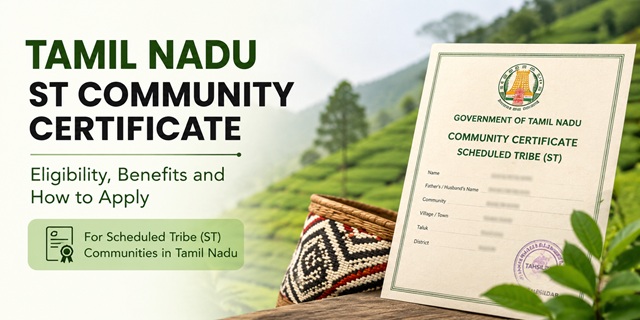
Tamil Nadu is home to several Scheduled Tribe (ST) communities, each with its own cultural heritage and traditional area of residence. While some tribes, such as the Toda and Kota, are primarily associated with the Nilgiris, others including the Irular, Kurumba, Kattunayakan, Muduvan, and Paniyan are found in different forest and hilly regions of the state. For this reason, eligibility for an ST Community Certificate may depend not only on your community but also on the area-specific conditions prescribed under the Constitution (Scheduled Tribes) Order, 1950, wherever applicable.
In Tamil Nadu, the ST Community Certificate is issued by the Revenue Department through the official Tamil Nadu e-Sevai system. Although the application procedure is similar to that followed for other community certificates, applicants belonging to Scheduled Tribes should carefully verify that their community and, where applicable, their place of residence satisfy the notified eligibility conditions before submitting the application.
Scheduled Tribes Notified in Tamil Nadu
The following communities are notified as Scheduled Tribes (STs) for the State of Tamil Nadu under the Constitution (Scheduled Tribes) Order, 1950, as amended from time to time:
- Adiyan
- Aranadan
- Eravallan
- Irular, Irulan
- Kadar, Wayanad Kadar
- Kanikaran, Kanikkar (only in Kanyakumari district and Shenkottah and Ambasamudram taluks of Tirunelveli district)
- Kattunayakan
- Kochu Velan
- Konda Kapus
- Kondareddis
- Koraga
- Kota (excluding Kanyakumari district and Shenkottah taluk of Tirunelveli district)
- Kudiya, Melakudi
- Kurichchan
- Kurumbas (only in the Nilgiris district)
- Kurumans
- Maha Malasar
- Malai Arayan
- Malai Pandaram
- Malai Vedan
- Malakkuravan
- Malasar
- Malayali (only in Dharmapuri, North Arcot, Pudukottai, Salem, South Arcot, and Tiruchirapalli districts)
- Malayekandi
- Mannan
- Mudugar, Muduvan, Muthuvan
- Palleyan, Palliyan, Palliyar
- Paniyan
- Sholaga
- Toda (excluding Kanyakumari district and Shenkottah taluk of Tirunelveli district)
- Uraly
Important: Some Scheduled Tribe communities are recognised only in the specific districts or taluks mentioned in the Presidential Order. If your community has an area-specific restriction, you must satisfy those conditions to be eligible for an ST Community Certificate in Tamil Nadu.
Area-Specific Recognition for Certain Scheduled Tribes in Tamil Nadu
Unlike many Scheduled Tribe communities that are recognised throughout Tamil Nadu, a few communities are notified only for specific districts or taluks under the Constitution (Scheduled Tribes) Order, 1950. Applicants belonging to these communities must satisfy the area-specific conditions mentioned in the Presidential Order before applying for an ST Community Certificate.
- Kanikaran / Kanikkar: Recognised as a Scheduled Tribe only in Kanyakumari district and the Shenkottah and Ambasamudram taluks of Tirunelveli district.
- Kurumbas: Recognised as a Scheduled Tribe only in the Nilgiris district.
- Malayali: Recognised as a Scheduled Tribe only in the districts of Dharmapuri, North Arcot, Pudukottai, Salem, South Arcot, and Tiruchirapalli.
- Kota: Recognised as a Scheduled Tribe throughout Tamil Nadu except Kanyakumari district and Shenkottah taluk of Tirunelveli district.
- Toda: Recognised as a Scheduled Tribe throughout Tamil Nadu except Kanyakumari district and Shenkottah taluk of Tirunelveli district.
Important: Scheduled Tribe status is determined according to the notified community and the area specified in the Presidential Order. If your community is recognised as a Scheduled Tribe in another state but is not notified for Tamil Nadu, or the area-specific conditions are not satisfied, you may not be eligible for a Tamil Nadu ST Community Certificate.
The Nilgiris: A Prominent Tribal Region of Tamil Nadu
The Nilgiris district is one of Tamil Nadu's most important tribal regions and is home to several notified Scheduled Tribe communities with distinct cultural traditions. Communities such as the Toda, Kota, Kurumba, and Irular have lived in the Nilgiri hills for generations and continue to preserve their unique customs, languages, and traditional occupations.
The Toda community is well known for its pastoral heritage and traditional buffalo-based way of life, while the Kota community has historically been associated with skilled crafts, pottery, and music. The Kurumba and Irular communities have traditionally inhabited the forest and hill areas of the Western Ghats and the Nilgiris.
Applicants belonging to these notified Scheduled Tribe communities can apply for a Community Certificate through the competent Revenue Authority having jurisdiction over their place of residence, subject to verification of their eligibility under the applicable rules.
There Is No Religion-Based Restriction for an ST Community Certificate
Eligibility for a Scheduled Tribe (ST) Community Certificate in Tamil Nadu is based on whether the applicant belongs to a community notified under the Constitution (Scheduled Tribes) Order, 1950. Unlike the Scheduled Caste (SC) category, there is no religion-based restriction for the recognition of Scheduled Tribes.
An applicant who belongs to a notified Scheduled Tribe community may apply for an ST Community Certificate irrespective of the religion they profess, provided they satisfy the prescribed eligibility conditions and their tribal status is established through the required verification process.
Important: The competent Revenue Authority issues the certificate only after verifying the applicant's community and supporting records in accordance with the applicable rules.
Community Certificate Format and Issuing Authority
In Tamil Nadu, proof of Scheduled Tribe status is issued as a Community Certificate. The same certificate format is used for various recognised communities, including Scheduled Castes (SC), Scheduled Tribes (ST), Backward Classes (BC), Most Backward Classes (MBC), and other eligible categories. The certificate clearly mentions the applicant's notified community and is accepted wherever a valid Community Certificate is required under the applicable rules.
Applications are processed through the official Tamil Nadu e-Sevai system. After successful submission, the portal generates an application reference number (CAN Number), which can be used to check the application status and access related services online.
The Tahsildar of the concerned taluk is the competent authority to issue the Community Certificate. Before approval, the application and supporting records may be verified by the appropriate Revenue officials in accordance with the prescribed procedure.
How to Apply for a Tamil Nadu ST Community Certificate
You can apply for a Scheduled Tribe (ST) Community Certificate in Tamil Nadu through the official Tamil Nadu e-Sevai Portal, by visiting an authorised e-Sevai Centre, or by approaching the Revenue Department through your Taluk office. Before starting the application, keep all the required documents ready to avoid delays during verification.
Method 1: Apply Online Through the Tamil Nadu e-Sevai Portal
- Visit the official Tamil Nadu e-Sevai Portal at www.tnesevai.tn.gov.in.
- Sign in using your existing account. If you are a new user, complete the registration process by providing the required details.
- After logging in, open the list of Revenue Department services and choose Community Certificate.
- Complete the online application by entering your personal details, address, community name, and other information exactly as requested. If your Scheduled Tribe has area-specific recognition, ensure that your application reflects the correct district or taluk details.
- Upload clear scanned copies of the required supporting documents in the prescribed format.
- Review all the information carefully and submit the application. Once submitted successfully, the system will generate an application reference number (CAN). Save this number for future reference.
- Your application will be examined by the concerned Revenue authorities. If required, local verification may also be carried out before the competent authority takes a decision.
- After approval, you can download the digitally signed Community Certificate or use the application reference number to access certificate-related services available on the portal.
Method 2: Apply Through an Authorised e-Sevai Centre
If you are unable to apply online, you can visit any authorised Tamil Nadu e-Sevai Centre. The operator will submit the application electronically on your behalf through the official e-Sevai system.
- Visit the nearest e-Sevai Centre with your original documents and photocopies.
- Inform the operator that you wish to apply for a Scheduled Tribe (ST) Community Certificate.
- Provide the required information and submit the supporting documents for scanning and online submission.
- Pay the prescribed government fee and the applicable e-Sevai service charge, if any.
- Collect the acknowledgement receipt containing your application reference number (CAN) after the application is submitted successfully.
- You will receive updates regarding the status of your application. After the certificate is approved, you can collect it from the e-Sevai Centre using the acknowledgement receipt or download it online, wherever the facility is available.
Method 3: Apply Through the Taluk Office
Applicants who prefer offline submission may also approach the Taluk Office having jurisdiction over their place of residence.
- Visit the office of the Tahsildar during working hours and obtain the Community Certificate application form, if required.
- Fill in the application carefully and attach the necessary supporting documents.
- Submit the completed application to the designated counter and obtain an acknowledgement.
- The Revenue Department will verify the information and documents submitted with your application. Additional enquiry may be conducted wherever considered necessary.
- Once the verification process is completed and the application is approved, the Community Certificate will be issued by the competent authority.
Important: Enter your Scheduled Tribe community name exactly as it appears in the official Tamil Nadu Scheduled Tribes list. If your community is recognised only for specific districts or taluks, ensure that your application satisfies the prescribed area-specific eligibility conditions before submission.
Documents Required
- Aadhaar Card
- Proof of tribal community: old ST certificate of father or grandfather, school transfer certificate showing tribal community, or any government record mentioning your tribe name
- Ration Card or electricity bill as residence proof
- Birth certificate or SSLC (Class 10) marksheet
- Passport-size photograph
Validity of Tamil Nadu ST Community Certificate
The Scheduled Tribe (ST) Community Certificate issued by the competent Revenue Authority in Tamil Nadu is generally permanent because it is issued on the basis of community status and not income. Once issued, it normally does not require renewal.
However, certain recruitment agencies, educational institutions, or scholarship authorities may require a recently issued certificate or additional verification as part of their admission or recruitment process. Applicants should always follow the requirements mentioned in the relevant notification.
How to Verify a Tamil Nadu ST Community Certificate
- Visit the official Tamil Nadu e-District certificate verification portal at tnedistrict.tn.gov.in.
- Select the certificate verification option.
- Enter the certificate or application reference number and the required details.
- Submit the information to verify the authenticity of the issued Community Certificate.
The verification facility helps government departments, educational institutions, employers, and applicants confirm that the certificate has been issued through the official Revenue Department.
Application Fee and Processing Time
- Government Fee: Rs. 60.
- e-Sevai Service Charge: Additional service charges may apply when the application is submitted through an authorised e-Sevai Centre.
- Processing Time: Applications are processed after verification by the competent Revenue Authority. The time required may vary depending on document verification and local enquiry, if required.
Benefits of an ST Community Certificate in Tamil Nadu
An ST Community Certificate enables eligible applicants to claim reservation and other benefits available to Scheduled Tribes under the applicable Central and Tamil Nadu Government rules. The exact benefits depend on the recruitment, admission, or welfare scheme for which the certificate is being used.
- Reservation in recruitment to Tamil Nadu Government departments, public services, and other state establishments wherever Scheduled Tribe reservation is applicable.
- Reservation in admissions to government and government-aided educational institutions, including engineering, medical, law, arts, science, polytechnic, and other professional courses, as per the applicable admission policy.
- Eligibility to apply for Pre-Matric and Post-Matric scholarship schemes through the National Scholarship Portal and other scholarship programmes notified by the Central or Tamil Nadu Government.
- Age relaxation, qualifying marks relaxation, fee concessions, and other recruitment-related benefits wherever provided under the applicable government rules.
- Access to welfare programmes implemented by the Tamil Nadu Adi Dravidar and Tribal Welfare Department for eligible Scheduled Tribe beneficiaries.
- Support for claiming individual or community rights under the Scheduled Tribes and Other Traditional Forest Dwellers (Recognition of Forest Rights) Act, 2006, wherever the applicant satisfies the eligibility conditions prescribed under the Act.
- Eligibility for reservation and other benefits in Central Government recruitment, educational institutions, and scholarship schemes wherever an ST Community Certificate issued by the competent authority is accepted.
Note: The availability of reservation, scholarships, age relaxation, and other benefits depends on the eligibility conditions and rules prescribed by the concerned department, recruiting authority, or educational institution.
Helpline and Contact Details
- Official Portal: Tamil Nadu e-Sevai Portal
- Certificate Verification: Tamil Nadu e-District Portal
- Toll Free: 1800 425 6000
- Email: [email protected]
- District Assistance: Contact the Tahsildar or the concerned Taluk Office having jurisdiction over your place of residence.
नई टिप्पणी जोड़ें