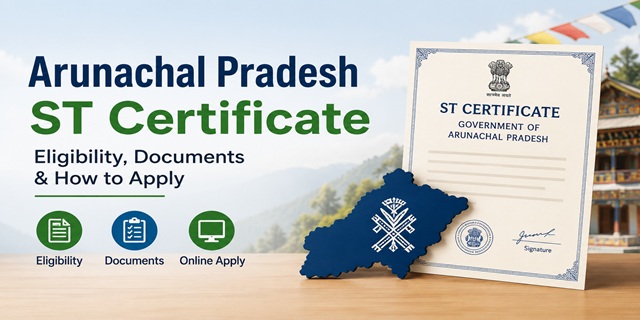
An Arunachal Pradesh Scheduled Tribe (ST) Certificate is an official document issued by the Office of the Deputy Commissioner (DC) of the concerned district. It confirms that the holder belongs to a Scheduled Tribe recognised for the State of Arunachal Pradesh and enables them to claim reservation benefits in government recruitment, admissions to educational institutions, scholarships, and various Central and State Government welfare schemes meant for Scheduled Tribe communities.
If you are a member of an indigenous tribal community of Arunachal Pradesh, you can apply for this certificate through the competent district authority. This guide explains who is eligible, the tribes covered under the ST notification, the documents you need, the mandatory recommendation from the Gaon Bura or other competent local authority, and the complete online and offline application process.
What Is an Arunachal Pradesh ST Certificate?
An Arunachal Pradesh Scheduled Tribe (ST) Certificate is an official document issued by the Office of the Deputy Commissioner of your district. It certifies that you belong to a tribe notified as a Scheduled Tribe under Part XVIII of the Constitution (Scheduled Tribes) Order, 1950 (inserted by Act 69 of 1986, effective 20th February 1987) as applicable to the State of Arunachal Pradesh. The certificate is issued for a lifetime and is accepted for all central and state level reservation purposes.
Who Is Covered Under the Arunachal Pradesh ST Notification?
The Scheduled Tribes recognised for Arunachal Pradesh are notified under Part XVIII of the Constitution (Scheduled Tribes) Order, 1950. The notification begins with the expression "All tribes in the State including:" followed by a list of specifically named tribes and tribal groups.
The 16 named entries in Part XVIII are:
- Abor
- Aka
- Apatani
- Nyishi
- Galong
- Khampti
- Khowa
- Mishmi (Idu, Taroon)
- Momba
- Any Naga tribes
- Sherdukpen
- Singpho
- Hrusso
- Tagin
- Khamba
- Adi
Since the notification opens with the words "All tribes in the State including:", Scheduled Tribe recognition in Arunachal Pradesh is not confined only to the communities listed above. Indigenous tribal communities covered under the statutory notification are also entitled to apply for an ST certificate, subject to verification by the competent authority in accordance with the applicable rules.
About the entries "Abor" and "Adi": The Adi community was historically referred to as "Abor" in certain colonial-era records. Both names appear separately in the Constitution (Scheduled Tribes) Order, 1950. "Abor" appears as Entry 1, while "Adi" was inserted later as Entry 16 through the relevant amendment. Both entries continue to form part of the statutory Scheduled Tribe list for Arunachal Pradesh.
No Religion Restriction for ST Certificate
There is no religion restriction for Scheduled Tribe status anywhere in India. You can be Hindu, Christian, Buddhist, Donyi-Polo practitioner, or follow any other faith and still qualify for an ST certificate if your tribe is indigenous to Arunachal Pradesh. This is different from the Scheduled Caste status, which is limited to Hindus, Sikhs, and Buddhists. Arunachal Pradesh currently has no SC communities notified, so the SC certificate does not apply in this state. The ST certificate is the primary caste-based identity document for all communities in Arunachal Pradesh.
Eligibility for Arunachal Pradesh ST Certificate
You are eligible to apply for an Arunachal Pradesh ST certificate if:
- You belong to a tribe or tribal community that is indigenous to Arunachal Pradesh
- Your tribal membership is by birth through your father or mother belonging to the same notified community
- You are a resident of Arunachal Pradesh
- Your claim is verifiable through a recommendation from the Gaon Bura, Head Gaon Bura, or Area Selection Member of your village or area
Documents Required for an Arunachal Pradesh ST Certificate
Keep the following documents ready before visiting the Jansuvidha Centre or submitting your online application. Carry the original documents for verification whenever required and upload or submit clear copies along with the application form.
- Father's ST Certificate or the applicant's Birth Certificate: Submit your father's Scheduled Tribe Certificate to establish your tribal lineage. If it is not available, you may submit your Birth Certificate instead. In case neither document is available, contact the Jansuvidha Centre at your district Deputy Commissioner's office to know the alternative documents accepted in your case.
- Aadhaar Card: A copy of your Aadhaar Card for identity and address verification.
- Recent passport-size photographs: Two recent passport-size photographs of the applicant.
- Recommendation from the Gaon Bura (GB), Head Gaon Bura (HGB) or Area Selection Member (ASM): This is a mandatory document. Applicants from rural areas must obtain a recommendation from the Gaon Bura or Head Gaon Bura of their village, while applicants residing in urban or semi-urban areas should obtain the recommendation from the concerned Area Selection Member (ASM). The recommendation confirms your tribal identity and local residence for verification purposes.
Important: Supporting document requirements may differ slightly from one district to another. Before submitting your application, it is advisable to confirm the latest document checklist with the Jansuvidha Centre at the Deputy Commissioner's office in your district. The prescribed application form can also be obtained from the same centre after payment of the applicable processing fee.
What Is the Gaon Bura Recommendation?
The Gaon Bura (GB) is a government-appointed traditional village-level authority in Arunachal Pradesh. The GB is responsible for village administration and serves as the first point of contact between the government and the village community. The Head Gaon Bura (HGB) is a senior Gaon Bura overseeing a cluster of villages. The Area Selection Member (ASM) performs the same function in urban and semi-urban areas. Their written recommendation certifies that you are a known member of the tribal community and a resident of their jurisdiction. This endorsement is a mandatory document for the ST certificate application and must be obtained before submitting your application at the Jansuvidha Centre.
How to Apply for an Arunachal Pradesh ST Certificate
You can apply for an ST certificate either online through the official Arunachal eServices Portal or by visiting the Jansuvidha Centre at the Deputy Commissioner's (DC) office in your district. Before applying, keep all the required documents ready, especially the recommendation issued by the Gaon Bura (GB), Head Gaon Bura (HGB) or Area Selection Member (ASM), as applicable.
Method 1: Apply Online Through the Arunachal eServices Portal
The Government of Arunachal Pradesh offers an online application facility through the Arunachal eServices Portal, which is operated on the NIC ServicePlus platform.
- Open the Arunachal eServices Portal in your web browser.
- If you are a new user, click Citizen Registration and create your account. Existing users can log in using their registered credentials.
- After logging in, search for or select the Scheduled Tribe (ST) Certificate service under the available citizen services.
- Fill in the online application form carefully with your personal details, tribe name, village, address and parent information exactly as recorded in your official documents.
- Upload clear scanned copies of all the required documents, including your father's ST Certificate or Birth Certificate, Aadhaar Card, passport-size photographs and the recommendation issued by the GB, HGB or ASM.
- Review all the information before submitting the application. Incorrect details or unreadable document uploads may delay verification.
- Submit the application and save the application reference number generated by the portal. Keep this number safely, as it will be required for future communication and status tracking.
- Once your application is processed and approved, you can download and verify the issued e-Certificate through the same portal using the reference number and other required details.
Method 2: Apply Offline Through the Jansuvidha Centre
If you prefer to apply offline, visit the Jansuvidha Centre located at the Deputy Commissioner's office of your district. The staff will guide you through the application process and document submission.
- Before visiting the Jansuvidha Centre, obtain the required recommendation letter from your Gaon Bura (GB), Head Gaon Bura (HGB) or Area Selection Member (ASM), whichever is applicable in your area.
- Visit the Jansuvidha Centre at the Deputy Commissioner's office during working hours and collect the ST certificate application form after paying the prescribed processing fee.
- Fill in the application form carefully and ensure that all personal and tribal details match your supporting documents.
- Attach copies of all the required documents, including your father's ST Certificate or Birth Certificate, Aadhaar Card, passport-size photographs and the GB, HGB or ASM recommendation letter.
- Submit the completed application at the designated counter and collect the acknowledgement receipt issued by the Jansuvidha Centre.
- Your application will be verified by the concerned authorities. Once the verification process is completed and the application is approved, the ST certificate will be issued by the Deputy Commissioner.
Note: Applicants from the Itanagar Capital Complex can contact the Deputy Commissioner's office at Itanagar (PIN: 791113, Phone: 0360-2292199). Applicants from other districts should contact the Deputy Commissioner's office or Jansuvidha Centre of their respective district for local assistance.
Application Fee
A minimal processing fee is charged when collecting the application form at the Jansuvidha Centre. The exact fee may vary by district. Confirm the applicable fee at your district Jansuvidha Centre before visiting. Online applications through eservice.arunachal.gov.in may also have a portal processing fee payable through the online payment gateway.
ST Certificate and Permanent Residence Certificate (PRC)
In Arunachal Pradesh, the ST certificate and the Permanent Residence Certificate (PRC) are two separate documents. The ST certificate certifies your tribal community membership by birth. The PRC certifies that you are a permanent resident of Arunachal Pradesh. For most state government job applications, educational institution admissions, and local reservation benefits in Arunachal Pradesh, you need both the ST certificate and the PRC. Both are issued by the DC office through the Jansuvidha Centre. The Inner Line Permit (ILP) system is a separate document required for non-residents visiting Arunachal Pradesh and is not relevant to your ST certificate application.
Where You Can Use the Arunachal Pradesh ST Certificate
- Reservation in Arunachal Pradesh state government jobs under ST quota
- Reservation in central government jobs under ST quota
- Admission to government colleges, central universities, IITs, NITs, and other central institutions under ST reservation seats
- Post Matric Scholarship for ST students from the Ministry of Tribal Affairs (scholarships.gov.in)
- Pre Matric Scholarship for ST students from the Ministry of Tribal Affairs
- National Fellowship for ST candidates
- National Overseas Scholarship for ST candidates
- Fee concession and hostel facility under ST reservation at educational institutions
- Benefits under tribal welfare schemes from the Ministry of Tribal Affairs, Government of India
- Benefits under Particularly Vulnerable Tribal Groups (PVTG) schemes for eligible tribes
- Ration card and welfare entitlements linked to ST status
नई टिप्पणी जोड़ें