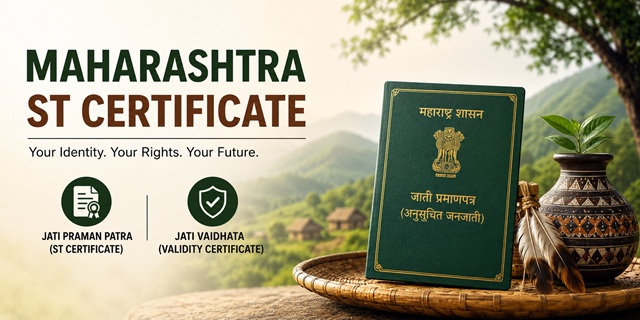
Maharashtra is home to one of the largest tribal populations in India. Spread across the Sahyadri ranges, the Vidarbha forests, and the northern districts bordering Madhya Pradesh and Gujarat, the state's tribal communities have a rich cultural identity and a strong set of constitutional protections. If you belong to a Scheduled Tribe in Maharashtra and need the tribe certificate for education, employment, or welfare benefits, this guide covers the complete process, the new digital validity system, and the exclusive opportunities available to tribal families in the state.
Scheduled Tribes Notified in Maharashtra
The following communities are notified as Scheduled Tribes (ST) in Maharashtra:
- Bhil
- Bhilala
- Pawra
- Vasava
- Vasave
- Tadvi Bhil and related sub-groups
- Gond
- Rajgond and related sub-groups
- Varli (Warli)
- Thakur
- Thakar
- Katkari
- Son Katkari
- Dhor Katkari
- Kokna
- Kokni
- Kukna
- Halba
- Halbi
- Korku
- Naikda
- Nayaka
- Gamit
- Gamta
- Gavit
- Padvi
- Dhodia
- Dubla
- Halpati
- Kolam
- Kol
- Koli Mahadev
- Dongar Koli
- Koli Malhar
- Oraon
- Korwa
- Kawar
- Kanwar
- Kharia
- Kondh
- Nagesia
- Pardhi and related sub-groups
- Rathawa
- Andh
- Baiga
- Bhaina
- Binjhwar
- Birhor
- Dhanka
- Dhanwar
- Kamar
- Parja
- Pomla
- Sawar
- Vitolia
Particularly Vulnerable Tribal Groups (PVTGs)
- Katkari (Kathkari) - Recognised as a Particularly Vulnerable Tribal Group (PVTG) in Maharashtra.
- Kolam - Recognised as a Particularly Vulnerable Tribal Group (PVTG) and covered under special tribal development programmes.
Major Tribal Communities in Maharashtra
- Bhil - The largest tribal community in Maharashtra, concentrated mainly in Nandurbar, Dhule and Nashik districts.
- Gond - One of the major tribal communities in Vidarbha, particularly in Gadchiroli, Chandrapur and Gondia districts.
- Varli (Warli) - Known for the famous Warli art tradition and primarily found in Palghar and nearby tribal regions.
- Katkari - A prominent tribal community in the Konkan region and one of Maharashtra's recognised PVTGs.
Important: If you are unsure whether your community is included in the Maharashtra Scheduled Tribe notification, contact the Tahsildar's office or the Integrated Tribal Development Project (ITDP) office serving your district before applying for an ST Certificate.
The Certificate You Need: Jati Praman Patra (Anusuchit Jati)
In Maharashtra, the ST certificate is called the Jati Praman Patra, with the category being Anusuchit Jan Jati (Scheduled Tribe). This is issued by the Tahsildar of your taluka. For most scholarship applications, fee concessions, and initial admissions, this certificate is sufficient.
However, for government job appointments and admission to professional colleges like medical and engineering, you also need the Jati Vaidhata Praman Patra (Caste Validity Certificate) from the district-level Scheduled Tribes Certificate Scrutiny Committee. This is mandatory under the Maharashtra Caste Certificate Act 2000, exactly as it is for SC candidates.
The New e-Tribe Validity System for ST Certificate Verification
Maharashtra has recently launched a dedicated digital platform called e-Tribe Validity, also known as Aadi Praman Pranali, specifically for processing ST certificate validity applications. This system was developed by TRTI (Tribal Research and Training Institute) and went live state-wide in October 2025. It uses blockchain technology and artificial intelligence to verify ST certificates.
Under this system, tribal candidates who need their Jati Praman Patra validated by the Scrutiny Committee can apply and track the verification process online instead of visiting offices repeatedly. This is a significant improvement over the previous manual process that required multiple physical visits to district offices.
The Scrutiny Committee for ST in Maharashtra operates at the regional level, with committees at Nashik, Amravati, Nagpur, Thane, Pune, and Chhatrapati Sambhaji Nagar (Aurangabad) covering different districts. The e-Tribe Validity portal helps you identify which committee has jurisdiction over your district and submit your application digitally.
Documents Required for ST Certificate in Maharashtra
For the Jati Praman Patra from the Tahsildar, keep these ready before you apply:
- Aadhaar Card for identity and address proof
- Proof of tribal identity: old ST certificate of your father or grandfather, school leaving certificate showing tribal community, or birth certificate showing tribal caste
- Ration Card showing your Maharashtra address
- Maharashtra Domicile Certificate
- Birth certificate or school leaving certificate of the applicant
- Passport-Size Photograph
- Self-declaration affidavit about tribal identity
- 7/12 extract or village land record (strengthens the application, especially for communities living in tribal belts)
For the Jati Vaidhata Praman Patra, additionally bring your Jati Praman Patra and ancestral documents showing long-term tribal community membership.
How to Apply for ST Certificate in Maharashtra
Online via Aaple Sarkar Portal
The Aaple Sarkar portal (aaplesarkar.mahaonline.gov.in) is the primary online platform for applying for the ST Jati Praman Patra in Maharashtra. The Revenue Department on this portal handles the caste certificate service.
- Visit aaplesarkar.mahaonline.gov.in and log in or register a new account.
- Navigate to Revenue Department services and search for caste certificate.
- Select the ST (Anusuchit Jan Jati) category and fill the application form with your full name, your community name exactly as notified in the Maharashtra ST list, and your taluka and district.
- Upload scanned documents in the required format and size as specified on the portal.
- Pay the application fee online and submit. Save your application number.
- The Talathi of your village will be assigned to conduct a field visit and verify your tribal identity, residence, and community status.
- After the Talathi submits the verification report to the Tahsildar, the certificate is reviewed and issued.
- Download the approved certificate from your Aaple Sarkar account.
Through Setu Suvidha Kendra
If you live in a remote tribal area without reliable internet access, visit the nearest Setu Suvidha Kendra (Maharashtra's Common Service Centre network). These centres are specifically active in tribal districts across Nashik, Thane, Nandurbar, Amravati, Gadchiroli, Gondia, and Yavatmal. The operator submits your application through the Aaple Sarkar portal, collects your documents, and gives you an acknowledgement slip. You pay the government fee plus a small facilitation charge.
Directly at Tahsildar Office
In many tribal talukas, applicants prefer to submit in person at the Tahsildar office. Collect the application form at the counter, fill it with your community name, taluka, and district, attach self-attested copies of all documents, and submit at the counter. Collect your receipt. The Talathi field visit will happen after submission, and you will be notified when the certificate is ready.
What the Talathi Verifies for Tribal Certificates
The Talathi's role in tribal certificate applications is more detailed than in SC certificate applications. Beyond verifying your residence and caste documents, the Talathi checks village records for your family's long-standing tribal community membership and confirms that your community is listed in the Maharashtra ST notification. If your family migrated from a tribal area to a city, the Talathi may contact the Talathi of your ancestral village for supporting records. This is common for tribal families who moved to cities like Pune, Mumbai, or Nagpur for work.
Ashram Schools and Hostels for Tribal Children
A valid ST certificate unlocks access to Maharashtra's extensive tribal education infrastructure. The Tribal Development Department runs 502 government ashram schools and works with 539 aided ashram schools across the state. These residential schools provide free education, food, and accommodation to tribal children from Class 1 through Class 10, with entry from Class 5 or Class 8 depending on the school. Admission requires a valid ST certificate.
The department also runs residential hostels at division, district, taluka, and village levels for tribal students studying in Class 8 and above. These hostels provide free lodging, food, and educational materials. Applications for hostel admission are processed through swayam.mahaonline.gov.in.
TRTI Competitive Exam Coaching for Tribal Students
The Tribal Research and Training Institute at trti.maharashtra.gov.in runs free pre-examination training programs exclusively for Maharashtra's ST candidates in the following categories:
- UPSC Civil Services (Preliminary and Mains), with training in Delhi for selected candidates
- MPSC State Services exam and Group C positions
- PSI (Police Sub-Inspector), STI (Sales Tax Inspector), and ASO (Assistant Section Officer) exams
- Maharashtra Teacher Eligibility Test (TET)
- Police recruitment and Military recruitment training
- IBPS banking exams and SSC exams
- JEE and NEET entrance coaching for engineering and medical admissions
- PhD entrance coaching (DBT scheme)
All these programs require a valid ST certificate. Candidates apply through the TRTI portal and selected candidates receive training completely free of charge. Financial assistance is also provided for MPSC interview preparation.
Fifth Schedule Areas and Forest Rights
Several districts of Maharashtra fall under the Fifth Schedule of the Constitution, which means tribal communities in these areas have special protections for their land, resources, and self-governance. Districts with significant Fifth Schedule coverage include Nandurbar, Nashik, Thane, Dhule, Pune, Ahmednagar, Nanded, Yavatmal, Amravati, and Gadchiroli.
Tribal families in these areas can also exercise rights under the Forest Rights Act 2006, which recognises the rights of forest-dwelling tribal communities to their traditional land. The TRTI supports implementation of forest rights and has a dedicated Forest Rights Act division. An ST certificate is the foundation document for claiming forest rights.
Benefits of ST Certificate in Maharashtra
- Reservation in Maharashtra state government jobs under the ST quota
- 7.5% reservation in central government jobs and central educational institutions nationally
- Reserved seats in government medical, engineering, law, and other professional colleges in Maharashtra
- Admission to government ashram schools and ST hostels
- Access to TRTI free coaching programs for competitive exams
- Pre-matric and post-matric tribal scholarships through the National Scholarship Portal
- Eklavya Model Residential School (EMRS) admissions
- Birsa Munda Krishi Kranti Yojana agricultural support for tribal farmers
- Thakkar Bappa Adivasi Vasti Sudhar Yojana for improvement of tribal settlements
- Forest Rights entitlements for tribal families in forest areas
- 5 years age relaxation in state and central competitive examinations
When Is Jati Vaidhata Praman Patra Required?
In Maharashtra, an ST Certificate (Jati Praman Patra) and an ST Validity Certificate (Jati Vaidhata Praman Patra) serve different purposes. While the ST Certificate establishes tribal status, certain admissions, appointments, and reservation-related processes may require verification through the competent Scheduled Tribe Certificate Scrutiny Committee.
- Admission to professional courses under the ST quota.
- Government job appointments against reserved ST vacancies.
- Verification of reservation claims during recruitment or admission processes.
- Cases where the institution or authority specifically asks for a validity certificate.
नई टिप्पणी जोड़ें