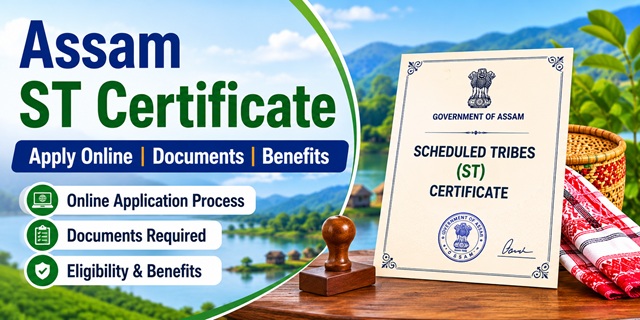
Assam has one of the most diverse tribal populations in India. From the Bodo communities of the Bodoland Territorial Area Districts (BTAD) in western Assam, to the Karbi of the Karbi Anglong highlands, the Mishing rice-farmers along the Brahmaputra riverbanks, and the Dimasa of the Dima Hasao hills, Assam's tribal landscape is spread across distinct geographic zones. The ST caste certificate process uses the same e-District and Seva Setu portal system as the SC certificate, with the same Arunodoy CSC and Public Facilitation Centre network, the same helplines, and the same certificate number format. However, tribal applicants in Assam must be aware of district-specific eligibility rules that apply to several communities.
Scheduled Tribes Notified in Assam
The following communities are officially notified as Scheduled Tribes in Assam:
Bodo, Bodo Kachari, Chakma, Deori, Dimasa (Hill Tippera), Garo (in Kamrup, Darrang, and Goalpara districts), Hajong (in North Cachar Hills and Karbi Anglong districts), Hojai (in Nowgong and Sibasagar districts), Karbi (Mikir), Khasi (in certain areas), Kuki (in Cachar, Karbi Anglong, North Cachar Hills, and Nowgong districts), Lalung (Tiwa), Lakher (Mara), Man (Tai Speaking), Miri (Mishing), Rabha, Singhpo, Sonwal Kachari (Sonowal Kachari), and Thengal Kachari.
Bodo is the largest ST community in Assam. Karbi (Mikir) communities are concentrated in Karbi Anglong district. Mishing (Miri) communities live along the Brahmaputra and its tributaries, primarily in Lakhimpur, Dhemaji, and Majuli districts. Dimasa is the principal tribe of Dima Hasao district. Sonowal Kachari is concentrated in Dibrugarh and Tinsukia districts.
District-Specific ST Communities in Assam
Several tribal communities in Assam are notified as ST only for specific districts or areas. Before applying, confirm your community is notified as ST in your home district:
- Garo: Notified as ST only in Kamrup, Darrang, and Goalpara districts
- Hajong: Notified as ST only in North Cachar Hills (Dima Hasao) and Karbi Anglong districts
- Hojai: Notified as ST only in Nowgong (Nagaon) and Sibasagar (Sivasagar) districts
- Kuki: Notified as ST only in Cachar, Karbi Anglong, North Cachar Hills, and Nowgong districts
If your community has a district-specific ST notification and you currently live outside the notified districts, you may not be eligible for an Assam ST certificate for your current address. Check with the Circle Officer of your area before applying.
No Religion Restriction for ST Certificate
The ST caste certificate in Assam has no religion restriction. Members of any notified tribal community can apply regardless of their religion - whether they follow tribal faith, Hinduism, Christianity, or any other belief. This is confirmed by the constitutional framework for Scheduled Tribes which applies no religion requirement.
Certificate Name and Portal System
Assam issues this as a standard Caste Certificate with the tribal category. Applications go through the e-District portal at edistrict.assam.gov.in or the Seva Setu portal at sewasetu.assam.gov.in. Both are official and both issue the same certificate. The portal is available in English, Assamese, Bengali, and Bodo, making it accessible across Assam's diverse linguistic communities.
Documents Required
- Aadhaar Card
- Proof of tribal community: old ST certificate of father or grandfather, school certificate showing tribal community, or any government document mentioning your tribe
- Assam Ration card
- Assam Permanent Residence Certificate (PRC)
- Birth certificate or HSLC marksheet
- Passport-size photograph
How to Apply: Four Methods
Method 1: Online Through e-District Portal
- Visit edistrict.assam.gov.in and register or log in.
- Select the Caste Certificate service for Scheduled Tribes (ST).
- Enter your tribe name exactly as it appears in the Assam ST notification. For district-specific communities, ensure you are applying from the correct district.
- Fill in district, sub-division, and circle details. Upload required documents.
- Submit and note your Application Number.
- Track your application status on the portal.
- Once issued, view the certificate using your Certificate Number (format: 00000000-000-00000000) on the "View Approved Certificate" feature.
Method 2: Online Through Seva Setu Portal
- Visit sewasetu.assam.gov.in and register or log in.
- Select the ST caste certificate service.
- Fill the form with your tribe name and details, upload documents, and submit.
- Track and download the certificate once issued.
Method 3: Through Arunodoy CSC
Arunodoy Common Service Centres (CSCs) are present at village and block level across all 27 Assam districts. Visit the nearest Arunodoy CSC with your documents. The operator submits your application through the e-District portal, collects the fee, and gives you an acknowledgement with your Application Number.
Method 4: At Public Facilitation Centre (PFC)
Public Facilitation Centres (PFCs) are government-staffed service counters at every District Collector (DC) office, Sub-Divisional Officer (SDO) office, and Circle office across Assam. Visit the PFC with your documents for direct in-person application and processing.
Certificate Verification and Helplines
Verify any Assam ST certificate by entering the Certificate Number (format: 00000000-000-00000000) on the "View Approved Certificate" section of edistrict.assam.gov.in.
For helpdesk support: Toll Free 18003451100 or 0361-2724222.
Benefits of ST Certificate in Assam
- Reservation in Assam state government jobs under the ST quota
- 7.5% reservation in central government jobs and central educational institutions nationally
- Reserved seats in government colleges for engineering, medicine, and other courses in Assam
- Pre-matric and post-matric tribal scholarships through the National Scholarship Portal
- 5 years age relaxation in APSC, Assam Police, and central competitive examinations
- Forest Rights entitlements for tribal families under the Forest Rights Act 2006
- Access to tribal welfare schemes under the Ministry of Tribal Affairs
नई टिप्पणी जोड़ें