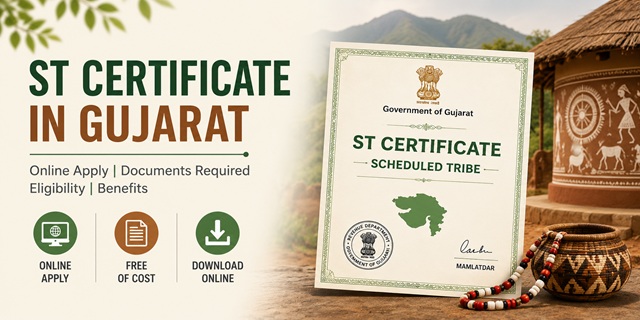
Gujarat's tribal communities are spread across three distinct regions: the Satpura and Vindhya ranges of north-eastern Gujarat where the Bhil, Rathwa, and Dhodia communities have lived for generations; the coastal and Saurashtra region where the Siddi community has a unique presence in the Gir forest area; and the southern Gujarat plains and Dang district where the Gamit, Dubla, Halpati, Naikda, and Chodhara communities are concentrated. Gujarat issues the ST Jati Praman Patra through the same two digital portals as the SC certificate, completely free of cost, through the Mamlatdar at the Taluka level.
Scheduled Tribes Notified in Gujarat
The following communities are officially notified as Scheduled Tribes in Gujarat:
Barda, Bavacha, Bamcha, Bhil, Bhil Garasia, Dholi Bhil, Dungri Bhil, Dungri Garasia, Mewasi Bhil, Rawal Bhil, Tadvi Bhil, Bhagalia, Bhilala, Pawra, Vasava, Vasave, Bharwad (in certain areas), Chodhara, Chaudhri, Dubla, Talavia, Halpati, Dhodia, Gamit, Gamta, Gavit, Mavchi, Padvi, Valvi, Gond, Naikpod, Rajgond, Kathodi, Katkari, Dhor Kathodi, Dhor Katkari, Son Kathodi, Son Katkari, Kokna, Kokni, Kukna, Koli Dhor, Tokre Koli, Kolcha, Kolgha, Naikda, Nayaka, Cholivala Nayaka, Kapadia Nayaka, Mota Nayaka, Nana Nayaka, Pardhi, Advichincher, Phanse Pardhi, Patelia, Pomla, Rathawa, Siddi, Varli, and Vitolia, Kotwalia, Barodia.
Among these, Bhil is the largest ST community in Gujarat, concentrated in the districts of Dahod, Panchmahal, Mahisagar, and Chhota Udaipur. Naikda communities are spread across Valsad, Navsari, Tapi, and Surat districts. Dubla (also called Halpati and Talavia) communities are found in south Gujarat. Gamit is concentrated in Tapi district. Rathawa is found in Chhota Udaipur and surrounding areas. The Siddi community in Gujarat is concentrated in the Gir Somnath and Junagadh area.
No Religion Restriction for ST Certificate
There is no religion restriction for the ST certificate in Gujarat or anywhere in India. Any member of a notified tribal community can apply regardless of their religion.
Fee: Completely Free
The ST Jati Praman Patra in Gujarat is issued completely free of cost. No application fee, no processing charge.
Issuing Authority
The ST certificate is issued by the Mamlatdar at the Taluka level. The Talathi at the village level verifies your tribal identity and residential details before the application moves to the Mamlatdar for final approval and certificate issuance.
Documents Required
- Aadhaar card
- Proof of tribal identity: old ST certificate of father or grandfather, school record showing tribal community, or any government document mentioning your tribe
- Gujarat ration card as residence and family proof
- Gujarat domicile certificate
- Birth certificate or school leaving certificate
- Passport-size photograph
How to Apply: Three Methods
Method 1: Online Through Digital Gujarat Portal
- Visit digitalgujarat.gov.in and register or log in.
- Select Jati Praman Patra (Caste Certificate) under Revenue Department services.
- Choose Scheduled Tribe (Anusuchit Janjati) as your category.
- Enter your tribe name exactly as it appears in the Gujarat ST notification.
- Fill personal details, Taluka, and district. Upload required documents.
- Submit. No fee is required.
- Note your application number for tracking.
- The Talathi conducts field verification. The Mamlatdar issues the digitally signed certificate.
- Download from the portal. The certificate is also available on DigiLocker once issued.
Method 2: Online Through eSamajKalyan Portal
- Visit esamajkalyan.gujarat.gov.in and register or log in.
- Select the ST caste certificate service.
- Fill the form with your tribe name, district, and personal details. Upload documents and submit.
- Track your application and download the certificate once the Mamlatdar issues it.
Method 3: Through CSC or Mamlatdar Office
Visit the nearest Common Service Centre (CSC) in your village or Taluka. The CSC operator submits your application through the official portal. Alternatively, visit the Mamlatdar's office at your Taluka headquarters with all documents for direct submission.
Benefits of ST Certificate in Gujarat
- Reservation in Gujarat state government jobs under the ST quota
- 7.5% reservation in central government jobs and central educational institutions nationally
- Reserved seats in government engineering, medical, and other professional colleges in Gujarat
- Pre-matric and post-matric tribal scholarships through the National Scholarship Portal
- 5 years age relaxation in GPSC, Gujarat Police, and central competitive examinations
- Access to tribal welfare schemes through the Gujarat government's tribal development department
- Forest Rights entitlements for tribal families in forest areas under the Forest Rights Act 2006
- Access to tribal welfare schemes under the Ministry of Tribal Affairs
नई टिप्पणी जोड़ें