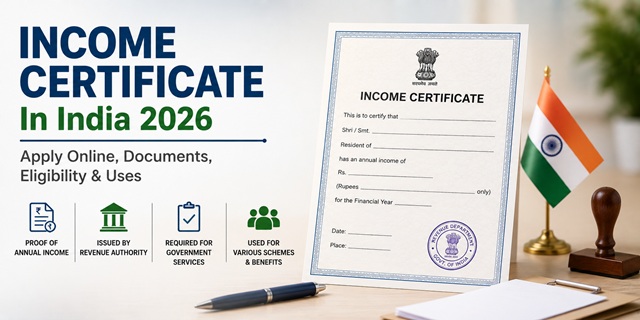
An Income Certificate is an official government document that certifies the annual income of a person or their family from all sources - salary, business, agriculture, pension, rental income, and any other source. It is issued by the Revenue Department of your state through officers like the Tehsildar, Sub-Divisional Magistrate (SDM), District Magistrate (DM), Revenue Circle Officer, or Deputy Commissioner depending on which state you live in. The certificate is valid for one financial year (April to March) and must be renewed every year. Two major uses drive most applications: scholarship and fee concession applications for students, and the 10% EWS (Economically Weaker Section) reservation in government jobs and education - where the central government has set the income limit at Rs. 8 lakh per year from all sources per the DOPT Office Memorandum dated 31 January 2019.
- National Services Portal: services.india.gov.in - find your state's income certificate service
Key Facts at a Glance
| Detail | Information |
|---|---|
| Who Issues It | Tehsildar, SDM, DM, Revenue Circle Officer, or Deputy Commissioner (varies by state) |
| Validity | One financial year (April to March) - must renew annually |
| EWS Income Limit (Central Govt) | Annual family income below Rs. 8 lakh from all sources |
| Processing Time | 7 to 15 working days in most states |
| Application Mode | Online (state e-district portals) or offline at Tehsildar/SDM office |
| Fee | Usually free or nominal (Rs. 10-30). CSC-assisted applications may have service fee. |
| Issued To | Individual or family - depends on purpose |
Who Issues Income Certificate in Each State
The issuing authority varies by state. This is confirmed from the DOPT Government of India Office Memorandum which lists the accepted issuing authorities for EWS certificates:
- Tehsildar - most states issue through the Tehsildar at taluka/tehsil level
- Sub-Divisional Magistrate (SDM) - Delhi, Haryana, Punjab, Himachal Pradesh
- District Magistrate / Additional District Magistrate / Collector - accepted in all states
- Revenue Circle Officer - Assam, Nagaland, other Northeast states
- Deputy Commissioner - J&K, Ladakh, some Northeast UTs
- Executive Magistrate / Sub-Divisional Officer - also accepted
Officers not below the rank of Tehsildar can issue income certificates for EWS purposes - confirmed from the DOPT OM dated 31.01.2019.
What Income Certificate Is Used For
- EWS Reservation (10% quota): Required for 10% reservation in central and state government jobs and admissions in educational institutions. Central limit: annual family income below Rs. 8 lakh from all sources.
- Scholarships and Fee Concessions: Pre-Matric, Post-Matric, and merit-cum-means scholarships from central and state governments require income certificates. Most scholarship schemes have their own income limits.
- BPL Ration Card Application: Delhi now mandates an income certificate from the Revenue Department for ration card applications since January 2026. Many other states also require it.
- Pradhan Mantri Awas Yojana (PMAY): EWS and LIG categories require income proof to avail housing subsidy.
- Court Fee Concession: Low-income litigants can apply for court fee waivers with an income certificate.
- Government Scheme Benefits: Pension schemes, healthcare subsidies, and dozens of state welfare schemes require proof of income.
- Educational Loan: Banks and institutions ask for income certificate to assess loan eligibility and repayment capacity.
- OBC Non-Creamy Layer Certificate: Non-Creamy Layer status for OBC requires family income to be below Rs. 8 lakh per year (same limit as EWS for central services).
Individual Income Certificate vs Family Income Certificate
| Type | What It Certifies | When Required |
|---|---|---|
| Individual Income Certificate | Income of a single person from all sources | Income tax-related submissions, loan applications, job applications |
| Family Income Certificate | Combined income of all earning members in the household | Scholarships, EWS certificate, ration card, welfare schemes - most government applications require family income |
When applying for scholarships, always check whether the scheme requires individual or family income. Most central government scholarship schemes specifically ask for family income from all sources.
Documents Required to Apply
Documents vary by state but these are required in almost all states:
- Aadhaar card (applicant and family members)
- Ration Card (used to verify family composition)
- Proof of income - whichever applies:
- Salary certificate or pay slip (for salaried persons)
- Latest ITR or Form 16 (if filing income tax)
- Bank passbook (last 6 months statements)
- Self-declaration affidavit on Rs. 10 stamp paper (for those with no formal income proof)
- Voter ID or Passport (for address verification)
- Passport-size photographs
- Self-declaration or affidavit declaring total annual income from all sources
How to Apply - General Process
The process varies by state. The general flow is:
- Go to your state's e-district or citizen services portal (listed below by state).
- Register or log in with your Aadhaar-linked mobile number.
- Select Income Certificate under the Revenue Department services.
- Fill the application form with complete details - name, address, family members, income from each source.
- Upload required documents.
- Submit. An application number is generated for tracking.
- A Revenue Inspector or Patwari may conduct a field verification at your residence.
- After verification and approval by the Tehsildar or SDM, the digitally signed certificate is available for download on the portal.
For offline applications, visit your nearest Tehsildar or SDM office directly with the same documents.
State-wise Portal Links for Income Certificate
| State / UT | Official Portal | Issuing Authority |
|---|---|---|
| Andhra Pradesh | meeseva.ap.gov.in | Tehsildar |
| Arunachal Pradesh | arunachal.gov.in | Circle Officer / Deputy Commissioner |
| Assam | yourdistrict.assam.gov.in | Revenue Circle Officer |
| Bihar | serviceonline.bihar.gov.in | Circle Officer / Tehsildar |
| Chhattisgarh | cgedistrict.cgstate.gov.in | Tehsildar |
| Delhi (NCT) | edistrict.delhigovt.nic.in | Sub-Divisional Magistrate (SDM) |
| Goa | goaonline.gov.in | Mamlatdar / Deputy Collector |
| Gujarat | digitalgujarat.gov.in | Mamlatdar / Talati |
| Haryana | saralharyana.gov.in | Tehsildar / SDM |
| Himachal Pradesh | edistrict.hp.gov.in | Tehsildar |
| Jharkhand | jharsewa.jharkhand.gov.in | Circle Officer / Tehsildar |
| Karnataka | nadakacheri.karnataka.gov.in | Nadakacheri / Revenue Inspector |
| Kerala | edistrict.kerala.gov.in | Village Officer / Tehsildar |
| Madhya Pradesh | mpedistrict.gov.in | Tehsildar |
| Maharashtra | aaplesarkar.mahaonline.gov.in | Tehsildar |
| Manipur | manipuronline.nic.in | Sub-Divisional Officer |
| Meghalaya | megedistrict.gov.in | Circle Officer / SDO |
| Mizoram | edistrict.mizoram.gov.in | Sub-Divisional Officer |
| Nagaland | edistrict.nagaland.gov.in | Circle Officer |
| Odisha | edistrict.odisha.gov.in | Revenue Inspector / Tahasildar |
| Punjab | eservices.punjab.gov.in | Tehsildar |
| Rajasthan | emitra.rajasthan.gov.in | Tehsildar |
| Sikkim | sikkimservices.gov.in | Sub-Divisional Officer |
| Tamil Nadu | tnedistrict.tn.gov.in | Tehsildar |
| Telangana | ts.meeseva.telangana.gov.in | Tehsildar / MeeSeva Centre |
| Tripura | edistrict.tripura.gov.in | Sub-Divisional Officer |
| Uttar Pradesh | edistrict.up.gov.in | Tehsildar |
| Uttarakhand | eservices.uk.gov.in | Tehsildar |
| West Bengal | edistrict.wb.gov.in | Block Development Officer / SDO |
| Andaman and Nicobar Islands | edistrict.andamannicobar.gov.in | Tehsildar / Sub-Divisional Officer |
| Chandigarh | chandigarh.gov.in/services | Tehsildar / SDM |
| Dadra NH and Daman Diu | ddd.gov.in | Mamlatdar / District Officer |
| Jammu and Kashmir | jkedistrict.nic.in | Tehsildar |
| Ladakh | ladakh.gov.in | Tehsildar / Deputy Commissioner |
| Lakshadweep | lakshadweep.gov.in | Sub-Divisional Officer |
| Puducherry | edistrict.py.gov.in | Tehsildar |
EWS Income Certificate - Central Rules
The EWS (Economically Weaker Section) Income and Asset Certificate is a specific form of income certificate for claiming the 10% reservation in central government jobs and educational institutions. The criteria set by the Government of India (DOPT OM 31.01.2019) are:
- Annual family income below Rs. 8 lakh from all sources (salary, business, agriculture, profession)
- Family should not own agricultural land of 5 acres or more
- Residential flat of 1000 sq ft or more not owned
- Residential plot of 100 sq yards or more in notified municipalities not owned
- Residential plot of 200 sq yards or more in non-notified municipal areas not owned
Note: Some states have their own lower income limits for state-level EWS certificates. For central government jobs and IIT/NIT admissions, the Rs. 8 lakh limit applies regardless of state rules.
What to Do If Your Certificate Is Delayed
Income certificates are supposed to be issued within 7 to 15 working days in most states under their Right to Public Services Acts. If your certificate has been delayed beyond this period:
- Check online status on your state e-district portal using your application number. If status shows "Pending at Patwari" or "Pending at Tehsildar", visit the concerned office directly.
- File a complaint with your state's Right to Public Services commission or the District Collector's office citing the delay.
- Use RTI (Right to Information Act, 2005) - file an RTI application to the Tehsildar's office asking for the status of your specific application. RTI applications cost Rs. 10 and must be responded to within 30 days. This is an effective tool when scholarship or EWS seat deadlines are approaching.
Common Reasons Applications Are Rejected
- Mismatch between declared income and documents submitted
- Incomplete or unsigned self-declaration affidavit
- Address on Aadhaar not matching current residential address
- Missing income proof for one family member
- Application submitted at wrong jurisdiction - you must apply in the area where you permanently reside
Official Links
- National Government Services Portal - services.india.gov.in (search "income certificate" + your state)
State-specific guides will be published separately for each state with exact steps, fees, and portal navigation.
Related articles:
Ration Card in India - Complete Guide
How to Apply for Aadhaar Card
Disclaimer: Income certificate rules, income limits, and processes vary by state. Always verify the current process on your state's official e-district portal before applying.
Add new comment