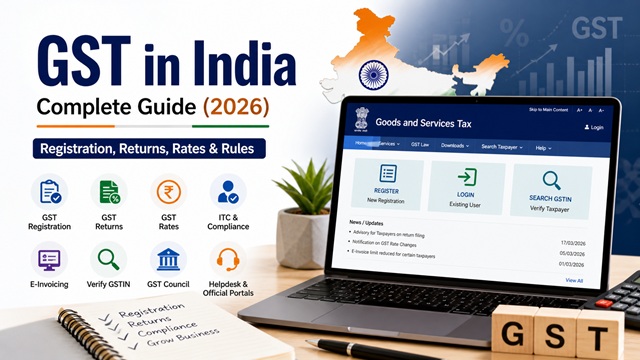
GST in India – Complete Guide (2026)
Goods and Services Tax (GST) is India's single, unified indirect tax system that replaced a complex web of central and state taxes on 1st July 2017. It is governed by the Central Goods and Services Tax Act, 2017 (CGST Act) and implemented jointly by the Central Government and all State Governments. The official GST portal is www.gst.gov.in, managed by GSTN (Goods and Services Tax Network) under the National Informatics Centre (NIC).
What is GST?
GST stands for Goods and Services Tax. It is a comprehensive, multi-stage, destination-based indirect tax levied on every value addition in the supply of goods and services across India.
In simple words: whenever goods are sold or services are provided, GST is charged. It is collected at each stage of the supply chain but the final tax burden falls only on the end consumer. Businesses in between can claim credit for GST paid on their purchases, which is called Input Tax Credit (ITC).
Key features of GST as per the CGST Act, 2017:
- It is a destination-based tax, tax goes to the state where goods or services are consumed, not where they are produced.
- It is a multi-stage tax, levied at every point of supply from manufacturer to retailer.
- It replaced multiple indirect taxes like Central Excise Duty, Service Tax, VAT, CST, Octroi, Entry Tax, and others.
- GST registration is mandatory for businesses that meet the prescribed turnover threshold or fall under specific categories as defined under the CGST Act, 2017.
- GST is administered jointly by the Central Government (through CBIC) and State Governments.
History and Evolution of GST in India
The following timeline is sourced directly from gst.gov.in/about/gst/history:
| Year / Date | Event |
|---|---|
| During PM Vajpayee's tenure | Idea of GST for India first mooted |
| 28 February 2006 | Union Finance Minister proposed GST introduction from 1 April 2010 in Budget 2006-07 |
| November 2009 | Empowered Committee released First Discussion Paper (FDP) on GST |
| March 2011 | Constitution (115th Amendment) Bill, 2011 introduced in Lok Sabha; lapsed in August 2013 |
| 19 December 2014 | Constitution (122nd Amendment) Bill 2014 introduced; passed by Lok Sabha in May 2015 |
| 3 August 2016 | Bill passed by Rajya Sabha |
| 8 August 2016 | Bill passed by Lok Sabha |
| 8 September 2016 | Constitution (101st Amendment) Act 2016 notified, paved way for GST |
| 29 March 2017 | CGST, IGST, UTGST and Compensation Bills passed by Lok Sabha |
| 6 April 2017 | All four Bills passed by Rajya Sabha |
| 12 April 2017 | GST Acts enacted |
| 1 July 2017 | GST launched across India, midnight function at Central Hall of Parliament |
Types of GST: CGST, SGST, IGST and UTGST
As per the GST laws enacted in 2017, GST is divided into four components. Which one applies depends on whether the transaction is within a state or between states.
| Type | Full Form | Governing Act | Applicable When | Revenue Goes To |
|---|---|---|---|---|
| CGST | Central Goods and Services Tax | CGST Act, 2017 | Intra-state supply (within same state) | Central Government |
| SGST | State Goods and Services Tax | SGST Act, 2017 (each state) | Intra-state supply (within same state) | State Government |
| IGST | Integrated Goods and Services Tax | IGST Act, 2017 | Inter-state supply or imports | Central Government (then apportioned) |
| UTGST | Union Territory Goods and Services Tax | UTGST Act, 2017 | Supply within Union Territories without legislature | Union Territory administration |
Simple rule: On any intra-state sale, CGST and SGST are both charged at equal halves of the total rate. On any inter-state sale, only IGST is charged at the full rate.
Example: If GST on a product is 18%, an intra-state sale attracts 9% CGST + 9% SGST. An inter-state sale attracts 18% IGST.
GST Tax Rate Slabs
GST rate structure in India underwent a major change following the 56th GST Council meeting held on 3 September 2025. CBIC notified the new rates on 17 September 2025, effective from 22 September 2025. This reform, called GST 2.0, simplified the earlier five-slab structure into three main slabs.
The old 12% and 28% slabs have been removed for most goods and services. Most items previously at 12% moved to 5%, and most items previously at 28% moved to 18%. A new 40% slab was introduced for sin and luxury goods.
Current GST Rate Structure (Effective 22 September 2025)
| GST Rate | Category | Examples |
|---|---|---|
| 0% (Nil) | Essential goods and exempted services | Fresh fruits and vegetables, milk, curd, eggs, bread, books, newspapers, educational services, healthcare services, individual health and life insurance premiums (now exempt) |
| 5% | Necessities and daily-use goods | Edible oil, sugar, spices, tea, coffee, domestic LPG, economy air tickets, transport services, soaps, shampoos, packaged food, medicines, two-wheelers, small cars, bicycles, medical equipment, clothing, footwear (items previously at 12% largely moved here) |
| 18% | Most goods and services (standard rate) | Telecom services, IT services, financial services, electronics, capital goods, AC hotels and restaurants, cement, automobiles (non-luxury), construction materials (items previously at 28% for most categories moved here) |
| 40% | Sin and luxury goods (new demerit slab) | Aerated drinks, energy drinks, premium cars above 1200cc petrol / 1500cc diesel, large SUVs, high-end motorcycles above 350cc, pan masala, cigarettes, tobacco products other than bidis (effective 1 February 2026 for tobacco per CBIC Notification 19/2025) |
| Special rates | Specific categories | 3% on gold jewellery, 0.25% on rough diamonds, 18% on bidis (w.e.f. 1 February 2026) |
Note on Compensation Cess: As per the 56th GST Council decisions, compensation cess on pan masala and tobacco products has been reduced to Nil from 1 February 2026. The compensation cess on motor vehicles and caffeinated beverages was also reduced to Nil effective 22 September 2025.
Annual return waiver: Requirement to file GSTR-9/9A has been waived for taxpayers with aggregate annual turnover up to Rs. 2 crore, from FY 2024-25 onwards.
Note: GST rates are decided by the GST Council and notified by CBIC. For the exact current rate on any specific item, always use the official HSN/SAC search tool at services.gst.gov.in/services/searchhsnsac. Rates for individual items may vary, check the specific HSN code before invoicing.
Who Must Register for GST?
As per Section 22 of the CGST Act, 2017 (sourced from taxinformation.cbic.gov.in), registration is mandatory for:
Turnover-based registration threshold
| Category | Threshold (Annual Turnover) |
|---|---|
| Suppliers of goods only (normal states) | Exceeds Rs. 40 lakh |
| Suppliers of services or mixed supply (normal states) | Exceeds Rs. 20 lakh |
| Special category states (Arunachal Pradesh, Assam, Himachal Pradesh, Meghalaya, Sikkim, Uttarakhand, Manipur, Mizoram, Nagaland, Tripura) | Exceeds Rs. 10 lakh |
Mandatory registration regardless of turnover
Certain persons must register under GST irrespective of their turnover:
- Persons making inter-state taxable supplies.
- Casual taxable persons.
- Non-resident taxable persons.
- Persons liable to pay GST under reverse charge mechanism.
- E-commerce operators and persons supplying through e-commerce platforms.
- Input Service Distributors (ISD).
- Tax Deductors at Source (TDS) and Tax Collectors at Source (TCS).
- Persons already registered under earlier tax laws (VAT, Service Tax, etc.)
What is GSTIN? Structure and Format
GSTIN stands for Goods and Services Tax Identification Number. Every business registered under GST receives a unique 15-digit alphanumeric GSTIN. It is PAN-based and state-specific.
GSTIN Structure (15 digits)
| Position | Characters | What It Represents |
|---|---|---|
| 1 – 2 | 2 digits (numeric) | State Code as per Indian Census 2011. Example: 27 = Maharashtra, 07 = Delhi, 29 = Karnataka, 33 = Tamil Nadu |
| 3 – 12 | 10 characters (alphanumeric) | PAN (Permanent Account Number) of the taxpayer or business |
| 13 | 1 character (alphanumeric) | Entity number - how many registrations the same PAN has in the same state (1, 2, 3... then A, B, C...) |
| 14 | 1 character | Nature of taxpayer: Z for regular taxpayers · D for TDS deductors · C for TCS collectors |
| 15 | 1 character (alphanumeric) | Check code - used for error detection. Can be a number or alphabet. |
Example: 27ABCDE1234F2Z5
- 27 → Maharashtra (state code)
- ABCDE1234F → PAN of the business
- 2 → Second registration in Maharashtra under the same PAN
- Z → Regular taxpayer
- 5 → Check code
GST State Codes (Key States)
| Code | State / UT | Code | State / UT |
|---|---|---|---|
| 01 | Jammu & Kashmir | 20 | Jharkhand |
| 02 | Himachal Pradesh | 21 | Odisha |
| 03 | Punjab | 22 | Chhattisgarh |
| 04 | Chandigarh | 23 | Madhya Pradesh |
| 05 | Uttarakhand | 24 | Gujarat |
| 06 | Haryana | 27 | Maharashtra |
| 07 | Delhi | 29 | Karnataka |
| 08 | Rajasthan | 30 | Goa |
| 09 | Uttar Pradesh | 32 | Kerala |
| 10 | Bihar | 33 | Tamil Nadu |
| 18 | Assam | 36 | Telangana |
| 19 | West Bengal | 37 | Andhra Pradesh |
For the complete official list, visit einvoice1.gst.gov.in/Others/MasterCodes.
7. How to Register for GST
GST registration is done online through the official portal. No physical visit to any office is needed in most cases.
Official portal: reg.gst.gov.in/registration
Basic process:
- Go to www.gst.gov.in and from Services, click on New Registration.
- Fill Part A: Enter PAN, mobile number, and email. Verify with OTP. A Temporary Reference Number (TRN) is generated.
- Using TRN, complete Part B: Enter business details, place of business, promoter/partner details, authorized signatory, and upload required documents.
- Digitally sign using DSC, E-Sign, or EVC and submit the application.
- An Application Reference Number (ARN) is generated on submission.
- The tax officer processes the application. GSTIN and Registration Certificate are issued once approved.
Documents generally required:
- PAN of the business or proprietor.
- Aadhaar of authorized signatory.
- Proof of principal place of business (rent agreement, electricity bill, etc.).
- For Full KYC: Photo ID, address proof (Aadhaar, PAN, Voter ID, Driving Licence, Passport).
- Bank account details (optional at registration, to be submitted via amendment later).
GST Returns - Types and Filing
Every GST-registered business must file regular returns on the official GST portal. The type and frequency of return depends on the taxpayer category. All return forms are available at gst.gov.in/help/returns.
| Return Form | Who Files | What it Covers | Frequency |
|---|---|---|---|
| GSTR-1 / GSTR-1A | Normal taxpayers | Details of outward supplies (sales invoices) | Monthly or Quarterly (QRMP) |
| GSTR-2A / GSTR-2B | Normal taxpayers | Auto-drafted inward supplies and ITC statement | System generated (view only) |
| GSTR-3B | Normal taxpayers & casual taxpayers | Summary return for tax payment | Monthly or Quarterly (QRMP) |
| GST CMP-08 / GSTR-4 | Composition taxpayers | Quarterly statement and annual return | Quarterly / Annual |
| GSTR-5 | Non-resident taxable persons | Outward and inward supplies | Monthly |
| GSTR-5A | Online Information & Database Access (OIDAR) providers | Details of OIDAR supplies | Monthly |
| GSTR-6 | Input Service Distributors | Distribution of ITC | Monthly |
| GSTR-7 | Tax deductors (TDS) | TDS deducted | Monthly |
| GSTR-8 | E-commerce operators (TCS) | TCS collected | Monthly |
| GSTR-9 / GSTR-9A | All normal and composition taxpayers | Annual return (waived for taxpayers with AATO up to Rs. 2 crore from FY 2024-25 onwards) | Annual |
| GSTR-9C | Taxpayers above specified turnover | Annual reconciliation statement (audit) | Annual |
Important: Filing GSTR-3B is mandatory for all normal and casual taxpayers even if there is no business activity in that period (Nil return must be filed). GSTR-3B cannot be revised once filed.
What is Input Tax Credit (ITC)?
Input Tax Credit (ITC) is the mechanism that prevents the cascading effect of tax-on-tax. A GST-registered business can claim credit for the GST it paid on purchases and use it to offset its GST liability on sales.
ITC utilisation rules (from tutorial.gst.gov.in):
- IGST credit can be used to pay IGST, CGST, or SGST/ UTGST liabilities (in that priority order).
- CGST credit can be used to pay CGST or IGST (not SGST/ UTGST).
- SGST/ UTGST credit can be used to pay SGST/ UTGST or IGST (not CGST).
ITC is auto-populated in GSTR-2B based on invoices filed by your suppliers in their GSTR-1. You can only claim ITC on invoices that appear in your GSTR-2B.
Important update from January 2026: The GST portal now blocks return filing if the ITC claimed in GSTR-3B exceeds what is available in GSTR-2B. Earlier, the portal would only show a warning but allow filing. From January 2026, if your supplier has not filed their GSTR-1, that invoice will not appear in your GSTR-2B and you cannot claim that ITC until the following month when the supplier files. This makes timely filing by suppliers critical for buyers.
GST Composition Scheme
Small businesses with limited turnover can opt for the Composition Scheme under GST. Under this scheme, businesses pay a flat tax rate on turnover instead of the standard GST rates and have simplified compliance.
Key conditions (from tutorial.gst.gov.in):
- A regular taxpayer can opt for composition if expected aggregate turnover stays below the specified threshold limit.
- Composition dealers cannot issue tax invoices or collect GST from customers.
- They cannot claim Input Tax Credit.
- Customers who buy from a composition dealer cannot claim ITC on those purchases.
- Inter-state supply is not allowed under the composition scheme.
- They file GST CMP-08 quarterly and GSTR-4 annually.
E-Invoicing under GST
E-invoicing is a system where B2B invoices are reported to the government's Invoice Registration Portal (IRP) and authenticated with a unique Invoice Reference Number (IRN). It is managed by NIC through einvoice1.gst.gov.in.
Current applicability (updated as of May 2026):
- Businesses with Aggregate Annual Turnover (AATO) of Rs. 5 crore and above must generate e-invoices for all B2B invoices, credit notes, debit notes, and export transactions.
- From 1 April 2025, taxpayers with AATO of Rs. 10 crore and above must report e-invoices to the IRP within 30 days from the invoice date. If reported beyond 30 days, the system blocks IRN generation. This applies to invoices, credit notes, and debit notes.
- E-invoicing is applicable to B2B and export transactions only. B2C invoices do not require IRN.
- Once an e-invoice is registered on the IRP, a digitally signed e-invoice with an embedded QR code is returned. The QR code can be verified using the official e-Invoice QR Code Verifier app.
How to Verify a GST Number
Anyone can verify a GSTIN for free without logging in, directly on the official GST portal. No registration needed.
Official verification path:
gst.gov.in → Services → Search Taxpayer → Search by GSTIN/UIN
Direct link: services.gst.gov.in/services/searchtp
What you can verify:
- Legal Name of Business.
- Trade Name.
- GSTIN status: Active, Cancelled, or Suspended.
- Constitution of Business (Proprietorship, Company, LLP, etc.).
- Date of Registration.
- State of Registration.
What the portal does NOT show publicly: Owner's personal details, full address, turnover, bank account details, or return filing history. These are only visible to the registered taxpayer after login.
GST Penalties and Late Fees
Non-compliance under GST attracts penalties and late fees as per the CGST Act. Key provisions:
- Late filing of returns: Late fee of Rs. 50 per day (Rs. 25 CGST + Rs. 25 SGST) per return. For nil returns, the late fee is Rs. 20 per day (Rs. 10 CGST + Rs. 10 SGST). Subject to a maximum cap as notified by the government.
- Non-registration despite liability: Penalty of Rs. 10,000 or the amount of tax evaded, whichever is higher.
- Fraudulent transactions: Penalty equal to the tax amount evaded in addition to the tax due.
- Interest on late tax payment: 18% per annum on the outstanding tax amount.
GST Council
The GST Council is a constitutional body established under Article 279A of the Constitution of India (inserted by the 101st Constitutional Amendment Act, 2016). It is the apex decision-making body for all GST-related matters.
Composition:
- Union Finance Minister (Chairperson)
- Union Minister of State for Finance
- Finance Ministers of all State Governments and Union Territories with legislature
The Council recommends tax rates, exemptions, threshold limits, composition scheme rules, and any changes to GST laws. Decisions are made by a three-fourth majority of weighted votes.
More details: gst.gov.in/about/gst/council
Official GST Portals and Helpdesk
| Portal / Resource | Purpose | Link |
|---|---|---|
| GST Main Portal | Registration, returns, payments, login | www.gst.gov.in |
| GST Services Portal | Search Taxpayer, HSN/SAC search, track application | services.gst.gov.in |
| GST Registration Portal | New registration, amendments, cancellation | reg.gst.gov.in/registration |
| GST Tutorial Portal | User manuals, FAQs, training videos | tutorial.gst.gov.in |
| CBIC Tax Information Portal | CGST Act, Rules, Notifications, Circulars | taxinformation.cbic.gov.in |
| E-Invoice Portal (NIC) | E-invoice generation, IRN, Master Codes | einvoice1.gst.gov.in |
| E-Way Bill Portal | Generate and manage e-way bills | ewaybillgst.gov.in |
| GST Grievance Portal | Lodge and track complaints | selfservice.gstsystem.in |
| CBIC Official Website | GST Acts, notifications, CBIC circulars | www.cbic.gov.in |
GST Helpdesk Number: 18001034786 (from gst.gov.in)
Add new comment