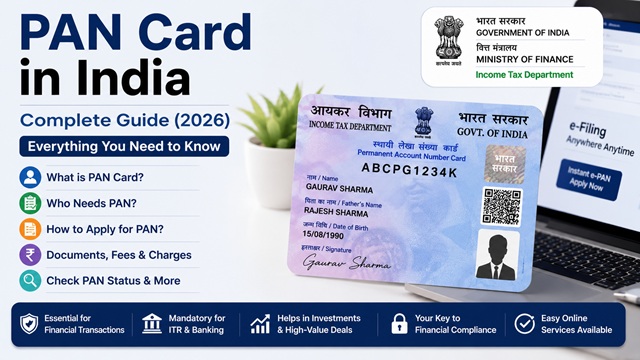
A Permanent Account Number, commonly known as PAN, is a unique 10-digit alphanumeric identifier issued by the Income Tax Department of India to every taxpayer - individuals, companies, firms, trusts, and other entities. It is one of the most important identification numbers in India's financial and tax system.
PAN was introduced in 1972 and has evolved significantly over the decades. In 2026, with the rollout of the PAN 2.0 project approved by the Cabinet Committee on Economic Affairs and the enactment of the new Income Tax Act, 2025, the entire PAN system is undergoing its most significant upgrade since its introduction. This guide covers everything you need to know about PAN in India.
What is a PAN Card?
A PAN card is a laminated or digital card that displays your Permanent Account Number along with your name, father's name or mother's name (in case of single parent), date of birth, photograph, and signature. It also carries a QR code that can be scanned to verify the holder's details against the Income Tax Department's database.
The Income Tax Department issues PAN and manages the PAN database. Two authorised agencies process PAN applications on behalf of the department:
- Protean eGov Technologies Limited (formerly NSDL): protean-tinpan.com
- UTI Infrastructure Technology And Services Limited (UTIITSL): pan.utiitsl.com
The official portal for all income tax and PAN-related services is www.incometax.gov.in.
PAN Structure - What Does Each Character Mean?
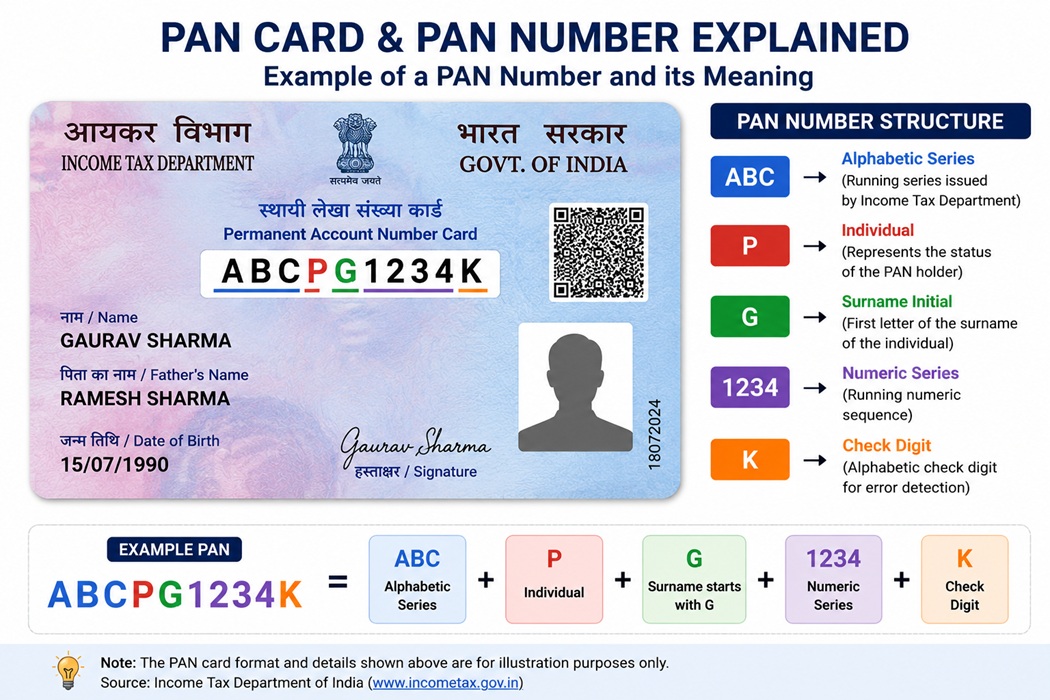
A PAN is a 10-character alphanumeric code. Each character has a specific meaning as per Income Tax rules:
| Position | Characters | What It Represents |
|---|---|---|
| 1 - 3 | 3 letters (AAA to ZZZ) | Running alphabetic series issued sequentially by the Income Tax Department |
| 4 | 1 letter | Status of the PAN holder: P = Individual, C = Company, H = HUF, F = Firm, A = AOP, T = Trust, B = BOI, L = Local Authority, J = Artificial Juridical Person, G = Government |
| 5 | 1 letter | First letter of the surname of an Individual, or first letter of the entity name for non-individuals |
| 6 - 9 | 4 digits (0001 to 9999) | Running numeric series |
| 10 | 1 letter (check digit) | Alphabetic check digit for error detection |
Example: ABCPG1234K
- ABC = alphabetic series
- P = Individual
- G = surname starts with G
- 1234 = numeric series
- K = check digit
Who Needs a PAN Card?
Under the Income Tax Act, the following are required to obtain PAN:
- Every person whose total income exceeds the basic exemption limit in a financial year
- Every person who carries on a business or profession whose sales, turnover, or gross receipts exceed Rs. 5 lakh in a financial year
- Every person who is required to furnish a return of income
- Importers and exporters
- Companies, firms, trusts, LLPs, Hindu Undivided Families
- Any person who enters into specified financial transactions where quoting PAN is mandatory
Where PAN is Mandatory to Quote
As per the Income Tax Rules, PAN must be quoted in the following transactions:
- Filing income tax return
- Opening a bank account (savings, current, or demat)
- Applying for a credit card
- Purchase or sale of immovable property exceeding Rs. 10 lakh
- Purchase of motor vehicle (other than two-wheelers)
- Cash deposit exceeding Rs. 50,000 in a single day with a bank
- Purchase of bank drafts, pay orders, or banker's cheques for Rs. 50,000 or more in a single day
- Purchase of units of mutual funds for Rs. 50,000 or more
- Purchase of bonds or debentures for Rs. 50,000 or more
- Purchase of shares from a company for Rs. 1 lakh or more
- Purchase of jewellery, bullion, or precious metals exceeding Rs. 2 lakh
- Hotel or restaurant bills exceeding Rs. 50,000 at a time
- Foreign travel exceeding Rs. 50,000 at a time
- Payment of insurance premium exceeding Rs. 50,000 in a year
Types of PAN - Physical Card, e-PAN, and Aadhaar-Based e-PAN
| Type | What It Is | Validity | How to Get |
|---|---|---|---|
| Physical PAN Card | Laminated card with photo, name, DOB, signature, and QR code | Valid proof of identity, no expiry | Via Protean or UTIITSL with fee. Delivered by India Post. |
| e-PAN (PDF) | Digitally signed PDF version of PAN, equally valid as physical card | Same validity as physical card | Via Instant e-PAN (free) on incometax.gov.in or download from Protean/UTIITSL after allotment |
| Instant e-PAN (Aadhaar-based) | Free, paperless, immediate PAN allotment using Aadhaar e-KYC | Same validity as any PAN | Via incometax.gov.in for individuals with Aadhaar and linked mobile only |
PAN 2.0 Project - What Has Changed in 2026
The Cabinet Committee on Economic Affairs (CCEA) approved the PAN 2.0 Project for the Income Tax Department with a financial outlay of Rs. 1,435 crore. This is the most significant upgrade to the PAN system since its introduction. Key changes under PAN 2.0 (sourced from the official PIB press release at pib.gov.in):
- Single unified portal: All PAN and TAN services - currently spread across the e-Filing portal, UTIITSL portal, and Protean portal - are being consolidated into one portal under the Income Tax Department.
- Free PAN allotment and updates: Allotment, updation, and correction of PAN details will be done free of cost. The e-PAN will be sent to the registered email ID.
- Physical PAN card fee: For a physical PAN card, a fee of Rs. 50 applies for domestic delivery. For delivery outside India, Rs. 15 plus India Post charges at actuals.
- Enhanced QR code: PAN cards issued under PAN 2.0 carry a dynamic QR code showing the latest data from the PAN database. The QR code displays the holder's photo, signature, name, parents' names, and date of birth when scanned.
- Existing PAN holders: You are not required to apply for a new PAN under PAN 2.0. Your existing PAN card remains fully valid. A new card will be issued only if you specifically request a correction or update.
- PAN as Common Business Identifier: As announced in Union Budget 2023, PAN is being used as the common identifier for all digital systems of specified Government agencies for businesses.
- PAN Data Vault: Personal and demographic data will be protected through enhanced security measures including a dedicated PAN Data Vault.
- Improved duplicate detection: PAN 2.0 has enhanced system logic to identify and prevent duplicate PAN requests at the time of application itself.
Aadhaar-PAN Linking - Current Status
Under Section 139AA of the Income Tax Act, 1961, every individual who was allotted a PAN on or before 1st July 2017 and is eligible to obtain Aadhaar must link both. The deadline was 30th June 2023. PANs not linked by that date became inoperative from 1st July 2023.
If your PAN is inoperative, you can still make it operative by paying Rs. 1,000 and completing the Aadhaar-PAN linking process on incometax.gov.in.
For new PAN applicants, Aadhaar-PAN linking is done automatically at the time of allotment if Aadhaar Card is provided in the application.
For the complete step-by-step guide: How to Link Aadhaar with PAN Card - Step-by-Step Guide (2026)
Penalty for Non-Compliance
As per Section 272B of the Income Tax Act:
- A penalty of Rs. 10,000 applies for failure to obtain PAN when required, knowingly quoting an incorrect PAN on prescribed documents, or providing an incorrect PAN to a person deducting or collecting tax at source.
- No individual can hold more than one PAN. If you hold multiple PANs, you must inform the Jurisdictional Assessing Officer and request the additional PAN to be deleted or deactivated. PAN 2.0 has improved detection mechanisms to identify duplicate PANs at the application stage itself.
Summary of All PAN Services and Links
| Service | Where to Do It | Fee |
|---|---|---|
| Instant e-PAN (Aadhaar-based, Individuals only) | incometax.gov.in > Quick Links > Instant e-PAN | Free |
| Apply for PAN online (Form 49A) | protean-tinpan.com or pan.utiitsl.com | Rs. 110 (Indian address) |
| Download e-PAN | incometax.gov.in > Instant e-PAN > Check Status / Download | Free |
| Reprint physical PAN card | pan.utiitsl.com | Rs. 50 (Indian address) |
| Correction or change in PAN details | protean-tinpan.com or pan.utiitsl.com | Rs. 110 (Indian address); Free under PAN 2.0 |
| Link Aadhaar with PAN | incometax.gov.in > Quick Links > Link Aadhaar | Rs. 1,000 (if linking after June 2023 deadline) |
| Check Aadhaar-PAN link status | incometax.gov.in > Quick Links > Link Aadhaar Status | Free |
| Check PAN application status | tin.tin.nsdl.com/pantan/StatusTrack.html | Free |
| Verify PAN online | incometax.gov.in > Verify Your PAN | Free |
Official Portals for PAN Services
- Income Tax e-Filing Portal - incometax.gov.in
- Protean eGov Technologies - protean-tinpan.com
- UTIITSL PAN Portal - pan.utiitsl.com
- PAN Application Status Tracker - tin.tin.nsdl.com
Income Tax Helpline: 1800 103 0025 / 1800 419 0025 (Monday to Friday, 08:00-20:00 hrs)
Disclaimer: This article is for informational purposes only. All fees, procedures, and policies are subject to change by the Income Tax Department, CBDT, Protean, and UTIITSL. Always refer to incometax.gov.in for the latest official information.
Add new comment