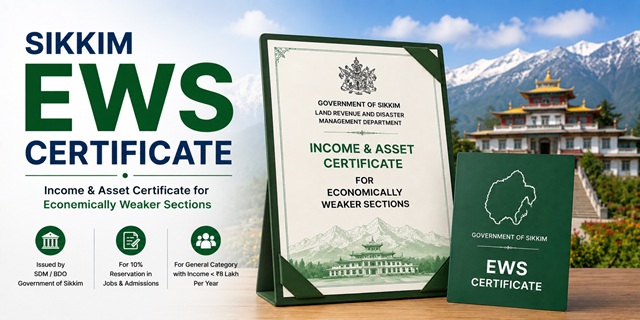
Sikkim follows the Economically Weaker Section (EWS) reservation framework for eligible applicants belonging to the unreserved category. Residents who meet the prescribed income and asset conditions can obtain an Income and Asset Certificate to claim reservation benefits in higher education, competitive examinations, and government recruitment processes.
The certificate serves as official proof of EWS status and is commonly required during admissions, counselling, scholarship applications, and recruitment exercises where EWS eligibility must be verified by a competent authority. In Sikkim, applicants can complete the process through the state's citizen service platforms or by approaching the concerned revenue authorities.
With this certificate, eligible general category residents of Sikkim can claim 10% reservation in central government jobs, SPSC (Sikkim Public Service Commission) exams, IITs, NITs, central universities, NEET All India Quota seats, and various state government scholarship and welfare schemes.
Applications are submitted through the the Sikkim GO SSO portal at sso.sikkim.gov.in for registered users. Offline applications go directly to the SDM office of your district. The Income Certificate and related revenue certificates are issued free of charge in Sikkim.
Eligibility Criteria
To be eligible for an EWS certificate in Sikkim, all of the following conditions must be satisfied:
- You must be a permanent resident of Sikkim and belong to the general (unreserved) category. You must not belong to SC, ST, OBC, or MBC (Most Backward Class) categories as listed in Sikkim state notifications
- Your family's gross annual income from all sources must be below Rs. 8 lakh for the financial year preceding the year of application. Income includes salary, agriculture, business, profession, rent, and any other source
- Your family must not own 5 acres of agricultural land or more
- Your family must not own a residential flat of 1,000 sq ft or more
- Your family must not own a residential plot of 100 sq yards or more in a notified municipality
- Your family must not own a residential plot of 200 sq yards or more outside notified municipalities
All four asset conditions must be satisfied alongside the income condition. Income is always on a gross basis. "Family" includes the applicant, parents, spouse, children below 18 years, and unmarried siblings below 18 years.
Sikkim's Unique Citizen Identity Documents
Sikkim has a unique set of documents used to establish citizenship and identity that are specific to the state:
- COI (Certificate of Identification): Issued by the Government of Sikkim, COI is the primary identity document for Sikkim residents, especially those who were residents before the 1975 merger. It establishes Sikkim citizenship and is used as a foundational document for many government services
- SSC (Sikkim Subject Certificate): Issued to residents who were Sikkim Subjects before the 1975 merger of Sikkim with India. SSC establishes original Sikkim citizenship status
- ICC (Indian Citizenship Certificate): Issued after 1975 to Sikkim residents who acquired Indian citizenship following the merger. ICC is used as foundational proof for state services
For EWS certificate applications from general category residents, these documents serve as identity and domicile proof. If you or your family members hold any of these certificates, carry them as additional identity proof. COI, SSC, and ICC are not required specifically for EWS but strengthen your application by establishing permanent residency in Sikkim.
MBC: Sikkim's Additional Backward Category
Sikkim classifies certain communities as MBC (Most Backward Class) in addition to the standard OBC category. MBC communities in Sikkim receive reservations under state government schemes. If your community is listed as MBC in Sikkim's state notification, you are not eligible for EWS benefits. EWS is exclusively for residents who are not covered under SC, ST, OBC, or MBC reservations.
Issuing Authority: SDM and BDO
In Sikkim, certificates are issued at the SDM and BDO level:
- Sub-Divisional Magistrate (SDM): The primary issuing authority for revenue certificates in Sikkim. The SDM signs all certificates after the LDC (Lower Division Clerk) processes the application and verifies documents. Sikkim has 4 districts, each with an SDM office
- Block Development Officer (BDO): The BDO can also issue certificates at the block level. Applications submitted through the eServices portal may be routed to either SDM or BDO based on the applicant's location
The LDC (Lower Division Clerk) at the SDM office is the first point of contact for all certificate applications in Sikkim. The LDC receives applications, verifies documents, and processes the file before placing it before the SDM for signing.
Documents Required
Keep the following documents ready. For online applications, files must be in PDF or JPEG format. For offline applications at the SDM office, carry self-attested photocopies and originals:
- Identity proof: Voter ID card (EPIC), Aadhaar Card, or PAN Card (self-attested). COI, SSC, or ICC if available
- Address proof: Ration Card, electricity bill, water bill, telephone bill, or driving licence showing Sikkim address
- Date of birth proof: School leaving certificate or birth certificate
- Income proof: Salary slip if employed; income details from all sources; self-declaration of income for farmers and self-employed persons
- Property documents: Parcha (land document in Sikkim) showing agricultural land held by family members. If no land is owned, include this in the self-declaration. Parcha is Sikkim's land ownership document maintained by the Revenue Department
- Bank receipt: A bank receipt may be required as part of the certificate application process. Confirm at the SDM office whether this is required for the EWS certificate
- Panchayat or Councillor Recommendation: A recommendation from your Ward Panchayat member or Councillor establishing your residence and community status in the locality. This is a required document for most certificates issued by the SDM in Sikkim
- Self-declaration certificate stating total family income from all sources is below Rs. 8 lakh and asset limits are not exceeded
- Passport-size photograph of the applicant
- For married women, proof of nationality such as the father's Voter card may also be required
Method 1: Apply Online Through Sikkim SSO Portal
- Go to sso.sikkim.gov.in/
- Click on the Register link on the homepage. Fill in your name, address, email ID, contact number, and other personal details. Submit the registration form. Your account is created
- Log in using your registered username and password
- On the dashboard, browse the available services under District Administration or Revenue Department
- Find the Income Certificate or EWS Income and Asset Certificate service. Click Apply
- Select your district carefully. Sikkim has 4 districts: East Sikkim (Gangtok), West Sikkim (Gyalshing), North Sikkim (Mangan), and South Sikkim (Namchi). The application is routed to the SDM or BDO office of the district you select
- Fill in the application form with your personal details, income from all sources for all family members, and asset details
- Upload all required documents within the portal's size limits. Upload identity proof, address proof, income proof, property documents (if applicable), and passport-size photograph
- There is no fee for revenue certificates in Sikkim. Submit the application
- An Application Reference Number is generated. Save this for tracking
- The application goes to the SDM or BDO office for verification. The LDC processes it and places it before the SDM for approval
- Once the SDM signs the certificate, it is available for download from the eServices portal
Method 2: Apply Offline at the SDM Office
- Visit the SDM office in your district. The four SDM offices are: East Sikkim SDM (Gangtok), West Sikkim SDM (Gyalshing), North Sikkim SDM (Mangan), South Sikkim SDM (Namchi)
- Go to the receiving counter and speak with the LDC (Lower Division Clerk). The LDC is the first point of contact for all certificate applications in Sikkim
- Collect the EWS Income and Asset Certificate application form from the LDC counter. The form follows the DoPT-prescribed Annexure-I format
- Fill in all details: applicant name, father's name, address, income from all sources for all family members, and land or property details
- Get a recommendation letter from your Ward Panchayat member or Councillor confirming your residence and community status in the locality
- Attach self-attested photocopies of all documents: identity proof (Voter ID, Aadhaar, COI/SSC/ICC if available), address proof, income proof, school leaving certificate, Parcha (if land is owned), and passport-size photograph
- Submit the complete set of documents and the filled form to the LDC at the receiving counter
- The LDC verifies all documents, prepares the file, and places it before the SDM for signature
- The SDM checks all documents and, after being satisfied, signs the EWS certificate and sends it back to the LDC
- The LDC informs you when the certificate is ready. Collect it from the SDM office counter by signing the Receipt Register. Carry your acknowledgement slip when collecting
Apply Through CSC (Common Service Centre)
CSC centres are present across all 4 districts of Sikkim. Citizens who cannot apply online independently can visit a nearby CSC. The operator submits the application through the eServices portal on your behalf. Carry all required documents. There is no government fee, but the CSC may charge a service fee. Collect the Application Reference Number from the operator after submission.
Application Fee
Revenue certificates in Sikkim, including the Income Certificate and EWS certificate, are issued free of charge. There is no government application fee. If a Bank Receipt is required as part of the application process, confirm the amount at the SDM office counter. CSC operators may charge a nominal service fee for their assistance.
Processing Time
The EWS certificate in Sikkim is typically processed within 7 to 15 working days after complete application submission. The LDC processes the documents and the SDM signs the certificate. Applications with complete documents including the Panchayat or Councillor recommendation are processed faster. If the certificate is not ready within the expected time, follow up directly with the LDC at the SDM office with your application reference.
Validity of the EWS Certificate in Sikkim
The EWS certificate is valid for one financial year (April 1 to March 31). It must be renewed every year. For SPSC exams, check the specific notification for validity requirements. For NEET All India Quota counselling in June or July, apply for a fresh certificate after April 1 of that year.
How to Track Application Status
- Go to eservices.sikkim.gov.in
- Log in with your credentials
- Go to your application history on the dashboard to check the current status
নতুন কমেন্ট যুক্ত করুন