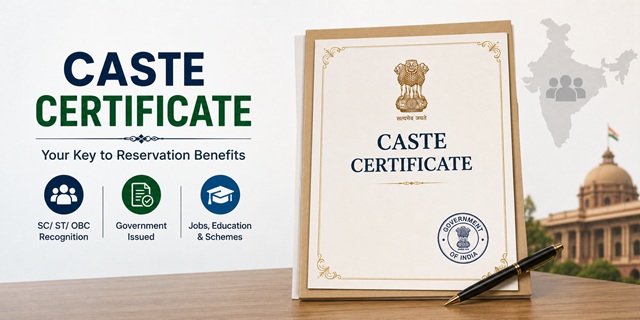
A caste certificate is an official document issued by your state government that confirms your caste belongs to the Scheduled Caste (SC), Scheduled Tribe (ST), or Other Backward Class (OBC) category as notified under the Constitution of India. Without this certificate, you cannot claim reservations in government jobs, college admissions, scholarships, or government schemes meant for these categories.
This guide covers everything you need to know about applying for a caste certificate in India, what documents you need, how long it takes, and where to apply.
Three Types of Caste Certificates in India
India has three distinct caste certificate categories. Each has a separate constitutional basis and different rules.
Scheduled Caste (SC) Certificate
The SC certificate is issued to people belonging to castes listed in the Constitution (Scheduled Castes) Order, 1950. The Ministry of Social Justice and Empowerment at the central level governs SC welfare and maintains a state-wise list of notified SC castes. A total of 1,208 castes are notified as Scheduled Castes across all states and UTs. There is no income limit to apply for an SC certificate. Your caste must appear in the SC list of the state where you or your ancestors originally belong, not necessarily where you currently live.
Scheduled Tribe (ST) Certificate
The ST certificate is issued based on the Constitution (Scheduled Tribes) Order, 1950. The Ministry of Tribal Affairs at the central level oversees ST welfare. Like SC, there is no income bar for ST certification. Your tribe must be notified as an ST in the specific state and district mentioned in the order. A person from an ST community in Rajasthan cannot use their ST certificate in another state where that tribe is not notified as ST.
OBC Certificate (Other Backward Class)
The OBC certificate is issued to castes listed in the Central List of OBCs maintained by the National Commission for Backward Classes (NCBC), a constitutional body under Article 338B of the Constitution. For central government jobs and central institutions, your caste must appear in the Central OBC list. For state government jobs and state institutions, your caste must appear in the state OBC list, which may differ from the central list.
OBC has one critical condition that SC and ST do not have: the creamy layer exclusion. If your family's annual income crosses the creamy layer limit set by the Central Government, you are not eligible for OBC reservation in central services, even if your caste is in the OBC list. The creamy layer income limit is currently Rs. 8 lakh per annum (family income, excluding agricultural income). The income of parents, not spouse, is considered for this calculation.
Who Issues the Caste Certificate
Caste certificates are issued by your state government, not the central government. The issuing authority differs by state but is always a revenue officer. Common issuing authorities across states include:
- Tehsildar or Naib Tehsildar
- Sub-Divisional Magistrate (SDM)
- Deputy Commissioner (DC) in northeastern states
- Revenue Divisional Officer (RDO) in some southern states
- Block Development Officer (BDO) in certain states
The certificate is valid in the state that issued it for state-level purposes. For central government jobs and central college admissions, the certificate is accepted across India as long as the caste appears in the respective central list.
Documents Required for Caste Certificate
The exact documents vary by state, but most states ask for the following:
- Filled application form (available at the Tehsil office or state e-district portal)
- Aadhaar Card (identity proof)
- Residence proof such as Ration Card, Voter ID Card, or utility bill
- Proof of caste of the applicant or their father or grandfather (old caste certificate, school leaving certificate showing caste, or any government document mentioning caste)
- Domicile Certificate or residence proof for the state of application
- Birth certificate or school leaving certificate
- Passport-size Photographs
- Self-declaration or affidavit about caste (required in many states)
For OBC certificates, some states also require an Income Certificate or a declaration that your family income is below the creamy layer limit. For SC and ST certificates, no income proof is needed.
How to Apply for Caste Certificate
You can apply through any of the following methods depending on what your state offers:
Method 1: Apply Online Through State e-District Portal
Most states now offer online applications through their official e-district portals. The process is broadly similar across states:
- Visit your state's official e-district or e-services portal.
- Register as a new user using your mobile number and Aadhaar Number.
- Log in and select the caste certificate service from the list of available services.
- Fill the application form with your personal details, caste name, and address.
- Upload scanned copies of all required documents.
- Pay the application fee online (fee varies by state, ranging from free to Rs. 100).
- Submit the application and note the acknowledgement number for tracking.
- The application goes to the Tehsildar or concerned officer for field verification and approval.
- Download the digitally signed certificate from the portal once approved.
Method 2: Apply Offline at Tehsil or SDM Office
If you prefer to apply in person or your state does not offer online services for caste certificates:
- Visit your nearest Tehsil office or SDM office.
- Collect the application form for a caste certificate (usually free of charge at the counter).
- Fill the form carefully. Write your caste name exactly as it appears in the official SC/ST/OBC list.
- Attach all required documents and submit the form at the counter.
- Pay the application fee if applicable and collect the receipt.
- A field verification may be carried out by the patwari, lekhpal, or village-level officer before the certificate is issued.
- Collect the certificate on the date mentioned on your receipt, or when you receive an SMS notification.
Method 3: Apply Through Common Service Centre (CSC)
Common Service Centres are government-authorised service points available in villages and small towns across India. If you do not have internet access at home or need help with the online process:
- Visit your nearest CSC (also called Jan Seva Kendra or Lok Seva Kendra in some states).
- Carry all original documents and self-attested photocopies.
- The CSC operator fills and submits the application on your behalf through the official state portal.
- Pay the CSC service charge along with the government fee (CSC typically charges Rs. 20 to Rs. 50 as a facilitation fee).
- Collect your acknowledgement slip and track the application status using your application number on the state portal.
Method 4: Apply Through UMANG App
Several states have integrated their e-district services with the UMANG (Unified Mobile Application for New-age Governance) platform available at umang.gov.in. Check if your state's caste certificate service is listed on UMANG by searching under your state's services after logging in.
State-wise Portals for Caste Certificate
Since caste certificates are issued at the state level, you must apply through your state's official portal. State e-district portals are not hyperlinked here as these are operational portals that require direct browser access. Below is a reference list of the official portal addresses for major states:
| State/UT | Official Portal |
|---|---|
| Uttar Pradesh | edistrict.up.gov.in / esathi.up.gov.in |
| Bihar | serviceonline.bihar.gov.in |
| Rajasthan | emitra.rajasthan.gov.in |
| Madhya Pradesh | mpedistrict.gov.in |
| Maharashtra | aaplesarkar.mahaonline.gov.in |
| West Bengal | castcertificatewb.gov.in |
| Karnataka | nadakacheri.karnataka.gov.in |
| Tamil Nadu | tnedistrict.tn.gov.in |
| Andhra Pradesh | meeseva.ap.gov.in |
| Telangana | meeseva.telangana.gov.in |
| Gujarat | digitalgujarat.gov.in |
| Punjab | connect.punjab.gov.in |
| Haryana | saralharyana.gov.in |
| Kerala | edistrict.kerala.gov.in |
| Odisha | edistrict.odisha.gov.in |
| Jharkhand | jharsewa.jharkhand.gov.in |
| Assam | sewasetu.assam.gov.in |
| Chhattisgarh | edistrict.cgstate.gov.in |
| Uttarakhand | eservices.uk.gov.in |
| Himachal Pradesh | himseva.hp.gov.in |
| Delhi | edistrict.delhigovt.nic.in |
| Jammu & Kashmir | jansugam.jk.gov.in |
Each state article on this site covers the exact portal, documents, fees, and steps specific to that state. Find your state's caste certificate guide in the links below.
Application Fee and Processing Time
The fee and processing time vary by state. Here is a general overview:
- Fee: Ranges from free (Bihar, Odisha, Gujarat) to Rs. 100 in some states. Most states charge between Rs. 10 and Rs. 50.
- Processing time: Typically 7 to 30 days depending on the state and whether field verification is required. Some states offer Tatkal or urgent processing in 3 to 5 days for an additional fee.
- Right to Public Service Acts: Most states have their own RTPS or Lok Seva Guarantee Act that sets a maximum number of days for certificate issuance. If the officer does not issue it within this fixed time, you can file a formal appeal.
Validity of Caste Certificate
SC and ST certificates are generally valid for a lifetime since caste status does not change. OBC certificates have limited validity in many states, commonly 1 to 3 years, because the non-creamy layer status must be periodically verified. Always confirm the validity period with your state's issuing authority before submitting the certificate for a government job or college admission.
Benefits of Caste Certificate
A valid caste certificate gives you access to the following:
- Reservation in central and state government jobs (15% for SC, 7.5% for ST, 27% for OBC at the central level)
- Reservation in central educational institutions including IITs, NITs, central universities, and medical colleges
- Pre-matric and post-matric scholarships through the National Scholarship Portal
- Fee waivers and relaxed cut-offs in government examinations
- Age relaxation in government job applications (5 years for SC/ST, 3 years for OBC)
- Priority in government housing schemes, self-employment loan schemes, and welfare programmes
- Access to schemes run by the Ministry of Social Justice and Empowerment for SC/OBC communities
Important Rules to Know
State-specific nature: Your caste must be notified as SC/ST/OBC in the state from which you are applying. A caste notified as ST in Jharkhand may not be notified as ST in Delhi. Check the official central OBC list on the National Commission for Backward Classes website for OBC, and the Ministry of Social Justice and Empowerment for SC.
Submitting a false caste certificate is a criminal offence. Appointments made on the basis of a false caste certificate can be cancelled even after many years of service.
Caste Scrutiny Committees: For ST certificates especially, many states have Caste Scrutiny Committees that verify the authenticity of the certificate before it is accepted for government jobs or college admissions. Your original certificate alone may not be sufficient, you may need a separate scrutiny approval from this committee.
OBC Central vs. State list difference: Your caste may be in the state OBC list but not in the central OBC list. In that case, your state OBC certificate is valid only for state government jobs and state college admissions, not for central services or central institutions.
মন্তব্যসমূহ
ST
मी मुळचा महाराष्ट्रचा आहे पण सध्या तेलंगणा राज्याचा रहिवाशी आहे तर मला एस टी च जात प्रमाणपत्र काढयच आहे मी.... "महादेव कोळी " जात आहे माझी ती तेलंगणा मध्ये नाही तर मला या वर उपाय सुचवा
নতুন কমেন্ট যুক্ত করুন