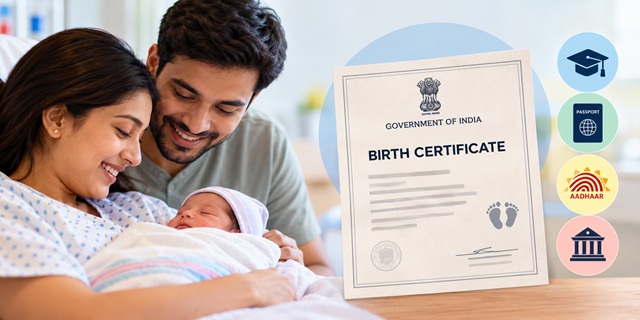
A Birth Certificate is one of the most important documents issued by the government. It officially records a person's date and place of birth and helps establish their identity. In India, every birth must be registered under the Registration of Births and Deaths Act, 1969, through the designated local Registrar.
Parents can register a child's birth through the hospital or the local birth registration authority, depending on where the delivery takes place. The Central Government provides the Civil Registration System (CRS) portal for online registration in supported States and Union Territories. However, the application process, supporting documents and service charges may differ from one state to another.
Birth Certificate in India: Highlights
Birth Certificate - Key Details |
|
|---|---|
| Document Name | Birth Certificate |
| Governing Law | Registration of Births and Deaths Act, 1969 |
| Implementing Authority | Office of the Registrar General, India, and State/UT Chief Registrars |
| Registration Authority | Local Registrar of Births and Deaths |
| Registration Period | Within 21 days from the date of birth |
| Registration Fee | Free when reported within the normal 21-day period |
| Application Mode | Online or Offline, depending on the State/UT and local authority |
| Central Online Portal | Civil Registration System (CRS) Portal |
| Applicable Law Update | Registration of Births and Deaths (Amendment) Act, 2026, effective from 1 October 2026 |
What is a Birth Certificate in India?
A Birth Certificate is an official record issued by the authorised Registrar of Births and Deaths. It confirms the registration of a person's birth and contains important details such as the date and place of birth, sex of the child, and parents' names, as recorded in the register.
The government registers births under the Registration of Births and Deaths Act, 1969. The Office of the Registrar General, India, coordinates the Civil Registration System at the national level, while the respective State and Union Territory authorities implement the registration process through local Registrars.
Registration takes place in the area where the birth actually occurred. For example, if a child is born in a hospital in another district, the birth must be registered with the authority having jurisdiction over that hospital's location, not automatically at the parents' permanent residential address.
A hospital discharge summary, delivery record or birth intimation may help establish the occurrence of a birth. However, these documents are not substitutes for the official Birth Certificate issued by the authorised registration authority.
Why is a Birth Certificate Important?
A Birth Certificate provides an official record of a person's birth. It is useful throughout life for education, identity-related services and several legal and administrative requirements.
Some important uses of a Birth Certificate include:
- School and educational admission: It helps establish a child's date and place of birth when applying for admission to an educational institution.
- Passport application: It serves as an important document for establishing date and place of birth.
- Aadhaar enrolment: It can be used as a supporting document for date of birth, subject to UIDAI's applicable document requirements.
- Driving licence: It can help establish the applicant's date of birth.
- Marriage registration: It may be required to establish age and date of birth.
- Government employment: It can serve as proof of date and place of birth where required under the applicable rules.
- Other legal purposes: It may be used in matters involving age verification, parentage and other official records.
Birth Certificate Rules Under the Registration of Births and Deaths Act
The Registration of Births and Deaths Act, 1969, provides the legal framework for registering births and deaths throughout India. The Act makes birth registration compulsory and assigns responsibilities to different persons and authorities.
The Office of the Registrar General, India, coordinates the national system. State and Union Territory governments appoint Chief Registrars, District Registrars and local Registrars to carry out the registration work.
The following provisions are particularly important for parents and applicants:
- Every birth must be reported to the authorised registration authority.
- The normal reporting period is 21 days from the date of occurrence.
- Registration takes place in the area where the birth occurred.
- The hospital or institution is responsible for reporting births that take place in its premises.
- For births at home, the responsibility generally rests with the head of the household or another person specified under the Act.
- Delayed registration is permitted under Section 13, subject to the applicable conditions, permissions, orders and fees.
- A birth can be registered even if the child has not yet been given a name.
Parents should report the birth as early as possible. Timely registration avoids the additional permissions and formalities that apply to delayed cases.
Birth Certificate Rule for Children Born on or After 1 October 2023
The Registration of Births and Deaths (Amendment) Act, 2023 introduced an important provision under Section 17(3) of the principal Act.
For a person born on or after 1 October 2023, the Birth Certificate must be used to prove the date and place of birth for the purposes specified in the law. These include:
- Admission to an educational institution.
- Issuance of a driving licence.
- Preparation of an electoral roll.
- Registration of a marriage.
- Appointment to a post in the Central Government, State Government, local body, public sector undertaking or statutory or autonomous body under the Central or State Government.
- Issuance of a passport.
- Issuance of an Aadhaar number.
- Any other purpose notified by the Central Government.
This provision specifically concerns proof of date and place of birth for the listed purposes. It does not mean that a Birth Certificate automatically replaces every other document. Authorities may still ask for separate identity, address, eligibility or other supporting documents under their respective rules.
Who is Responsible for Registering a Birth?
The Registration of Births and Deaths Act identifies the persons responsible for reporting a birth. The responsibility depends mainly on whether the child is born in a hospital or at home.
1. Birth Taking Place in a Hospital
When a child is born in a government or private hospital, maternity home, nursing home or another medical institution, the medical officer in charge or a person authorised by the officer must report the birth to the concerned Registrar.
Parents should collect the hospital's birth intimation or other relevant delivery record and keep it safely. They can use it when following up with the hospital or registration authority.
2. Birth Taking Place at Home
For a birth occurring at home, the head of the household or the nearest relative of the head who is present at the house is generally responsible for reporting the birth. If neither is present, the oldest person present during the relevant period may report the event.
Prescribed notifiers, such as ASHA workers, ANMs and Anganwadi workers, may also assist in reporting births under the applicable system.
3. Birth Taking Place at Another Location
If a birth takes place at a location other than a hospital or the child's home, the person responsible for reporting it must follow the applicable provisions of the Act and the instructions of the local Registrar.
Applicants should contact the Registrar having jurisdiction over the actual place of birth to confirm the reporting procedure and required supporting records.
Documents Required for Birth Certificate Registration
The documents required for registering a birth depend on the place of delivery and the rules followed by the concerned State or Union Territory. There is no single uniform document checklist that applies to every type of birth registration across India.
The following records are commonly relevant:
Documents for a Hospital Birth
- Birth intimation or delivery record issued by the hospital.
- Hospital discharge summary, where required by the registration authority.
- Parents' identity or address documents, if requested by the local authority.
- Any prescribed registration form or declaration required by the concerned authority.
For institutional births, the hospital or medical institution is responsible for reporting the event. Parents should not assume that submitting a separate application themselves replaces the institution's reporting duty.
Documents for a Home Birth
- Declaration or prescribed birth reporting form completed by the parent or responsible informant.
- Address proof of the household, as required by the concerned authority.
- Identity documents of the parents or informant, where required.
- Any additional evidence requested by the local Registrar to verify the date and place of birth.
For a home birth, the Registrar may ask for additional information or verification before registering the event. The exact requirements depend on the applicable State or Union Territory rules and the circumstances of the case.
Important Document Instructions
Parents should check the current checklist on their State's official birth registration portal or with the local Registrar before submitting an application. Do not treat the above list as a compulsory nationwide checklist.
How to Apply for a Birth Certificate Online in India?
The Central Government operates the Civil Registration System (CRS) portal for online birth and death registration in participating States and Union Territories. The portal allows users to report eligible events and check the relevant application details.
However, online registration is not available through the central portal for every location. Some States and local authorities use their own registration portals or offline procedures.
Steps to Apply Through the CRS Portal
- Visit the official Civil Registration System portal.
- Check whether the portal accepts birth registration for the State or Union Territory where the child was born.
- Open the applicable birth reporting or registration service.
- Follow the instructions displayed on the portal and enter the required details.
- Provide the child's birth information and the details of the parents or informant as requested.
- Upload the supporting documents, if the portal asks for them.
- Review the information carefully before submitting the application.
- Save the application reference number or acknowledgement for future use.
- Follow the application status and any further instructions issued by the concerned Registrar.
Online submission does not always mean that the certificate will be issued immediately. The concerned registration authority may examine the information, verify supporting records or seek clarification before completing registration.
States and Union Territories Covered by the Central CRS Portal
At the time of checking, the central CRS portal displayed online birth and death registration services for the following States and Union Territories:
| Category | States and Union Territories |
|---|---|
| States | Andhra Pradesh, Arunachal Pradesh, Assam, Bihar, Chhattisgarh, Goa, Gujarat, Haryana, Himachal Pradesh, Jharkhand, Madhya Pradesh, Maharashtra, Manipur, Meghalaya, Mizoram, Nagaland, Sikkim, Telangana (GHMC), Tripura, Uttar Pradesh and Uttarakhand. |
| Union Territories | Andaman and Nicobar Islands, Chandigarh, Dadra and Nagar Haveli and Daman and Diu, Jammu and Kashmir, Ladakh, Lakshadweep and Puducherry. |
| Specific Local Area | Delhi Cantonment Board. |
Important: The portal's availability list is subject to change. The online facility may cover only specified local areas or registration units within a State or Union Territory. For example, the portal specifically identifies Telangana (GHMC) and Delhi Cantonment Board rather than presenting these as blanket coverage of every local area.
If your location does not appear on the central CRS portal, check the official website of your State's Chief Registrar, municipal corporation, municipal council, Gram Panchayat or other local registration authority.
How to Apply for a Birth Certificate Offline?
Applicants can also complete birth registration through the local Registrar of Births and Deaths. This route is useful when the central CRS portal does not cover the applicant's location or when the concerned authority requires an in-person application.
Follow these general steps:
- Identify the Registrar having jurisdiction over the place where the child was born.
- Visit the relevant municipal office, Gram Panchayat, health department registration unit or other notified registration centre.
- Obtain the prescribed birth reporting form or application form.
- Fill in the child's birth details and the required information about the parents or informant.
- Attach the documents requested by the registration authority.
- Submit the form to the authorised official and collect the acknowledgement, where issued.
- Complete any additional verification or formalities required by the Registrar.
- Once the birth is registered, obtain the Birth Certificate through the prescribed collection or download facility.
The exact office and form may differ between urban and rural areas. In some locations, government hospitals also have authorised birth registration units.
Birth Registration Time Limit and Late Registration Rules
Section 13 of the Registration of Births and Deaths Act, 1969, explains how authorities handle births reported after the normal registration period.
The normal period for reporting a birth is 21 days from the date of occurrence. If parents miss this period, they can still seek registration, but the procedure depends on how much time has passed.
The Registration of Births and Deaths (Amendment) Act, 2026 changed the procedure for cases delayed by more than one year. The amendment came into force on 1 October 2026.
1. Birth Reported Within 21 Days
Parents or the responsible informant should report the birth within 21 days. The CRS FAQ states that no registration fee is charged when the event is reported within this normal period.
2. Birth Reported After 21 Days but Within 30 Days
If the birth is reported after the normal 21-day period but within 30 days of its occurrence, the Registrar can register it after payment of the prescribed late fee.
3. Birth Reported After 30 Days but Within One Year
When the reporting delay exceeds 30 days but remains within one year, registration requires:
- Written permission from the District Registrar or another authority prescribed under the applicable rules.
- Payment of the prescribed fee.
- Production of a self-attested document in the prescribed form and manner.
4. Birth Reported After One Year but Within Two Years
Under the 2026 amendment, a birth reported after one year but within two years can be registered only on an order issued by one of the following authorities having jurisdiction over the place where the birth occurred:
- District Magistrate (DM).
- Sub-Divisional Magistrate (SDM).
- Executive Magistrate authorised by the District Magistrate.
The authority must verify the correctness of the birth before issuing the order. The applicant must also pay the prescribed fee.
5. Birth Reported After Two Years
If the birth is reported after two years from the date of occurrence, registration requires an order from the Judicial Magistrate of the First Class having jurisdiction over the area where the birth took place.
The Judicial Magistrate must verify the correctness of the birth before passing the order. The prescribed fee must also be paid.
| Reporting Delay | Requirement Under Section 13 |
|---|---|
| Within 21 days | Normal registration; no registration fee. |
| After 21 days but within 30 days | Registration by the Registrar after payment of the prescribed late fee. |
| After 30 days but within one year | Written permission of the District Registrar or other prescribed authority, prescribed fee and self-attested document. |
| After one year but within two years | Order of the DM, SDM or authorised Executive Magistrate after verification, along with the prescribed fee. |
| After two years | Order of the Judicial Magistrate First Class after verification, along with the prescribed fee. |
Important: The late fees, supporting documents and detailed application procedure are governed by the applicable rules. Applicants should confirm the current requirements with the concerned registration authority before filing a delayed registration request.
Can a Birth Certificate Be Issued Without the Child's Name?
Yes. Section 14 of the Registration of Births and Deaths Act allows the registration of a child's birth even when the parents have not yet decided on a name.
Parents do not need to delay birth registration only because the child's name has not been finalised. They can complete the registration first and request the registration authority to enter the name later.
According to the CRS FAQ:
- The child's name can be entered without charge within 12 months from the date of registration.
- The name can be entered after 12 months by paying the prescribed fee, subject to the applicable period and rules.
- The FAQ describes the period for entering the name as up to 15 years from the date of registration, with extensions from time to time.
Parents should confirm the current name-entry deadline and fee with their State or local Registrar because the applicable rules and any extensions must be checked before applying.
How to Download a Birth Certificate Online?
Once the Registrar completes the birth registration, the applicant can obtain the certificate through the official portal or the registration office, depending on the system followed in that location.
For locations using the central CRS portal, applicants should visit the official CRS website and follow the available certificate or application-status instructions.
In other locations, the certificate may be available through a State e-District portal, municipal corporation website or another government service platform.
In general, applicants may need the following information to retrieve a certificate:
- Application or acknowledgement number, if available.
- Date of birth.
- Name of the child, if already entered in the register.
- Parents' names or other identifying details requested by the portal.
- Registration number, if already issued.
After retrieving the certificate, check that the child's name, date of birth, place of birth and parents' details match the official records. If any detail is incorrect, contact the concerned Registrar and follow the correction procedure under Section 15 and the applicable State rules.
Birth Certificate Registration Fee in India
The registration fee depends on when the birth is reported and the applicable State or Union Territory rules.
The CRS FAQ confirms that no registration fee is charged when the birth is reported within the normal 21-day period. For delayed registration, the applicant must pay the prescribed fee under Section 13.
There is no single late-registration fee that should be assumed for every State and Union Territory. The amount and payment method may depend on the applicable rules and the period of delay.
Applicants should also distinguish between the government registration fee and any separate service or facilitation charge collected by a Common Service Centre (CSC) or authorised service provider. Before paying, check the official fee schedule or obtain a receipt.
Birth Registration of an Indian Child Born Outside India
The procedure for a child born outside India is different from the normal domestic birth registration process.
According to the CRS FAQ, the birth of a child born abroad to Indian citizens is registered under the Citizenship Act, 1955, and the Citizens (Registration at Indian Consulates) Rules, 1956, through the concerned Indian Mission or Consulate.
Parents should contact the Indian Embassy, High Commission or Consulate having jurisdiction over the place of birth to confirm the applicable registration procedure and documents.
Section 20 of the Registration of Births and Deaths Act also provides a specific route in certain cases where the parents return to India with the intention of settling there. The CRS FAQ refers to registration within 60 days of the child's arrival in India at the place of settlement, with delayed registration provisions applying if that period is missed.
Parents should confirm the current legal and documentary requirements with the Indian Mission and the local registration authority before proceeding.
Birth Certificate Correction in India
If the Birth Certificate contains an incorrect name, date of birth, place of birth or other registered information, the applicant should approach the Registrar who maintains the birth record.
Section 15 of the Registration of Births and Deaths Act provides for correction or cancellation of an entry in the register, subject to the applicable State or Union Territory rules.
The Registrar may ask for documentary evidence to support the requested correction. The documents and verification procedure depend on the type of error and the applicable local rules.
Applicants should not submit a fresh birth registration merely to correct an existing entry. They should first contact the authority that maintains the original record and follow its correction procedure.
Official Websites for Birth Certificate Registration
Applicants should use government portals to register a birth, check application status or obtain a certificate. The following official resources are useful:
| Official Resource | Purpose | Website |
|---|---|---|
| Central CRS Portal | Online birth and death registration in supported locations | Visit CRS Portal |
| Office of the Registrar General, India | National civil registration information and guidelines | Visit Official Website |
| CRS Frequently Asked Questions | Registration period, fees, reporting responsibility and other rules | Download Official FAQ |
| Registration of Births and Deaths Act, 1969 | Legal provisions governing birth and death registration | Read the Act |
| CRS Annual Report 2023 | Official national report on the Civil Registration System | View ORGI Report |
Note: The 1969 Act PDF currently available on India Code is an earlier consolidated text and does not incorporate the 2026 amendment. Applicants dealing with delayed registration must also refer to the 2026 Amendment Act and its commencement notification.
State-Wise Birth Certificate Application Guides
Although the Registration of Births and Deaths Act provides the national legal framework, the actual application process is handled by State and Union Territory authorities. The portal, application form, supporting documents, local office, fees and certificate download facility may differ by location.
For accurate instructions, applicants should refer to the guide for the State or Union Territory where the birth occurred. A State-specific guide should explain the local portal, registration office, application steps, document requirements and certificate retrieval process.
Before applying, always confirm that the selected portal or registration office has jurisdiction over the place where the birth took place.
নতুন কমেন্ট যুক্ত করুন