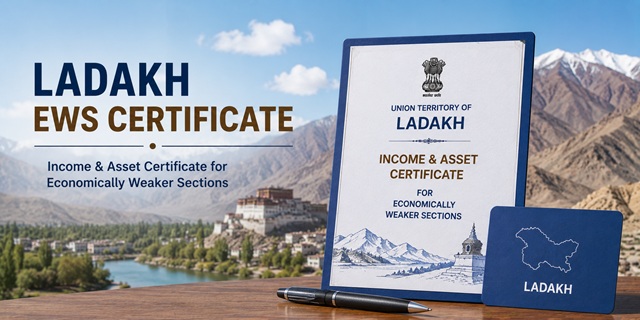
Ladakh's EWS certificate system operates within a unique high-altitude revenue administration that serves both Leh and Kargil districts. Eligible residents belonging to the unreserved category can obtain an Income and Asset Certificate to claim EWS reservation benefits in higher education, competitive examinations, and government recruitment where proof of economic eligibility is required.
Unlike most states and Union Territories, residency and land ownership verification in Ladakh often relies on region-specific revenue records such as LRC, Jamabandi, Shajra Nasab, and other historical land documents maintained by the revenue authorities. These records play an important role in establishing local residency, family background, and landholding details while processing EWS-related applications in the Union Territory.
Ladakh became a Union Territory on 31 October 2019 following the reorganisation of Jammu and Kashmir. It has two districts: Leh (the larger district covering the Leh region, Nubra, Changthang, and Zanskar areas) and Kargil (covering Kargil town, Drass, Suru Valley, and Zanskar). Each district has Tehsil offices with designated Tehsildars and Naib Tehsildars handling revenue services.
Applications are submitted through the Ladakh e-Seva platform at eseva.ladakh.gov.in (for online applications) or at the Tehsildar's office in your Tehsil. The e-Seva platform is developed and maintained by CDAC under the Ladakh e-Governance Agency, IT Department.
Eligibility Criteria
To be eligible for an EWS Certificate in Ladakh, all of the following conditions must be satisfied:
- You must be a permanent resident of Ladakh holding a valid Ladakh Resident Certificate (LRC) or be eligible to hold one. You must belong to the general (unreserved) category and must not belong to SC, ST, or OBC categories
- Your family's gross annual income from all sources must be below Rs. 8 lakh for the financial year preceding the year of application. Income includes salary, wages, agriculture, animal husbandry, business, profession, and any other source
- Your family must not own 5 acres of agricultural land or more
- Your family must not own a residential flat of 1,000 sq ft or more
- Your family must not own a residential plot of 100 sq yards or more in a notified municipality
- Your family must not own a residential plot of 200 sq yards or more outside notified municipalities
All four asset conditions must be satisfied alongside the income condition. Income is always on a gross basis. "Family" includes the applicant, parents, spouse, children below 18 years, and unmarried siblings below 18 years.
LRC: Ladakh's Foundational Resident Certificate
The Ladakh Resident Certificate (LRC) is the primary permanent residency document in Ladakh, established by the Administration of UT Ladakh after the 2019 reorganisation. The LRC replaced the earlier Permanent Resident Certificate (PRC) of J&K for Ladakh residents. It is issued by the Tehsildar and confirms that the holder is a permanent resident of Ladakh.
For EWS certificate applications, the LRC (or the older J&K-era Permanent Resident Certificate for those who hold it) is the primary document establishing permanent residency. Without confirmed Ladakh residency, the EWS certificate cannot be issued.
The Administration issued the first LRC through the ADC Kargil in October 2021. Since then, Tehsildars across Leh and Kargil districts have been issuing LRCs. Naib Tehsildar at GM Pore (Kargil) was also delegated powers to issue LRCs through Order No. 14 (REV) of 2024.
Ladakh's Unique Revenue Documents
Ladakh's land records use unique historical documents that are specific to the region:
- Jamabandi (Misal-e-Haqiyat): The primary land ownership record in Ladakh. The historic Misal-e-Haqiyat refers to land settlement records prepared before 1944 AD. The current Jamabandi is the updated land record. Together they establish land ownership
- Shajra Nasab: The genealogical family tree record maintained in Ladakh's revenue system. It establishes ancestral links and family history in the revenue records. For EWS and residency purposes, Shajra Nasab is used to establish historic family connection to Ladakh
- Khacharai records (1908-09 AD): For landless families and nomadic communities (Changpa nomads of Changthang and Drokpa communities), the Khacharai records serve as the residency evidence. These communities do not own agricultural land but have historically grazed on designated pastureland (Khacharai) recorded in revenue documents
These documents are unique to Ladakh and J&K and are not found in any other state or UT in India. When applying for EWS certificates, Ladakh residents may be asked for current Jamabandi records to verify land holdings.
Documents Required
Keep the following documents ready. For online applications through eseva.ladakh.gov.in, files must be in PDF or JPEG format. For offline Tehsil applications, carry self-attested photocopies and originals:
- Ladakh Resident Certificate (LRC) or the older J&K Permanent Resident Certificate (PRC): The primary residency document for Ladakh. This is mandatory
- Aadhaar Card of the applicant
- Government-issued Photo Identity Card: Driving Licence, EPIC (Voter ID), Passport, PAN Card, Aadhaar card, or School/College ID card. Any one is accepted as confirmed from the official LRC issuance notice on ladakh.gov.in
- Birth Certificate from the Registrar of Deaths and Births, or School Leaving Certificate, or High School Certificate
- Ration Card showing family members and Ladakh address
- Income proof: Salary certificate from employer for government and private sector employees; Income Tax Returns; or a self-declaration affidavit for those without formal income documentation. Animal husbandry income should also be declared for pastoral families
- Jamabandi or current revenue records: Current land records showing agricultural land held by family members. If no agricultural land is owned, a self-declaration or a nil-land record statement from the Patwari is submitted. For nomadic families, Khacharai records serve as the land/grazing record
- Property documents: Any document showing residential property owned. If none owned, include in the self-declaration
- Self-declaration affidavit stating total family income from all sources is below Rs. 8 lakh and all asset limits are within prescribed thresholds
- Passport-size photograph of the applicant
Method 1: Apply Online Through Ladakh e-Seva Platform
- Go to eseva.ladakh.gov.in
- Click Login on the homepage. If you are a new user, click the registration option. Enter your name, mobile number, email ID, and create a password. Verify via OTP. Your account is created
- Log in using your registered credentials
- On the dashboard, click on the Certificates section from the main menu (the platform features Agriculture, Govt. Schemes, Certificates, and Online Payments)
- Browse the available certificate services. Find and select EWS Certificate or Income and Asset Certificate for EWS
- The application form opens. Select your district (Leh or Kargil) and Tehsil carefully. The application is routed to the Tehsildar of the Tehsil you select
- Fill in personal details: name, father's name, address, Tehsil, village, and mobile number
- Fill in income details from all sources for all family members. Include salary, agricultural income, income from animal husbandry, business, and any other source
- Fill in asset details: agricultural land held and residential property owned by family members
- Upload all required documents: LRC or old PRC, Aadhaar, identity proof, income proof, Jamabandi or land records (if applicable), and passport-size photograph
- Pay the applicable fee through the online payment module. Confirm the fee at the payment step
- Submit the application. An Application Reference Number is generated. Save this number
- Once the Tehsildar approves the certificate, log in to the e-Seva platform and download the digitally signed certificate
Method 2: Apply at the Tehsildar Office
- Identify the Tehsildar office in your Tehsil. Leh district has Tehsil offices at Leh, Nubra, Changthang, Nyoma, and other Tehsils. Kargil district has Tehsil offices at Kargil, Drass, Zanskar, Shakar Chiktan, and other Tehsils. Naib Tehsildar offices at GM Pore (Kargil) also handle LRC and revenue certificates
- Visit the Tehsildar office on a working day during office hours. In high-altitude areas of Ladakh, office hours may vary seasonally. Confirm before visiting
- Collect the EWS Income and Asset Certificate application form from the receiving counter. Ask specifically for the DoPT-prescribed Annexure-I format for the EWS certificate
- Fill in all details: applicant's name, father's name, address, Tehsil, income from all sources separately for all family members, and details of all land and property held
- Attach self-attested photocopies of all required documents: LRC or old PRC, Aadhaar, photo identity proof, birth certificate or school leaving certificate, ration card, income proof, Jamabandi or land records (if applicable), and passport-size photograph
- Submit the completed form at the revenue counter. Provide your mobile number for communication. Collect the acknowledgement receipt with your application reference number
- The Tehsildar verifies the documents and land records through the Patwari records. The Patwari's report on land holdings and income verification is submitted to the Tehsildar
- The Tehsildar reviews all documents and the Patwari's report, then approves and signs the EWS certificate
- The certificate is made available for download on the e-Seva platform or for collection from the Tehsildar office. You are notified when it is ready
Apply Through CSC (Common Service Centre)
CSC centres are present across Leh and Kargil districts. In remote Tehsils and villages, CSC operators can submit the e-Seva application on your behalf. Carry all required documents. Pay the government fee plus the CSC service charge. Collect the Application Reference Number. For remote areas with limited connectivity, the Tehsildar office or CSC at the nearest Tehsil headquarters is the most practical option.
Application Fee
Confirm the exact government fee at the e-Seva platform payment step or at the Tehsildar office counter. Revenue certificate fees in Ladakh are nominal. Contact the Tehsildar office at Leh or Kargil for fee confirmation before applying.
Processing Time
The EWS certificate in Ladakh is typically processed within 15 to 30 working days of application submission. Processing time varies by Tehsil. Remote high-altitude Tehsils in Changthang, Nubra, and Zanskar may take longer due to geographic constraints. The Patwari's land record verification is required before the Tehsildar can issue the certificate. For time-sensitive applications (exam or job deadlines), apply well in advance and contact the Tehsildar office directly.
Validity of the EWS Certificate in Ladakh
The EWS certificate is valid for one financial year (April 1 to March 31). It must be renewed every year by applying fresh. For UT Ladakh Administration government job applications, check the specific recruitment notification for validity requirements. For NEET All India Quota counselling in June or July, apply for a fresh certificate after April 1 of that year.
Ladakh Domicile Certificate Rules 2025: Key Update
The Ministry of Home Affairs notified the Ladakh Civil Services Decentralization and Recruitment Grant of Domicile Certificate (Procedure) Rules, 2025 through an official Gazette dated 3 June 2025. Under these rules, the Tehsildar is designated as the competent authority for issuing Domicile Certificates which are now mandatory for appointments to UT Ladakh government posts. The Domicile Certificate is now a key document for UT Ladakh government job applications. For EWS certificates used in Ladakh government jobs, both the Domicile Certificate (new framework) and the EWS Income and Asset Certificate are required. Apply for the Domicile Certificate through the Tehsildar office if you do not have one.
వ్యాఖ్యానించండి