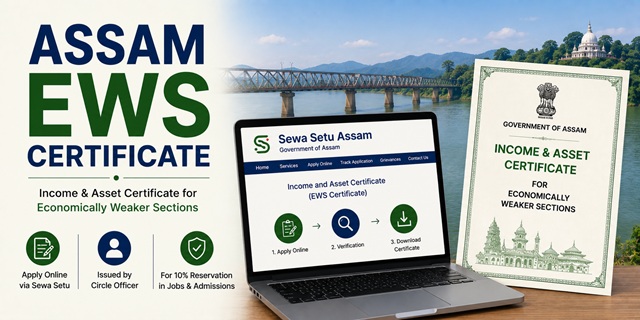
The EWS certificate in Assam is officially called the Income and Asset Certificate for Economically Weaker Sections. The official prescribed format is published by the General Administration Department of the Government of Assam and is available at gad.assam.gov.in. The certificate is issued by the Circle Officer (Revenue Circle Officer) of the revenue circle where the applicant lives.
With this certificate, eligible residents can claim 10% reservation in central and state government jobs, APSC (Assam Public Service Commission) exams, SLPRB (Assam State Level Police Recruitment Board) recruitments, IITs, NITs, central universities, NEET All India Quota seats, and various state government welfare schemes.
Applications are submitted through the Sewa Setu portal at sewasetu.assam.gov.in, through CSC centres, or offline at the nearest Circle Office. The official EWS certificate format and income and asset declaration form are available for download from gad.assam.gov.in under Public Utility Forms.
Eligibility Criteria: Assam Uses Bigha, Not Acres
Assam's EWS eligibility criteria use the local land measurement unit Bigha instead of the standard acres and square yards used in other states. The Government of Assam revised and relaxed the asset limits in 2022 through an official notification. The current eligibility conditions are:
- You must be a permanent resident of Assam and belong to the general (unreserved) category.
- You must not belong to SC, ST, OBC, or MOBC (More Other Backward Classes) categories. MOBC is an Assam-specific classification for communities included in the state OBC list but with additional welfare provisions
- Your family's gross annual income from all sources must be below Rs. 8 lakh for the financial year preceding the year of application. Income includes salary, agriculture, business, profession, and any other source
- Your family must not own 30 bighas of agricultural land or more in rural areas (revised from the earlier 15 bighas)
- Your family must not own 2 bighas of residential land or more in rural areas (revised from the earlier 1 bigha)
- Your family must not own 8,640 sq ft of land or more in notified Municipal Corporation, Municipal Board, or Town Committee areas (revised from the earlier 4,320 sq ft)
- Your family must not own a house with built-up area of 2,000 sq ft or more in notified Municipal Corporation, Municipal Board, or Town Committee areas (revised from the earlier 1,000 sq ft)
Income is always calculated on a gross basis for the financial year prior to the year of application. "Family" includes the applicant, parents, spouse, children below 18 years, and unmarried siblings below 18 years. Property held by family members in different locations is clubbed together when checking land and property limits.
The revised criteria (2022) significantly increased the asset thresholds, making more families eligible than before. The earlier limits of 15 bighas agricultural, 1 bigha residential, and 1,000 sq ft built-up area have all been doubled or more.
MOBC: Assam's Unique Backward Class Category
Assam uses MOBC (More Other Backward Classes) as a separate state-level classification in addition to the standard OBC. MOBC communities are communities that appear in the Assam state OBC list and receive additional welfare provisions from the state government. If you belong to any community classified as MOBC in Assam, you are not eligible for the EWS certificate. Check the Assam government's list of OBC and MOBC communities if you are unsure about your community's classification.
Documents Required
Keep the following documents ready before applying. All documents must be in PDF or JPEG format for online upload:
- Aadhaar Card of the applicant
- Voter ID Card (EPIC card) as identity and residence proof
- PRC (Permanent Residence Certificate) of Assam. The PRC establishes permanent residency in Assam and is a required document for the EWS application. Apply for a PRC through Sewa Setu if you do not have one
- Income proof: Salary certificate from employer for salaried persons; Income Tax Returns; or a self-declaration of income for agricultural workers and self-employed persons
- Chitha and Jamabandi: Assam's primary land records maintained by the Revenue Department. Chitha records the landowner's name and plot details. Jamabandi is the record of land revenue and rights. These are needed to verify agricultural land and residential land held by family members. Obtain them from the Circle Office or through the online land records portal. If no land is owned, submit a self-declaration
- Khajna receipt: The land revenue payment receipt in Assam. This is also accepted as evidence of land possession. Submit the most recent Khajna receipt for any agricultural or residential land held
- Property documents: Sale deed or property tax receipt showing area of any built-up property owned by family members in municipal areas. If no property is owned, include this in the self-declaration
- Passport-size photograph of the applicant
- Self-declaration stating total family income from all sources is below Rs. 8 lakh and that asset limits are not exceeded
Method 1: Apply Online Through Sewa Setu Portal
- Go to sewasetu.assam.gov.in
- Click Login or Register at the top right corner of the homepage. Click the Citizen button from the dropdown
- If you are a new user, click New User? on the login page. Register by entering your name, mobile number, email ID, and password. Verify your mobile number via OTP. Your account is created
- Log in using your mobile number, username, or Aadhaar or PAN card linked credentials
- On the Sewa Setu dashboard, click My Account at the top right, then click My Applications
- Click on Citizen Services. A list of all services available on the portal appears
- Search for Income and Asset Certificate for EWS or scroll through the Revenue and Disaster Management Department services
- Click on the service to open the application form
- Fill in the application form with your personal details: name, father's name, address, district, circle, village, and mobile number
- Fill in income details: enter gross income from all sources separately for all family members for the previous financial year
- Fill in asset details: enter agricultural land held in Bighas, residential land in Bighas or Kathas, and built-up area in sq ft for all family members. Declare nil if no land or property is owned
- Upload all required documents including the PRC, Chitha and Jamabandi (or Khajna receipt), income proof, and Aadhaar card
- Upload your passport-size photograph
- Pay the applicable processing fee online. The Income Certificate fee on Sewa Setu is Rs. 30. Confirm the exact fee displayed on the portal at the time of submission as EWS fees may vary slightly
- Submit the application. An acknowledgement number is generated. Save this number. An SMS is sent to your registered mobile
- The application goes to the Circle Officer of your revenue circle for verification and approval
- Once the Circle Officer approves the certificate, log in to the Sewa Setu portal, go to My Applications, and download the digitally signed certificate
Method 2: Apply Through CSC (Common Service Centre)
- Locate your nearest CSC centre. CSC centres are available across all 35 districts of Assam at block and panchayat levels
- Carry your Aadhaar card, Voter ID, PRC, income proof, Chitha and Jamabandi or Khajna receipt (if land is owned), and passport-size photograph
- Tell the CSC operator you need the Income and Asset Certificate for EWS
- The operator logs into the Sewa Setu portal and fills the application form on your behalf
- Documents are scanned and uploaded. Photograph is uploaded
- Pay the government fee plus the CSC operator's service charge. Collect the printed acknowledgement receipt with your application number
- You receive SMS updates on your registered mobile as the application moves through verification stages
- Once approved, return to the CSC to collect a printout or download the certificate from the Sewa Setu portal using your application number
Method 3: Apply Offline at the Circle Office
- Visit the Circle Office in your revenue circle. Every district in Assam is divided into revenue circles, each headed by a Circle Officer. The Circle Office is where the Circle Officer operates
- Collect the EWS Income and Asset Certificate application form from the counter. The form is also available for download from the General Administration Department website at gad.assam.gov.in under Public Utility Forms
- Fill in the application form with your complete details including family income from all sources and land or property details of all family members. The form must be filled in English or Assamese as per the format prescribed by GAD Assam
- Attach photocopies of all required documents: Aadhaar card, Voter ID, PRC, income proof, Chitha and Jamabandi or Khajna receipt (if applicable), and passport-size photograph
- Submit the completed form at the Circle Office counter
- The Circle Office staff registers your application and gives you an acknowledgement receipt
- The Circle Officer verifies the documents and income and asset declarations. A verification process involving the Mouzadar (revenue official at the Mouza level) and a local inquiry may be conducted within 2 weeks of receipt of the application
- The verification report is submitted to the Circle Officer who reviews the documents and the field report, then approves or rejects the application
- Once issued, collect the certificate from the Circle Office or download it from the Sewa Setu portal if the application was entered into the system
Verification Process in Assam
After application submission, the following steps take place:
- The application is scrutinised by the Circle Office staff for completeness
- A verification date is notified to the applicant within 2 weeks of receipt of the application. The applicant must appear for verification of family income and community status on the specified date
- The Mouzadar (the revenue official at the Mouza level, below the Circle Officer) may also conduct a field verification of land records through Chitha and Jamabandi
- The verification report is sent to the Circle Officer who issues the final certificate after scrutinising the report and supporting documents
Application Fee
The processing fee for certificates through the Sewa Setu portal is Rs. 30 for most revenue certificate services including the income and EWS-related applications. Confirm the exact fee displayed on the portal at the time of submission as fees may vary. If applying through a CSC, the operator adds a service charge over the government fee. If applying offline at the Circle Office, confirm any applicable charges at the counter.
Processing Time
The EWS certificate in Assam is typically issued within 15 to 30 working days of application submission. The actual time depends on the Mouzadar's field verification and the workload at the Circle Office. Applications with complete and consistent documents are processed faster. The applicant must appear for verification on the date notified by the Circle Office within 2 weeks of application receipt, failing which the application may be delayed.
Validity of the EWS Certificate in Assam
The EWS certificate is valid for one financial year (April 1 to March 31). It must be renewed every year by applying fresh. For APSC, SLPRB, and other state exams, always check the specific notification for validity requirements at document verification. For NEET counselling in June or July, apply for a fresh certificate after April 1 of that year.
How to Track Application Status
- Go to sewasetu.assam.gov.in
- Log in using your credentials
- Click My Account at the top right, then click My Applications
- Click on Citizen Services
- Your submitted application and its current status are displayed in the list
వ్యాఖ్యానించండి