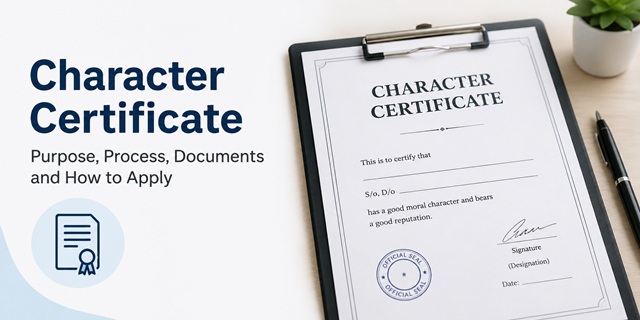
A Character Certificate in India is an official document that certifies that a person bears a reputable character and has no known adverse antecedents that make them unsuitable for a specific purpose such as government employment, educational admission, professional training, contractual engagement, licensing, or other official requirements. Depending on the purpose, the certificate may be issued by a Gazetted Officer, educational institution, employer, or a police authority. The certificate serves as a formal confirmation of an individual's conduct, reputation, and suitability for the purpose for which it is being sought.
The Central Government Attestation Form (Annexure II) used in various government recruitment processes defines a Character Certificate as a declaration by an authorized signatory stating that they have personally known the applicant for a specified period, generally not less than six months, and that the applicant bears a good moral character. The signatory must also certify that they are not related to the applicant and that they are unaware of any circumstance that would render the individual unsuitable for government service. This format continues to be used in several recruitment and verification procedures conducted by Central and State Government departments.
It is important to understand that a Character Certificate is not always the same as a Police Clearance Certificate (PCC). Many applicants use these terms interchangeably, but they serve different purposes. A Character Certificate is generally used within India for employment, admissions, scholarships, internships, apprenticeships, armed forces recruitment, and other domestic purposes. A Police Clearance Certificate, on the other hand, is issued after police verification and is commonly required for immigration, long-term visas, foreign employment, permanent residency applications, and other overseas requirements.
Character certificates are required for a wide range of purposes across India. Government departments frequently ask for them during recruitment and service verification. Educational institutions may require them at the time of admission or hostel allotment. Certain licensing authorities, armed forces recruitment boards, police organizations, courts, and public sector undertakings may also request character verification as part of their selection or approval process. Because the issuing authority and procedure differ from one purpose to another, applicants should always verify the specific requirement mentioned in the notification, admission brochure, recruitment advertisement, or official instructions.
Broadly speaking, there are two common routes through which a Character Certificate is obtained. The first is a certificate issued by a Gazetted Officer or other competent authority who personally knows the applicant and can certify their conduct. The second is a Police Character Certificate issued after verification by the local police authorities. Understanding which type is required can save applicants considerable time and prevent rejection of their application at a later stage.
Character Certificate: Quick Overview
| Document Name | Character Certificate |
| Purpose | Character and conduct verification |
| Issued By | Gazetted Officer, SDM, DM, Educational Institution, or other competent authority |
| Application Mode | Online or Offline (State-specific) |
| Processing Time | Varies by State |
| Validity | Generally 3 to 6 months (as required by the requesting authority) |
Two Types of Character Certificates in India
Although different organizations may use different formats, most character verification requirements in India fall into one of the following two categories:
1. Character Certificate Issued by a Gazetted Officer or Competent Authority
This is the most commonly requested form of character certificate for government job applications, educational admissions, scholarships, training programs, and various administrative purposes. It is issued by a Gazetted Officer or another competent authority who personally knows the applicant and is willing to certify their character and conduct.
Under the Central Government Attestation Form (Annexure II), the certificate is issued by an individual who has known the applicant personally for a specified period, usually not less than six months. The signatory certifies that the applicant bears a reputable character, has maintained good conduct to the best of their knowledge, and has no known antecedents that would make them unsuitable for government employment. The person issuing the certificate must not be related to the applicant.
Depending on the specific requirement, the following authorities may be accepted as competent signatories:
- Gazetted Officers of Central or State Government
- Members of Parliament (MPs)
- Members of State Legislative Assemblies or Councils (MLAs/MLCs)
- Revenue Officers
- Principals or Heads of Educational Institutions (where permitted)
- Other authorities specifically mentioned in recruitment or admission guidelines
This type of certificate is generally based on personal knowledge of the applicant rather than a formal police investigation. Therefore, applicants should carefully check the instructions issued by the concerned department to ensure that a Gazetted Officer certificate is acceptable for their purpose.
2. Police Character Certificate (Police Verification Certificate)
A Police Character Certificate is issued by the local police authorities after verification of the applicant's identity, residential address, and available police records. This certificate carries greater evidentiary value because it is based on official verification conducted by the police department rather than personal knowledge of the applicant.
Police Character Certificates are commonly required for:
- Armed Forces recruitment
- Applications for arms licences
- Security guard and private security agency registrations
- Contractual engagements involving sensitive duties
- Certain government recruitments requiring police verification
- Court-related and legal proceedings
- State-specific licensing and registration requirements
The application process varies from state to state. Some states provide dedicated online systems for applying and tracking Police Character Certificates, while others continue to process applications through local police stations, Superintendent of Police (SP) offices, or district police units.
For example, Maharashtra provides online Police Clearance and Character Verification services through its official portal. Several other states have integrated police verification services into their citizen service portals, e-District platforms, or state police websites. Where online services are not available, applicants generally need to submit a physical application at the concerned police station or district police office.
Because many recruitment notices use terms such as Character Certificate, Police Verification Certificate, Police Character Certificate, and Police Clearance Certificate, applicants should carefully read the exact wording used in the official notification before applying. Submitting the wrong type of certificate is one of the most common reasons for document verification delays and rejections.
Who Can Issue a Character Certificate
The authority that can issue a Character Certificate depends on the purpose for which the certificate is required. Different government departments, educational institutions, recruitment agencies, and licensing authorities may prescribe their own list of acceptable signatories. Therefore, applicants should always check the specific instructions mentioned in the recruitment notification, admission prospectus, application form, or official guidelines before obtaining a certificate.
For Central Government recruitment and verification purposes, the Attestation Form (Annexure II) recognizes several categories of public officials and authorities who can certify an applicant's character. These authorities issue the certificate based on their personal knowledge of the applicant and their conduct.
Authorities Commonly Authorized to Issue a Character Certificate
- Gazetted Officers of the Central Government or any State Government
- Members of Parliament (MPs) belonging to the constituency where the applicant or their parent or guardian ordinarily resides
- Members of State Legislature (MLAs or MLCs) belonging to the constituency where the applicant or their parent or guardian ordinarily resides
- Sub-Divisional Magistrates (SDMs) or Sub-Divisional Officers (SDOs)
- Tehsildars, Naib Tehsildars, and Deputy Tehsildars authorized to exercise magisterial powers
- Principal, Head Master, or Head of Institution of a recognized school, college, university, or educational institution where the applicant last studied
- Post Masters
- Panchayat Inspectors
In many educational admissions, the certificate issued by the Principal or Head of the last attended institution is generally accepted. For government employment, however, recruitment authorities may specifically require a certificate from a Gazetted Officer or another designated authority. Applicants should therefore verify the requirement before approaching a signatory.
Authorities Commonly Accepted for Higher-Level Verification
In cases involving district-level verification, licensing, court matters, sensitive appointments, or special administrative requirements, authorities may seek certification from senior government officials. Commonly accepted authorities include:
- Class-I Gazetted Officers
- Police Officers not below the rank of Station House Officer (SHO)
- Revenue Officers not below the rank of Tehsildar
- District-level administrative officers authorized by the State Government
- Chief Medical Officers (CMOs) of Government Hospitals where permitted
Some states also issue officially verified Character Certificates through District Magistrate offices, Police Departments, Citizen Service Centres, e-District portals, or State Police portals. In such cases, the certificate is generated after verification of the applicant's identity, address, and background records.
Important Conditions for the Issuing Authority
Regardless of who signs the certificate, certain conditions generally apply:
- The issuing authority should have personally known the applicant for a reasonable period, typically not less than six months.
- The signatory must not be related to the applicant.
- The certificate should be issued in the prescribed format, wherever a format has been specified.
- The authority should be able to certify the applicant's conduct and reputation to the best of their knowledge.
- False certification may attract disciplinary or legal consequences for the issuing authority.
Applicants should avoid obtaining a certificate from a person who does not genuinely know them, as some departments may conduct independent verification during document scrutiny or police verification.
When is a Character Certificate Required
A Character Certificate is one of the most commonly requested verification documents in India. It is used to establish that an applicant has maintained good conduct and does not have any known adverse background that would affect their eligibility for a particular opportunity, licence, appointment, or benefit.
The requirement varies depending on the organization, but the following are some of the most common situations where a Character Certificate may be required:
- Central Government Recruitment: Many Central Government departments require character verification documents as part of the attestation and appointment process.
- State Government Recruitment: State Public Service Commissions, subordinate service selection boards, police departments, education departments, and other government agencies frequently require Character Certificates during document verification.
- College and University Admissions: Educational institutions often ask for a Character Certificate issued by the Principal or Head of the institution last attended to assess the student's conduct and disciplinary record.
- Hostel Admissions: Residential schools, colleges, universities, and hostels may require a Character Certificate before allotting accommodation.
- Scholarship Applications: Certain scholarships, fellowships, and educational assistance programmes may ask for character verification documents.
- Armed Forces Recruitment: Recruitment processes for the Indian Army, Indian Navy, Indian Air Force, Coast Guard, and various paramilitary organizations may require Character Certificates as part of pre-enrolment verification.
- Police and Security Services: Security guard licensing, private security agency registration, and security-related employment often require Police Character Certificates.
- Arms Licence Applications: Character verification forms an important part of the arms licence approval process under the Arms Act and related rules.
- Contractual Government Engagements: Certain government contracts, outsourced positions, and consultancy assignments may require character verification before appointment.
- Court and Legal Proceedings: Courts may occasionally require character-related documents in matters involving employment disputes, guardianship, licensing, or other legal proceedings.
- Professional Courses and Training Programmes: Nursing institutions, teacher training programmes, skill development courses, and other professional education providers may request Character Certificates during admission.
- Visa and Immigration Requirements: Some foreign authorities may request a local Character Certificate in addition to, or separate from, a Police Clearance Certificate depending on the visa category and destination country.
- Tenant, Employee, and Contractor Verification: In certain situations, employers, housing societies, and institutions may request police-verified character documents before granting access or engagement.
One of the most common mistakes applicants make is assuming that every organization accepts the same type of Character Certificate. Some institutions accept a certificate issued by a Gazetted Officer or Principal, while others specifically require a Police Character Certificate issued after police verification. Therefore, applicants should carefully read the exact document requirement before applying.
How to Apply for a Character Certificate
Today, most State Governments provide Character Certificate services through their e-District portals, Citizen Service Portals, ServicePlus portals, Jan Seva portals, Lok Seva portals, e-Sevai portals, or similar online government service platforms. In states where online services are not available, applications can usually be submitted through the District Magistrate office, Sub-Divisional Magistrate office, Tehsil office, CSC centre, or other notified government offices.
Although the portal name and issuing authority may vary from one state to another, the application process remains broadly similar across India.
Step-by-Step Character Certificate Application Process
- Visit the official government portal or citizen service centre that provides Character Certificate services in your state.
- Select the Character Certificate service and create an account if registration is required.
- Fill in the application form with your personal details, residential address, date of birth, and the purpose for which the certificate is required.
- Upload the required documents such as identity proof, address proof, photograph, and any additional documents specified by the issuing authority.
- Pay the prescribed application fee, if applicable in your state.
- Submit the application and note down the acknowledgement or application reference number.
- The concerned authority verifies the information provided in the application. Depending on the state's rules, verification may include document verification, local inquiry, or verification through the police department.
- After successful verification, the competent authority approves the application and issues the Character Certificate.
- You can download the certificate online or collect the physical copy from the designated office, depending on the system followed in your state.
Who Issues the Character Certificate
The issuing authority varies across states and departments. Character Certificates are commonly issued by:
- Sub-Divisional Magistrate (SDM)
- Sub-Divisional Officer (SDO)
- District Magistrate (DM)
- Additional District Magistrate (ADM)
- Tehsildar or Executive Magistrate
- Other authorities notified by the respective State Government
In many states, the applicant submits the application online, while the verification is carried out by the concerned authorities before the certificate is finally approved and issued by the designated issuing authority.
Processing Time
The processing time depends on the state government's rules and the type of verification involved. In most cases, Character Certificates are issued within a few days to a few weeks after successful verification of the application.
Documents Required for a Character Certificate
The documents required for obtaining a Character Certificate may vary depending on the issuing authority, the purpose of the certificate, and the rules followed by the concerned State Government. However, the following documents are commonly required in most cases:
- Completed Character Certificate application form or written application
- Aadhaar Card, Voter ID Card, PAN Card, Passport, or any other valid photo identity proof
- Proof of current residential address
- Recent passport-size photographs
- Proof of date of birth, if specifically requested
- Educational documents when the certificate is required for admission, scholarship, or recruitment purposes
- Copy of the recruitment notice, admission letter, joining letter, or any document showing the purpose for which the certificate is being obtained
- Any additional documents prescribed by the issuing authority
In some states, applicants may also be required to submit a self-declaration or affidavit regarding their identity, address, and purpose of application. Where verification by the police department is part of the process, additional documents may be requested by the concerned authority.
Validity of a Character Certificate
There is no single nationwide validity period prescribed for Character Certificates in India. The authority requesting the certificate decides how recent the document should be.
In practice, most government departments, educational institutions, employers, and recruiting agencies prefer a Character Certificate that has been issued recently, often within the previous three to six months. Therefore, applicants should always check the specific requirements mentioned in the recruitment notification, admission prospectus, or official instructions.
Character Certificate vs Police Clearance Certificate (PCC)
Many people use the terms Character Certificate and Police Clearance Certificate interchangeably, but they serve different purposes.
| Parameter | Character Certificate | Police Clearance Certificate (PCC) |
|---|---|---|
| Purpose | Domestic use such as admissions, recruitment, scholarships, licensing, and government services | International purposes such as employment abroad, immigration, long-term visa, or foreign residency |
| Issuing Authority | Competent authority notified by the State Government, educational institution, or authorized officer | Passport Seva system under the Ministry of External Affairs after police verification |
| Passport Required | No | Yes |
| Primary Use | Character and conduct verification within India | Verification for foreign governments and overseas employers |
If an employer, university, government department, or licensing authority specifically asks for a Character Certificate, applicants should submit a Character Certificate and not assume that a PCC will automatically satisfy the requirement.
వ్యాఖ్యానించండి