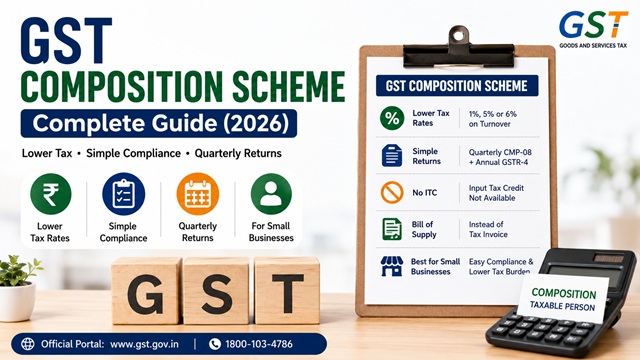
This scheme is mainly designed for small traders, manufacturers, restaurants, and certain service providers who want simpler compliance and fewer GST return filings.
Under the Composition Scheme, businesses pay tax quarterly, file fewer returns, and avoid complex invoice-level GST calculations. However, they also face important restrictions such as no Input Tax Credit (ITC), no inter-state sales, and no tax invoice issuance.
Many taxpayers remain confused about who can opt for the Composition Scheme, whether service providers are eligible, how Form CMP-02 works, what happens if turnover exceeds the limit, and whether Amazon or Flipkart selling is allowed.
This guide explains the complete GST Composition Scheme process according to the latest 2026 GST rules, including eligibility, tax rates, turnover limits, CMP-02 application, CMP-04 withdrawal, return filing, restrictions, penalties, and common mistakes.
| Feature | Details |
|---|---|
| Scheme Name | GST Composition Scheme |
| Applicable Under | GST / CGST Act |
| Main Benefit | Lower tax & simplified compliance |
| Turnover Limit | ₹1.5 Crore / ₹75 Lakh / ₹50 Lakh |
| Main Forms | CMP-02, CMP-04, CMP-08, GSTR-4 |
| Return Filing | Quarterly + Annual |
| ITC Allowed? | No |
| Inter-state Sales Allowed? | No |
| Official Portal | gst.gov.in |
What is the GST Composition Scheme?
Under the regular GST system, businesses must file multiple returns every month, charge GST on every invoice, maintain detailed records, and reconcile purchases with sales. This can be complex for small businesses.
The Composition Scheme removes most of this complexity. Under it:
- You pay tax at a fixed flat rate on your total sales turnover
- You do not charge GST separately on your invoices to customers
- You pay tax quarterly and file just one annual return
- You do not need to maintain detailed GST records
- You cannot claim Input Tax Credit (ITC) on your purchases
Who Can Opt for the Composition Scheme?
Any GST-registered taxpayer whose annual aggregate turnover does not exceed the prescribed limit can opt for this scheme. The turnover limits are:
| Category | Turnover Limit |
|---|---|
| Manufacturers and traders (goods) - most states | Up to Rs. 1.5 crore per year |
| Manufacturers and traders (goods) - North-East states and Himachal Pradesh | Up to Rs. 75 lakh per year |
| Service providers (restaurants, other services) | Up to Rs. 50 lakh per year |
Important: The turnover is calculated on the basis of all GST registrations taken on the same PAN across India not just one state. So if you have two businesses under the same PAN, both are counted together for the turnover limit.
Who Cannot Opt for the Composition Scheme?
Even if your turnover is within the limit, you cannot opt for the Composition Scheme if:
- You supply goods that are exempt from GST (nil-rated goods)
- You make inter-state outward supplies of goods (selling goods to buyers in other states)
- You sell goods through e-commerce operators like Amazon, Flipkart, Meesho, who are required to collect TCS under Section 52
- You manufacture goods that are specifically notified by the Government as ineligible (like ice cream, pan masala, tobacco products, aerated water)
- You are a casual taxable person or non-resident foreign taxpayer
- You are registered as an Input Service Distributor (ISD)
- You are registered as a TDS deductor or TCS collector
- Any one GSTIN under the same PAN is registered as an SEZ Unit or SEZ Developer
Tax Rates Under the Composition Scheme
| Type of Business | GST Rate on Turnover |
|---|---|
| Manufacturers (other than notified goods) | 1% (0.5% CGST + 0.5% SGST) |
| Traders (dealers in goods) | 1% (0.5% CGST + 0.5% SGST) |
| Restaurants not serving alcohol | 5% (2.5% CGST + 2.5% SGST) |
| Service providers (other than restaurants) | 6% (3% CGST + 3% SGST) |
These rates are applied to your total turnover, not to individual invoices. You pay this fixed amount quarterly.
Key Restrictions Under the Composition Scheme
The Composition Scheme comes with important restrictions you must understand before opting in:
- No ITC: You cannot claim Input Tax Credit on any purchases. Whatever GST you pay on raw materials, goods, or services, you cannot get it back.
- No tax invoice: You cannot issue a tax invoice to your customers. You must issue a Bill of Supply instead. This means your business customers cannot claim ITC based on purchases from you.
- No inter-state supply: You cannot sell goods to customers in other states. You can only make intra-state supplies (within your own state).
- Must display ‘Composition Taxable Person’: Every Bill of Supply you issue must mention “Composition Taxable Person, not eligible to collect tax on supplies”.
- No e-commerce selling: You cannot sell on platforms like Amazon or Flipkart where TCS is collected.
Can Composition Taxpayers Purchase Goods From Other States?
Yes. Composition taxpayers can purchase goods from suppliers located in other states.
The restriction under the Composition Scheme mainly applies to outward taxable supplies (sales) made by the composition taxpayer.
In simple terms:
- Inter-state purchases: Allowed
- Inter-state sales: Not allowed
Many taxpayers incorrectly assume that interstate purchases are banned under the Composition Scheme, but the restriction primarily applies to interstate outward supplies.
Can Composition Dealers Issue GST Tax Invoice?
No. Composition taxpayers cannot issue a normal GST tax invoice because they are not allowed to collect GST separately from customers.
Instead, they must issue a Bill of Supply.
| Document | Used By | ITC Available to Buyer? |
|---|---|---|
| Tax Invoice | Regular GST taxpayers | Yes |
| Bill of Supply | Composition taxpayers | No |
Every Bill of Supply issued by a Composition taxpayer must mention:
"Composition Taxable Person, not eligible to collect tax on supplies."
Returns to be Filed Under the Composition Scheme
One of the biggest advantages of the Composition Scheme is the simplified return filing:
| Return | Purpose | Frequency |
|---|---|---|
| Form GST CMP-08 | Statement of payment of self-assessed tax. You declare your total turnover and pay tax. | Quarterly (every 3 months) |
| Form GSTR-4 | Annual return for composition taxpayers. Summary of all quarterly payments made during the year. | Once a year |
Compare this to a regular GST taxpayer who files GSTR-1 and GSTR-3B every month, that is 24 returns per year versus just 5 for a composition taxpayer (4 CMP-08 + 1 GSTR-4).
How to Opt In to the Composition Scheme
There are two situations, one for new GST registrations and one for existing registered taxpayers.
For New Taxpayers (At the Time of Registration)
If you are registering for GST for the first time and want to opt for the Composition Scheme from the start:
- Go to www.gst.gov.in.
- Go to Services > Registration > New Registration.
- In the registration form (Form GST REG-01), on the Business Details tab, select Yes for the option “Are you opting for Composition?”.
- Complete the remaining registration steps.
- Your registration will be as a Composition taxpayer from the start.
For Existing Regular Taxpayers (Switching to Composition)
If you are already registered as a regular GST taxpayer and want to switch to the Composition Scheme, you must apply before the start of the financial year using Form GST CMP-02:
- Log in to www.gst.gov.in.
- Go to Services > Registration > Application to Opt for Composition Levy.
- The Application to Opt for Composition Levy page is displayed. Your GSTIN, legal name, trade name, address, and jurisdiction are auto-populated.
- Select the Category of Registered Person (Manufacturer, Trader, Restaurant, or Service provider).
- Select the Composition and Verification Declaration checkbox.
- Select the Authorised Signatory from the dropdown and enter the Place.
- Click Save.
- Submit using DSC or EVC (OTP on registered mobile and email).
- A success message is displayed. You will receive an acknowledgement within 15 minutes at your registered email and mobile.
Important deadline: Existing regular taxpayers must file Form CMP-02 before the start of the financial year (i.e., before 1st April) for which they want the Composition Scheme to apply. The portal checks your previous year’s Annual Aggregate Turnover (AATO) before allowing the application. If your AATO exceeds the limit, the system will block the submission.
Stock Intimation After Opting In (Form ITC-03)
After opting for the Composition Scheme, you must file a Stock Intimation in Form ITC-03 within 60 days from the date you opted for Composition Levy. This form declares the details of stock held by you on the day before the Composition Scheme took effect. The ITC on that stock must be reversed (paid back) since you can no longer claim ITC as a Composition taxpayer.
How to Opt Out of the Composition Scheme
You can withdraw from the Composition Scheme at any time during the year voluntarily, or the system will prompt you to withdraw if your turnover exceeds the prescribed limit. The withdrawal is done using Form GST CMP-04:
- Log in to www.gst.gov.in.
- Go to Services > Registration > Application for Withdrawal from Composition Levy.
- Select the Date from which withdrawal is sought. This date cannot be before the date you opted in.
- Select the Reason for withdrawal from the dropdown.
- Select the verification checkbox, choose the Authorised Signatory, and enter the Place.
- Click Save.
- Submit using DSC or EVC.
- The application is auto-approved immediately. You receive an ARN confirmation within 15 minutes on your registered email and mobile.
- After withdrawal, your taxpayer type changes back to Regular and you have access to all regular GST returns.
After withdrawal: You can file Form GST ITC-01 to claim ITC on the stock of inputs, semi-finished goods, finished goods, and capital goods held on the date of withdrawal.
Composition Scheme for Restaurants
Restaurants not serving alcohol can opt for the Composition Scheme and pay GST at 5% of turnover (2.5% CGST + 2.5% SGST).
This option is commonly used by small local restaurants, cafes, food counters, and takeaway businesses because compliance becomes simpler compared to regular GST.
However, composition restaurants:
- Cannot claim Input Tax Credit (ITC)
- Cannot issue GST tax invoices
- Cannot collect GST separately from customers
- Cannot supply alcohol under Composition Scheme rules
If the restaurant mainly serves business customers who require ITC invoices, regular GST registration may be more suitable.
Composition Scheme vs Regular GST - Quick Comparison
| Feature | Composition Scheme | Regular GST |
|---|---|---|
| Tax rate | Fixed flat rate (1%, 5%, or 6% on turnover) | Applicable GST rate on each supply (0%, 5%, 18%, 40%) |
| Input Tax Credit | Not available | Available |
| Invoice type | Bill of Supply (no tax invoice) | Tax Invoice |
| Returns per year | 5 (4 quarterly CMP-08 + 1 annual GSTR-4) | 24+ (monthly GSTR-1 and GSTR-3B) |
| Inter-state sales | Not allowed | Allowed |
| e-commerce selling | Not allowed (where TCS applies) | Allowed |
| Compliance burden | Low | High |
| Best for | Small local businesses with intra-state sales | All businesses, especially those with ITC benefits or interstate sales |
Official Portals and Useful Links
- GST Portal - gst.gov.in (Opt in/out of Composition Scheme)
- Official Manual - Opt for Composition Levy CMP-02 (tutorial.gst.gov.in)
- Official FAQ - Composition Scheme (tutorial.gst.gov.in)
- Official Manual - Withdrawal from Composition Levy CMP-04 (tutorial.gst.gov.in)
GST Helpdesk: 18001034786
Disclaimer: This article is for informational purposes only. Fees, rates, and procedures are subject to change by CBIC and GSTN. Always refer to gst.gov.in for the latest official information.
Add new comment