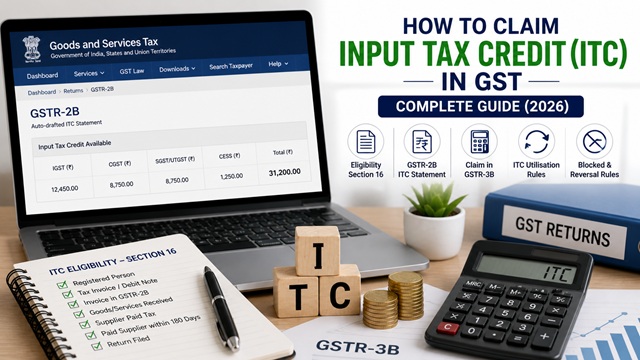
Input Tax Credit (ITC) is the mechanism under GST that allows a registered business to reduce its output GST liability by the GST it already paid on its purchases. In simple words, you do not pay GST twice on the same goods or services.
For example, if you paid Rs. 180 as GST on raw materials purchased, and you collected Rs. 360 as GST on your finished goods sold, you only need to pay Rs. 180 to the government. The Rs. 180 already paid on purchases is your Input Tax Credit.
This guide covers the complete rules, eligibility conditions, step-by-step process to claim ITC, reversal rules, and blocked credits - all sourced from the CGST Act and official GST portal manuals.
What is Input Tax Credit (ITC)?
As per Section 16 of the CGST Act, 2017 (sourced from taxinformation.cbic.gov.in), every registered person is entitled to take credit of input tax charged on any supply of goods or services or both to them, which are used or intended to be used in the course or furtherance of their business.
ITC can be claimed on:
- Inputs (raw materials and consumables used in production)
- Input services (services used in business)
- Capital goods (plant, machinery, equipment used in business)
Why Input Tax Credit is Important
- Reduces overall tax liability.
- Prevents double taxation.
- Improves business cash flow.
- Ensures compliance with GST rules.
Conditions to Be Eligible to Claim ITC - Section 16
As per Section 16(2) of the CGST Act, 2017, all of the following four conditions must be met before you can claim ITC on any invoice:
- You must be a registered taxpayer: ITC can only be claimed by a person registered under GST.
- You must have a tax invoice or debit note: You must hold a valid tax invoice issued by a GST-registered supplier, a debit note, or a Bill of Entry (for imports).
- The invoice must appear in your GSTR-2B: As per Section 16(2)(aa) inserted by the Finance Act 2021, the supplier must have filed their GSTR-1 and the invoice details must be communicated to you through Form GSTR-2B. You cannot claim ITC for invoices that do not appear in your GSTR-2B.
- You must have received the goods or services: The goods must have been physically delivered to you or the services must have been received. For goods delivered in instalments, ITC can be claimed only after the last instalment is received.
- Tax must have been paid to the government by the supplier: The supplier must have actually paid the GST to the government. If the supplier has collected GST on their invoice but not deposited it, you may still be able to claim ITC, subject to certain conditions, but it may be reversed later.
- You must have paid the supplier within 180 days: If you have not paid your supplier the invoice value plus tax within 180 days from the invoice date, the ITC must be reversed proportionately. This is governed by Rule 37 (see Section 7 below).
- You must have filed your GST return: ITC can be claimed only in the GSTR-3B return for the relevant period.
ITC Utilisation Rules - Which Credit Can Be Used for Which Tax?
As per Section 49 of the CGST Act and the official GST tutorial portal, ITC must be utilised in a specific order. You cannot mix credit types freely.
| Credit Available | Can Be Used To Pay | Cannot Be Used To Pay |
|---|---|---|
| IGST Credit | IGST first, then CGST, then SGST/UTGST | No restriction - can pay all three |
| CGST Credit | CGST first, then IGST | Cannot pay SGST or UTGST |
| SGST / UTGST Credit | SGST/UTGST first, then IGST | Cannot pay CGST |
Key rule: IGST credit is the most flexible and should be utilised first before CGST or SGST credit is used to pay IGST. CGST and SGST credits cannot be used to pay each other.
How to Claim ITC - Step by Step via GSTR-2B and GSTR-3B
ITC is claimed every month or quarter in Form GSTR-3B. The amount is taken from your auto-drafted Form GSTR-2B. Here is the complete process:
- Log in to the GST portal at www.gst.gov.in.
- Go to Services > Returns > Returns Dashboard. Select the financial year and tax period.
- Click on the GSTR-2B tile to view your auto-drafted ITC statement. Check all invoices reflected against your GSTIN.
- Reconcile GSTR-2B with your own purchase records and books of accounts. Ensure every invoice in GSTR-2B matches your internal records.
- Identify invoices that are in your records but not in GSTR-2B. This means your supplier has not filed their GSTR-1 yet. You cannot claim ITC on these invoices in the current period - wait for the next month when the supplier files.
- Open Form GSTR-3B from the Returns Dashboard.
- In Table 4 - Eligible ITC of GSTR-3B, fill in the ITC amounts broken down by:
- 4(A)(1) - Import of goods
- 4(A)(2) - Import of services (reverse charge)
- 4(A)(3) - Inward supplies liable to reverse charge (other than above)
- 4(A)(4) - Inward supplies from ISD (Input Service Distributor)
- 4(A)(5) - All other ITC (normal B2B purchases from registered suppliers)
- In Table 4(B) - ITC Reversed, enter any reversals applicable for the period (non-payment to supplier beyond 180 days, exempt supply use, etc.).
- In Table 4(D) - Ineligible ITC, enter ITC that is blocked under Section 17(5) and any other ineligible credits. This is for reporting only and must not be included in Table 4(A).
- The net eligible ITC is auto-calculated. This credit is available in your Electronic Credit Ledger for offsetting your output tax liability.
- File GSTR-3B using DSC or EVC after paying any remaining cash liability.
What is GSTR-2B and How Does It Help Claim ITC?
As per the official GST portal FAQ at tutorial.gst.gov.in, Form GSTR-2B is an auto-drafted, static, read-only ITC statement generated for every registered taxpayer on the basis of:
- Invoices, credit notes, and debit notes filed by your suppliers in their GSTR-1 / GSTR-1A / GSTR-5
- ITC received through GSTR-6 (from Input Service Distributors)
- Import of goods data from ICEGATE (customs system), including supplies from SEZ units and developers
Key facts about GSTR-2B:
As per the official GSTR-2B FAQ at tutorial.gst.gov.in, GSTR-2B for each month is generated on the 14th day of the succeeding month. For example, GSTR-2B for July is generated on 14th August and made available to taxpayers on that date.
- It is generated on the basis of cut-off dates. For monthly GSTR-1 filers, GSTR-2B for month M includes all documents filed by suppliers from 00:00 hours on the 12th of month M to 23:59 hours on the 11th of the succeeding month. For quarterly GSTR-1/IFF filers, the cut-off runs from the 14th of the relevant month to the 13th of the succeeding month.
- GSTR-2B is static and read-only. You cannot edit it or add documents to it.
- It shows ITC availability as Yes or No against each document.
- ITC is shown as No in two specific cases: (a) when the invoice is time-barred under Section 16(4), (b) when the supplier and place of supply are in the same state but you are in a different state (a cross-charge issue).
- You can download GSTR-2B in Excel or JSON format from the portal.
- If a Bill of Entry (import) is missing from GSTR-2B, you can fetch it from ICEGATE using the self-service functionality provided by GSTN on the portal.
How to access GSTR-2B: Log in to the GST portal > Services > Returns > Returns Dashboard > File Returns > GSTR-2B tile.
Blocked Credits - ITC You Cannot Claim (Section 17(5))
As per Section 17(5) of the CGST Act, 2017 (sourced from taxinformation.cbic.gov.in), ITC is completely blocked on the following categories. These are called blocked credits and must be reported in Table 4(D) of GSTR-3B, but cannot be used:
| Category | ITC Blocked | Exceptions (ITC available if) |
|---|---|---|
| Motor vehicles for transportation of persons (capacity not more than 13 persons including driver) | Yes - blocked | If used for: further supply of such vehicles, transportation of passengers, imparting driving training, or for businesses where it is the stock in trade |
| Vessels and aircraft | Yes - blocked | If used for further supply, transportation of passengers or goods, or as stock in trade |
| Services of general insurance, servicing, repair and maintenance of the above vehicles/vessels/aircraft | Yes - blocked | Same exceptions as above |
| Food and beverages, outdoor catering, beauty treatment, health services, cosmetic and plastic surgery | Yes - blocked | If the inward supply of goods or services is used to make an outward taxable supply of the same category or as an element of a composite or mixed supply |
| Membership of a club, health and fitness centre | Yes - blocked | No exception |
| Rent-a-cab, life insurance, health insurance | Yes - blocked | If the government notifies it as obligatory for an employer, or if used to make an outward taxable supply of the same category |
| Travel benefits to employees (leave or home travel concession) | Yes - blocked | No exception |
| Works contract services for construction of immovable property (other than plant and machinery) | Yes - blocked | If the input service is used for further supply of works contract service |
| Goods or services received for construction of immovable property on own account | Yes - blocked | Plant and machinery is excepted |
| Goods or services on which the composition taxpayer has paid tax | Yes - blocked | No exception |
| Goods or services used for personal consumption | Yes - blocked | No exception |
| Goods lost, stolen, destroyed, written off, or given as gifts or free samples | Yes - blocked | No exception |
ITC Reversal If Supplier Not Paid Within 180 Days (Rule 37)
As per Rule 37 of the CGST Rules (sourced from taxinformation.cbic.gov.in), if you have claimed ITC on an invoice but have not paid your supplier the invoice value plus tax within 180 days from the date of the invoice, you must reverse the ITC proportionate to the unpaid amount.
Key points on Rule 37
- The reversal must be made in the GSTR-3B for the tax period immediately following the 180 days.
- Interest at 18% per annum is payable on the reversed ITC amount from the date the ITC was originally claimed.
- Once you make the payment to the supplier after the reversal, you can reclaim the ITC in the return period in which the payment is made.
- This rule does not apply to reverse charge transactions (where you pay the tax directly to the government).
- Supplies made without monetary consideration as specified in Schedule I of the CGST Act are deemed paid for this rule.
ITC Reversal for Exempt and Non-Business Use (Rules 42 and 43)
If your business makes both taxable and exempt supplies, or uses inputs for both business and personal purposes, you must reverse a proportionate amount of ITC. This is governed by Rules 42 and 43 of the CGST Rules.
Rule 42 - Reversal for inputs and input services
- ITC must be reversed proportionately on inputs and input services used for exempt supplies or for non-business purposes.
- The calculation involves identifying the total ITC, splitting it into: ITC for taxable supplies, ITC for exempt supplies, ITC for non-business use, and common ITC.
- The common ITC is apportioned based on the ratio of exempt turnover to total turnover for the financial year.
- The final reversal is calculated annually by September of the following financial year and adjusted in GSTR-3B.
Rule 43 - Reversal for capital goods
- For capital goods used for both taxable and exempt supplies, ITC reversal is calculated over five years (60 months).
- Each month, a proportionate reversal is made based on the ratio of exempt turnover.
ITC on Stock Held Before GST Registration (Section 18)
As per Section 18 of the CGST Act, a newly registered person or a person who becomes liable to pay GST and applies for registration within 30 days can claim ITC on:
- Inputs (goods) held in stock and semi-finished or finished goods using such inputs on the day immediately preceding the date of registration
- Capital goods on the day immediately preceding the date of registration
This claim is made using Form GST ITC-01 on the GST portal within 30 days of becoming eligible. If the claim exceeds Rs. 2 lakh, a certificate from a Chartered Accountant or Cost Accountant must be uploaded.
Time Limit to Claim ITC
As per Section 16(4) of the CGST Act, ITC on an invoice can be claimed only up to the earlier of:
- The due date for filing the GSTR-3B for the month of November following the end of the financial year in which the invoice was issued, or
- The date of furnishing the relevant Annual Return (GSTR-9)
In simple words: for invoices of FY 2025-26, the last date to claim ITC is the due date of filing October 2026 GSTR-3B (i.e. November 20, 2026) or the date GSTR-9 for FY 2025-26 is filed, whichever is earlier.
Important: Any invoice that is time-barred under Section 16(4) is shown as ITC Not Available in GSTR-2B. You cannot claim such ITC even if the invoice appears in GSTR-2B.
How to Check ITC Comparison Report on GST Portal
The GST portal provides a Tax Liability and ITC Comparison Report that shows you whether the ITC you claimed in GSTR-3B matches the ITC that accrued to you in GSTR-2B. This helps identify discrepancies before a tax officer flags them.
How to access
- Log in to the GST portal at www.gst.gov.in.
- Go to Services > Returns > Tax Liabilities and ITC Comparison.
- Select the Financial Year and click SEARCH.
- The Credit and Liability Statement page appears with five comparison reports.
- Click the DOWNLOAD COMPARISON REPORT (EXCEL) button to download all reports.
The five comparison reports are
- Tax Liability and ITC Statement (Summary)
- Tax Liability other than export and reverse charge
- Tax Liability due to reverse charge
- Tax Liability due to export and SEZ supplies
- Input Tax Credit claimed and due (other than import of goods)
- Input Tax Credit claimed and due (import of goods)
Any values highlighted in red indicate that you claimed more ITC in GSTR-3B than what accrued in GSTR-2B. These must be reviewed and either justified or reversed to avoid notices.
January 2026 Update - Hard Block on Excess ITC Claims
From January 2026, the GST portal now blocks your GSTR-3B filing if the ITC you try to claim in Table 4(A) exceeds the ITC available in your GSTR-2B. Earlier, the portal would only display a warning message but still allow filing.
What this means for you:
- If your supplier has not filed their GSTR-1 by the cut-off date, their invoice will not appear in your GSTR-2B and you cannot claim that ITC in the current return period.
- You will need to wait until the following month when the supplier files their GSTR-1, at which point the invoice will appear in the next GSTR-2B.
- This makes timely GSTR-1 filing by your suppliers critical for your own ITC claims.
- Always reconcile your purchase register with GSTR-2B before filing GSTR-3B to avoid the portal blocking your return.
GST Helpdesk: 1800-103-4786 (as listed on gst.gov.in)
Disclaimer: This article is for informational purposes only. All rules and procedures are subject to change by GSTN, CBIC, and the Government of India. Always refer to gst.gov.in and taxinformation.cbic.gov.in for the latest official information.
Add new comment