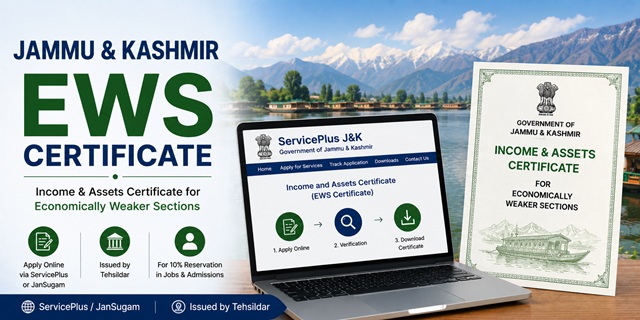
The EWS Certificate in Jammu and Kashmir is officially called the Income and Assets Certificate for Economically Weaker Sections. Jammu and Kashmir is a Union Territory (UT) since October 2019, and the certificate is issued by the Revenue Department, Government of the Union Territory of Jammu and Kashmir, through the Tehsildar of the concerned Tehsil where the applicant resides.
With this certificate, eligible general category residents can claim 10% reservation in central government jobs, JKSSB (Jammu and Kashmir Services Selection Board) recruitments, JKPSC (Jammu and Kashmir Public Service Commission) exams, IITs, NITs, central universities, NEET All India Quota seats, and various UT government welfare schemes and educational admissions.
Applications are submitted through the J&K ServicePlus portal at serviceonline.gov.in/jammu, through the JanSugam portal at jansugam.jk.gov.in, through Common Service Centres (CSCs) across all 20 districts of J&K, or offline at the nearest Tehsil office. The official J&K government portal for forms and revenue services is jkrevenue.nic.in.
Eligibility Criteria
To be eligible for an EWS certificate in Jammu and Kashmir, all of the following conditions must be satisfied:
- You must be a permanent resident of Jammu and Kashmir with a valid domicile. You must belong to the general (unreserved) category and must not belong to SC, ST, OBC (RBA/ALC/OSC in J&K terminology), or any other reserved category
- Your family's gross annual income from all sources must be below Rs. 8 lakh for the financial year preceding the year of application. Income includes salary, agriculture, business, profession, income from buildings and land, and any other source
- Your family must not own 5 acres of agricultural land or more
- Your family must not own a residential flat of 1,000 sq ft or more
- Your family must not own a residential plot of 100 sq yards or more in a notified municipality
- Your family must not own a residential plot of 200 sq yards or more outside notified municipalities
All four asset conditions must be satisfied alongside the income condition. Income is always calculated on a gross basis. "Family" includes the applicant, parents, spouse, children below 18 years, and unmarried siblings below 18 years.
J&K-Specific Reserved Categories
Jammu and Kashmir uses different terminology for its backward class categories compared to other states and the central government. The reserved categories in J&K include SC, ST, and the following UT-specific categories:
- RBA (Residents of Backward Areas): Reserved for people residing in designated backward areas of J&K
- ALC (Actual Line of Control area residents): Reserved for residents of areas near the Line of Control
- OSC (Other Special Category): Includes weak and under-privileged classes, physically challenged, and children of defence personnel, ex-servicemen, and state police personnel
- PSP (Pahari Speaking People): A category for Pahari-speaking communities
If you belong to any of these UT-specific categories or to any other reserved category in J&K, you are not eligible for the EWS certificate. EWS is only for general category residents not covered under any of the above reserved categories.
Unique J&K Land Documents: Jamabandi and Chulla
Jammu and Kashmir uses unique land and household records that are different from other states. These are mandatory for the EWS application:
- Jamabandi (also spelled Jumabandi or Jamabandi): J&K's primary land ownership document maintained by the Patwari (called Halqa Patwari in J&K). The Jamabandi shows the owner's name, Khasra number, and area of agricultural land. It is the basis for verifying agricultural land holdings for EWS eligibility
- Chulla Abstract: A unique document in J&K. "Chulla" literally means a household hearth and is used as a unit to measure a family household in J&K's revenue system. The Chulla abstract is maintained by the Patwari and contains details of the household including family members, income sources, and basic asset information. The official Ganderbal district website lists "Chulla abstracts with details" as a required document for the EWS certificate, making it a J&K-specific requirement not found in any other state in India
Both the Jamabandi abstract and Chulla abstract must be prepared by the Patwari and authenticated by the Tehsildar before being submitted with the EWS application. These cannot be self-declared. The Patwari prepares these documents based on the revenue records maintained at the Halqa (circle) level.
Documents Required
The following documents are required as per the official Ganderbal district (J&K government) confirmation. Documents 3 and 4 must be prepared by the Patwari and authenticated by the Tehsildar:
- Aadhaar Card of the applicant
- Domicile Certificate of J&K (mandatory to prove permanent residency in the UT since the Domicile Law was revised in 2020)
- Abstract of Jamabandi: Land ownership record prepared by the Halqa Patwari showing agricultural land owned by the family. Must be authenticated by the Tehsildar. If no agricultural land is owned, a nil-land declaration by the Patwari is submitted
- Chulla abstract with details: Household record prepared by the Halqa Patwari showing family members and household income details. Must be authenticated by the Tehsildar
- Income details in prescribed format: Details of income from land, buildings, salaries, and all other sources for all family members in the prescribed format. This must be prepared by the Patwari and authenticated by the Tehsildar
- Income proof: Salary certificate from employer, Form 16, or Income Tax Returns for salaried persons. Self-declaration for other income sources
- Property documents: Documents showing area of any residential property owned by family members. If no property is owned, a self-declaration is submitted
- Voter ID Card (EPIC Card) as identity and residence proof
- Ration Card showing family members and J&K address
- PAN Card of the applicant and earning family members
- Passport-size photograph of the applicant
Method 1: Apply Online Through J&K ServicePlus Portal
- Go to serviceonline.gov.in/jammu (for Jammu division districts) or jansugam.jk.gov.in (the unified J&K ServicePlus portal)
- On the homepage, click Register Here if you are a new user. Enter your name, email ID, mobile number, gender, and create a password. Click Submit. Your registration is created
- Click Login on the homepage. Enter your user ID and password, and complete the captcha. Click Login
- After logging in, click Apply for Services from the left menu, then click View All Available Services
- In the search field, type Income and Assets Certificate for Economically Weaker Section or EWS
- Click on the service name Issuance of Income and Assets Certificate for Economically Weaker Section from the results
- The application form opens. Fill in your personal details: name, father's name, address, district, Tehsil, village or ward, and mobile number
- Fill in income details: enter gross income from all sources separately (land, buildings, salary, business, profession) for all family members. Enter total annual family income
- Fill in asset details: agricultural land held and residential property owned by all family members
- Upload all required documents within the portal's file size limits. Upload the Jamabandi abstract, Chulla abstract, income details in prescribed format (all Patwari-prepared and Tehsildar-authenticated), domicile certificate, Aadhaar, Voter ID, and passport-size photograph
- Submit the application. An Application ID is generated. Save this for tracking and downloading
- To track status: log in to jansugam.jk.gov.in, go to View Status of Application, click Track Application Status, and enter your Application ID
- Once the Tehsildar approves the certificate, log in to the portal, go to View Status of Application, click Download/Print Certificate, and download the digitally signed certificate in PDF format
Method 2: Apply Through Common Service Centre (CSC)
- Locate a nearby CSC (Common Service Centre) in your district. CSCs are available across all 20 districts of J&K. Ask at your Tehsil office or Panchayat for the nearest CSC location
- Before visiting, approach your Halqa Patwari first and request the Chulla abstract, Jamabandi abstract, and income details in prescribed format to be prepared. These documents must be ready before the application can be submitted as they are mandatory supporting documents
- Once you have the Patwari-prepared documents authenticated by the Tehsildar, visit the CSC with all required documents including domicile certificate, Aadhaar, Voter ID, income proof, and passport-size photograph
- Tell the CSC operator you need the EWS Income and Assets Certificate
- The operator logs into the ServicePlus portal and fills the application form on your behalf. Documents are scanned and uploaded
- Pay the government fee plus the CSC operator's service charge. Collect the printed acknowledgement with your Application ID
- You receive SMS updates on your registered mobile as the application moves through the Tehsildar's verification process
- Once approved, return to the CSC to collect a printed certificate or download it from the portal using your Application ID
Method 3: Apply Offline at the Tehsil Office
- First approach your Halqa Patwari (the revenue official at the Halqa or circle level) for your village or area. Request the Patwari to prepare the Chulla abstract, Jamabandi abstract, and income details in prescribed format for your household. The Patwari prepares these from the revenue records. Get these documents authenticated by the Tehsildar
- Once the Patwari-prepared documents are ready and authenticated, visit the Tehsil office for your area
- Obtain the EWS Income and Assets Certificate application form from the Tehsil office counter. Application forms are also available at jk.gov.in under the forms section
- Fill in all details in the application form including family income from all sources and land or property details
- Attach photocopies of all required documents: Chulla abstract, Jamabandi abstract, income details in prescribed format, domicile certificate, Aadhaar, Voter ID, ration card, income proof, property documents (if any), and passport-size photograph
- Submit the completed form with all attachments at the Tehsil office receiving counter. Provide your mobile number for SMS alerts
- The Tehsil office registers the application. The Tehsildar reviews all documents including the Patwari-prepared abstracts
- After verification, the Tehsildar issues the certificate. You are notified by SMS. Collect the certificate from the Tehsil office
Role of the Halqa Patwari in J&K EWS Process
The Halqa Patwari plays a more central role in the J&K EWS process than Patwaris in other states. Unlike states where the Patwari only does field verification after application submission, in J&K the Patwari must prepare the Chulla abstract, Jamabandi abstract, and income details in prescribed format before the application is even submitted. These documents form the basis of the EWS application. This means you must approach the Halqa Patwari first, before going to the portal or the Tehsil office. The Patwari's documents must then be authenticated by the Tehsildar before being used in the application.
Application Fee
The J&K ServicePlus portal does not charge a government fee for most revenue certificates. The EWS certificate is issued free of charge by the Tehsildar. If applying through a CSC, the operator charges a nominal service fee. Confirm the fee at the CSC before submitting. For offline applications at the Tehsil office, confirm any applicable fees at the counter.
Processing Time
The time limit for the EWS Income and Assets Certificate in Jammu and Kashmir is 30 days from the date of complete application submission. This is confirmed from the official Ganderbal district website of J&K government. Under the J&K Public Services Guarantee Act, certificates must be issued within the stipulated timeframe. If the certificate is not issued within 30 days, you can approach the First Appellate Authority or use the J&K ServicePlus grievance mechanism.
Validity of the EWS Certificate in J&K
The EWS certificate is valid for one financial year (April 1 to March 31). It must be renewed every year by applying fresh. For JKSSB and JKPSC exam document verification, always check the specific notification for validity requirements. For NEET and JEE counselling in June or July, apply for a fresh certificate after April 1 of that year.
How to Track Application Status
- Go to jansugam.jk.gov.in
- Log in with your credentials
- Click on View Status of Application from the left menu
- Click Track Application Status
- Enter your Application ID in the field provided and click Submit
- The current status of your application is displayed
You can also track without login by using the status check option available on the jansugam.jk.gov.in homepage. Go to jk.gov.in/jkeservices/getAppIdforStatusCheckByCitizen.action and enter your Application ID to get the current status.
Add new comment