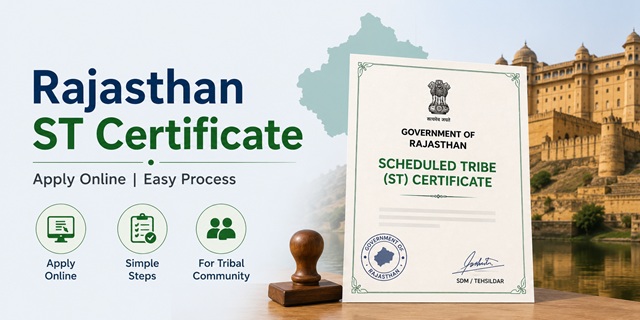
Rajasthan's tribal population is primarily concentrated in two distinct belts: the Meena communities of eastern Rajasthan spanning Jaipur, Sawai Madhopur, and Dausa districts, and the Bhil communities of the southern Rajasthan tribal tract covering Udaipur, Banswara, Dungarpur, Pratapgarh, and Rajsamand. The ST certificate process in Rajasthan uses the same eMitra and SSO platform as the SC certificate, but tribal applicants need to understand a few specific rules about their community before applying.
Scheduled Tribes Notified in Rajasthan
To obtain an ST Certificate in Rajasthan, your community must be included in the Scheduled Tribes list notified under the Constitution (Scheduled Tribes) Order, 1950. The major Scheduled Tribe communities recognised in Rajasthan are:
- Bhil Group: Bhil, Bhil Garasia, Dholi Bhil, Dungri Bhil, Dungri Garasia, Mewasi Bhil, Rawal Bhil, Tadvi Bhil, Bhagalia, Bhilala, Pawra, Vasava, and Vasave.
- Bhil Mina: Bhil Mina.
- Damor Group: Damor and Damaria.
- Dhanka Group: Dhanka, Tadvi, Tetaria, and Valvi.
- Garasia Group: Garasia (excluding Rajput Garasia).
- Kathodi Group: Kathodi, Katkari, Dhor Kathodi, Dhor Katkari, Son Kathodi, and Son Katkari.
- Kokna Group: Kokna, Kokni, Kukna, Koli Dhor, Tokre Koli, Kolcha, and Kolgha.
- Mina (Meena): Mina.
- Naikda Group: Naikda, Nayaka, Cholivala Nayaka, Kapadia Nayaka, Mota Nayaka, and Nana Nayaka.
- Other Notified Tribes: Patelia and Sahariya (also known as Seharia and Sehria).
Mina (commonly known as Meena) is the largest Scheduled Tribe community in Rajasthan and is mainly concentrated in eastern districts such as Jaipur, Dausa, Sawai Madhopur, Tonk, and Alwar. Bhil communities form the second-largest tribal group and are primarily found in southern Rajasthan, including Udaipur, Banswara, Dungarpur, Pratapgarh, and Rajsamand districts.
Garasia is another important tribal community found mainly in Sirohi, Pali, and Udaipur districts. However, the Rajasthan ST notification specifically excludes Rajput Garasia from Scheduled Tribe status.
Two Important Rules Before You Apply
Garasia: Rajput Garasia Is Excluded
The official notification specifically lists Garasia as ST but explicitly excludes Rajput Garasia. If your family identity is Rajput Garasia, you are not eligible for the ST certificate under the Rajasthan notification. Only Garasia communities not identified as Rajput Garasia are covered. If you are applying as Garasia, ensure your community does not fall under the Rajput Garasia sub-group before submitting your application.
No Religion Restriction for ST
Unlike the SC certificate in Rajasthan (which applies only to people of Hindu, Buddhist, or Sikh faith), the ST certificate has no religion restriction. A Bhil, Meena, or any other tribal community member can apply for the ST certificate regardless of their religion.
Sahariya: Rajasthan's Particularly Vulnerable Tribal Group
The Sahariya (also listed as Seharia and Sehria) community is classified as a Particularly Vulnerable Tribal Group (PVTG) in Rajasthan. The Sahariya population is concentrated primarily in the Baran district, particularly in the Shahabad and Kishanganj tehsils. They represent one of the most economically and socially marginalised tribal communities in Rajasthan.
Sahariya community members are eligible for all standard ST benefits plus additional targeted PVTG support programs. An ST certificate is the primary document to access both standard ST benefits and PVTG-specific schemes.
Issuing Authority
The ST Jati Praman Patra in Rajasthan is issued by the Tehsildar or Sub-Divisional Magistrate (SDM) under the Revenue Department. The Patwari conducts field verification before the Tehsildar approves and issues the certificate.
Documents Required
- Aadhaar Card
- Jan Aadhaar card (Rajasthan's family ID, required for eMitra services)
- Proof of tribal identity: old ST certificate of father or grandfather, school record showing tribal community, or any government document showing your tribe name
- Ration Card
- Rajasthan Domicile Certificate (Mool Niwas Praman Patra)
- Birth certificate or school leaving certificate
- Passport-size photograph
How to Apply for ST Certificate in Rajasthan
Rajasthan allows applicants to apply for an ST Certificate either online through the eMitra portal using an SSO ID or by visiting the nearest eMitra Kiosk. Before starting the application, keep your Jan Aadhaar Card, Aadhaar Card, and tribal community documents ready.
Method 1: Apply Online Through eMitra Portal (SSO Login)
If you have internet access and basic computer knowledge, you can apply for the ST Certificate from home through Rajasthan's official eMitra platform.
- Visit the Rajasthan SSO Portal at sso.rajasthan.gov.in.
- If you do not already have an SSO ID, create one using your Aadhaar number, Jan Aadhaar number, or mobile number.
- After logging in, open the eMitra service from your SSO dashboard.
- Search for Jati Praman Patra (Caste Certificate) under Revenue Department services.
- Select Anusuchit Janjati (ST) as the certificate category.
- Enter your personal details, Jan Aadhaar number, Aadhaar number, address, and family information exactly as recorded in your government documents.
- Type your tribe name carefully. It should match the name notified in the Rajasthan Scheduled Tribe list. For example, applicants from the Meena community should enter "Mina", as this is the spelling used in the official notification.
- Upload scanned copies of the required documents, including identity proof, residence proof, and tribal community proof.
- Check all information carefully and click Submit.
- Save or print the application reference number generated by the system. You will need this number to track your application status later.
- The concerned Patwari verifies your tribal community, residence details, and supporting records at the local level.
- After successful verification, the application is forwarded to the Tehsildar or SDM for approval.
- Once approved, log in to your SSO account and download the digitally signed ST Certificate.
Tip: Make sure your Jan Aadhaar details and application details match exactly. Differences in name spelling, address, or family records can delay approval.
Method 2: Apply Through eMitra Kiosk
If you are not comfortable applying online yourself, visit the nearest eMitra Kiosk. This is the most popular option in rural and tribal areas of Rajasthan because the kiosk operator completes the application process on your behalf.
- Visit the nearest eMitra centre with your Jan Aadhaar Card, Aadhaar Card, photograph, and tribal community documents.
- Provide your documents to the eMitra operator and verify all details before submission.
- The operator fills out the application form and uploads the required documents through the official eMitra system.
- Pay the applicable service charge and collect the acknowledgement receipt.
- Keep the receipt safely because it contains your application reference number.
- The Patwari conducts local verification and submits a report to the Tehsildar or SDM.
- After approval, you can download the certificate online through your SSO account or obtain a printed copy from the eMitra centre.
Note: eMitra centres are available across Rajasthan, including villages, panchayats, towns, and district headquarters, making them the preferred option for many applicants from Bhil, Meena, Garasia, and Sahariya communities.
Benefits of ST Certificate in Rajasthan
- Reservation in Rajasthan state government jobs under the ST quota
- 7.5% reservation in central government jobs and central educational institutions nationally
- Reserved seats in government medical, engineering, and professional colleges in Rajasthan
- Pre-matric and post-matric tribal scholarships through the National Scholarship Portal
- 5 years age relaxation in RPSC, Rajasthan Police, and central competitive examinations
- Access to Anuprati Coaching for free competitive exam preparation
- Additional PVTG support for Sahariya community in Baran district
- Forest Rights entitlements for tribal families in forest areas under the Forest Rights Act 2006
- Access to schemes under the Ministry of Tribal Affairs
নতুন কমেন্ট যুক্ত করুন