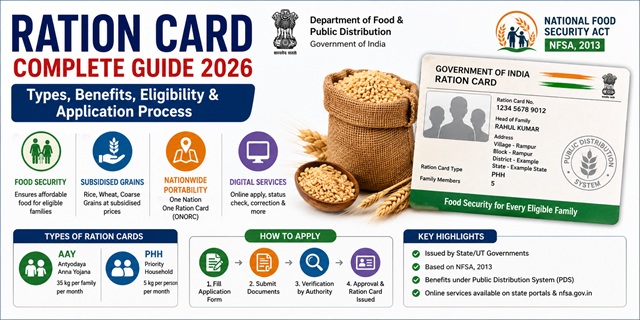
A ration card is an official document issued by state governments in India that entitles eligible households to receive subsidised food grains through the Public Distribution System (PDS). It is one of the most important welfare documents in India, serving crores of families across the country. Beyond food grains, a ration card also works as a valid proof of identity and address for many government services.
Ration cards in India are governed by the National Food Security Act, 2013 (NFSA) at the central level. The Department of Food and Public Distribution under the Ministry of Consumer Affairs, Food and Public Distribution manages the overall system. The official central portal is nfsa.gov.in, managed by the National Informatics Centre (NIC).
What is the Public Distribution System (PDS)?
The Public Distribution System is the government mechanism through which subsidised food grains are distributed to eligible families across India. The system works under the joint responsibility of the Central Government and the State/UT Governments.
The Central Government, through the Food Corporation of India (FCI), handles procurement, storage, transportation, and bulk allocation of food grains to state governments. The operational responsibility including allocation within the state, identification of eligible families, issuance of ration cards, and supervision of fair price shops rests with state governments.
Types of Ration Cards in India
Under the National Food Security Act, 2013, there are two main categories of ration cards:
| Type | Full Name | Who Gets It | Monthly Entitlement |
|---|---|---|---|
| AAY | Antyodaya Anna Yojana | Poorest of the poor households. Includes landless agricultural labourers, marginal farmers, rural artisans, daily wage earners, homeless persons, widows with no support, elderly without income, and similar categories. | 35 kg of food grains per family per month, regardless of family size. At highly subsidised rates. |
| PHH | Priority Household | Low-income families who do not fall under AAY but are eligible under NFSA. Identified by state governments based on socio-economic criteria. | 5 kg per person per month at subsidised prices. |
Additionally, many states also issue a third category for families above the poverty line who are not covered under NFSA but need a ration card as identity proof. This is commonly called the Non-Priority Household (NPHH) or APL (Above Poverty Line) card. These cards may receive limited or no food subsidies depending on the state.
Who is Not Eligible for a Ration Card?
Eligibility rules differ across states, but families may be excluded from NFSA benefits if they fall under exclusion categories notified by the state government.
Common exclusion categories may include:
- Income tax payers
- Government employees above specified grades
- Families owning large land holdings
- Households with high-income commercial assets
- Families already covered under another ration card
Exact eligibility and exclusion rules vary from state to state.
Subsidised Food Grain Prices Under NFSA
Under the National Food Security Act and the Pradhan Mantri Garib Kalyan Anna Yojana (PMGKAY), the Central Government has made food grains available at heavily subsidised or free rates to NFSA beneficiaries. The entitlements and prices are set by the Central Government and confirmed on nfsa.gov.in:
- AAY households: 35 kg of food grains per family per month
- PHH households: 5 kg per person per month
- Under PMGKAY, free food grains are provided to NFSA beneficiaries. Check the current status on dfpd.gov.in as this scheme is periodically extended by the government.
NFSA Coverage Across India
The National Food Security Act covers up to 75% of the rural population and 50% of the urban population across India. This translates to approximately 81 crore beneficiaries nationwide. The exact number of beneficiaries in each state is determined by the Census-based allocation set by the Central Government.
Who is Eligible for a Ration Card?
Eligibility for a ration card is determined by each state government within the overall NFSA framework. However, the general national-level criteria are:
- Must be an Indian citizen
- Must be a resident of the state where applying
- The family must not already hold a ration card in any state in India
- For AAY cards: must belong to the poorest households as identified by the state government
- For PHH cards: must fall within the income and social criteria set by the state government
Each state sets its own income limits, social criteria, and exclusion conditions. For example, families owning a four-wheeler, paying income tax, or having a member employed in a government job may be excluded in many states. Check your state’s food department portal for the exact criteria.
One Nation One Ration Card (ONORC)
The One Nation One Ration Card scheme is one of the most significant reforms in the PDS system. It allows any NFSA beneficiary to purchase their entitled food grains from any Fair Price Shop (FPS) anywhere in India, not just in their home state.
This is particularly beneficial for migrant workers who move to other states for work. They can now access their ration entitlement in the state they are working in without having to go back to their home state or transfer their card.
All 36 states and union territories are covered under ONORC. Purchases are made through biometric authentication (fingerprint or iris scan) at the FPS using an ePoS (electronic Point of Sale) machine. The system is linked to Aadhaar.
Aadhaar Linking with Ration Card
The Central Government has made Aadhaar linking mandatory for all ration card holders to ensure accurate identification, eliminate duplicate and ghost beneficiaries, and enable the ONORC system. Every member of a household must have their Aadhaar linked and e-KYC completed to continue receiving ration benefits without interruption.
Ration Card e-KYC
e-KYC (electronic Know Your Customer) is a digital verification process under which all ration card members must verify their Aadhaar-linked identity. This is done through biometric verification at the nearest Fair Price Shop using the ePoS machine. Failure to complete e-KYC can lead to suspension of ration benefits.
How to Apply for a Ration Card
Ration card issuance is a state subject. There is no single central portal for applying. Each state has its own food department portal where new applications, member additions, corrections, and status checks are handled.
However, the general process common across most states is:
- Visit your state’s food department portal (links provided in the table below)
- Register and log in or visit the nearest Common Service Centre (CSC)
- Fill the ration card application form with family details
- Upload required documents: identity proof, address proof, and Aadhaar details of all family members
- Submit and note down the acknowledgement number for status tracking
- A field verification by the Food Inspector may be conducted
- After approval, the ration card is issued and linked to a nearby Fair Price Shop
For state-specific detailed guides, refer to the state-wise article links below.
All State Ration Card Portals
All state portal links are also available on the official NFSA portal at https://nfsa.gov.in/portal/Ration_Card_State_Portals_AA.
| State | Food Department Portal |
|---|---|
| Uttar Pradesh | fcs.up.gov.in |
| Bihar | epds.bihar.gov.in |
| Madhya Pradesh | rationmitra.nic.in |
| Rajasthan | food.rajasthan.gov.in |
| Maharashtra | mahafood.gov.in |
| Uttarakhand | fcs.uk.gov.in |
| West Bengal | wbpds.wb.gov.in |
| Jharkhand | aahar.jharkhand.gov.in |
| Gujarat | ipds.gujarat.gov.in |
| Haryana | epds.haryanafood.gov.in |
| Karnataka | ahara.kar.nic.in |
| Tamil Nadu | tnpds.gov.in |
| Andhra Pradesh | ap.meeseva.gov.in |
| Telangana | epds.telangana.gov.in |
| Punjab | epos.punjab.gov.in |
| Delhi | nfs.delhi.gov.in |
Can a Ration Card Be Used as Address Proof?
Yes. In many situations, ration cards are accepted as proof of address for government and non-government services.
However, acceptance depends on the institution and the specific verification rules applicable there.
Some organisations may require additional identity proof along with the ration card.
Official Portals and Useful Links
- National Food Security Act Portal - nfsa.gov.in
- Department of Food and Public Distribution - dfpd.gov.in
- All State Ration Card Portals - nfsa.gov.in
- Public Distribution System Information - nfsa.gov.in
- Integrated Management of PDS - impds.nic.in
Central Government Food Helpline: 1967 (Toll-free, as listed on dfpd.gov.in)
Disclaimer: This article is for informational purposes only. Ration card eligibility, entitlements, and processes are governed by central and state governments and are subject to change. Always refer to nfsa.gov.in and your state food department portal for the latest official information.
नवी प्रतिक्रिया द्या