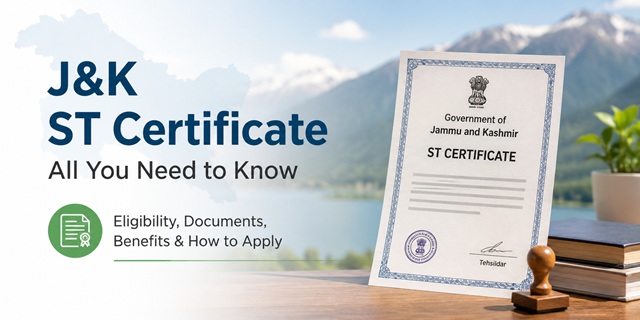
An ST Certificate in Jammu and Kashmir is an official government document issued to members of Scheduled Tribe communities notified for the Union Territory. It serves as proof of your tribal community and enables you to claim reservation benefits in government jobs, educational institutions, scholarships, welfare schemes, and other benefits available to Scheduled Tribe applicants under the applicable laws.
In Jammu and Kashmir, the certificate is issued by the Tehsildar under the provisions of the Jammu and Kashmir Reservation Act, 2004. Eligible applicants can submit their application online through the official JanSugam Portal, visit the concerned Tehsil office, or apply through an authorised Common Service Centre (CSC/Kiosk). Once approved, the certificate can be downloaded online from the portal.
Jammu and Kashmir became a Union Territory on 31 October 2019 following the implementation of the Jammu and Kashmir Reorganisation Act, 2019. Accordingly, Scheduled Tribe certificates are issued for the Union Territory based on the communities notified under the applicable Constitutional Orders and subsequent amendments.
Who Can Apply for a Jammu and Kashmir ST Certificate?
You can apply for a Scheduled Tribe (ST) Certificate in Jammu and Kashmir if you fulfil the eligibility conditions prescribed under the applicable reservation laws and the Revenue Department's guidelines.
- You must be a bonafide resident of the Union Territory of Jammu and Kashmir.
- Your community should be included in the Constitution (Jammu and Kashmir) Scheduled Tribes Order, 1989 (C.O. 78), as amended from time to time.
- There is no religion-based restriction for obtaining an ST Certificate in Jammu and Kashmir. However, the applicant must belong to a community officially notified as a Scheduled Tribe for the Union Territory.
- You should be able to establish your Scheduled Tribe status through your family lineage or other supporting documents accepted by the competent authority during verification.
List of Scheduled Tribe Communities in Jammu and Kashmir
The following communities are recognised as Scheduled Tribes for the Union Territory of Jammu and Kashmir under the Constitution (Jammu and Kashmir) Scheduled Tribes Order, 1989 (C.O. 78), as amended. These communities are eligible to apply for an ST Certificate in Jammu and Kashmir, subject to fulfilment of the prescribed conditions.
- Bakarwal (including Gujjar)
- Gaddi
- Garra
- Sippi
- Pahari Ethnic Group (included through the 2024 amendment)
- Padari Tribe (included through the 2024 amendment)
- Koli (included through the 2024 amendment)
- Gadda Brahmin (included through the 2024 amendment)
2024 Amendment to the J&K Scheduled Tribe List
The Constitution (Jammu and Kashmir) Scheduled Tribes Order (Amendment) Act, 2024 (Act 3 of 2024), passed by Parliament in February 2024, expanded the Scheduled Tribe list for the Union Territory by including the Pahari Ethnic Group, Padari Tribe, Koli, and Gadda Brahmin.
During the passage of the amendment, the Central Government clarified that the inclusion of these newly notified communities would not reduce the existing reservation benefits available to communities that were already recognised as Scheduled Tribes in Jammu and Kashmir, including the Bakarwal and Gujjar communities.
Benefits of a Jammu and Kashmir ST Certificate
A valid Scheduled Tribe (ST) Certificate allows eligible applicants to claim reservation and other benefits available under the applicable laws of the Union Territory of Jammu and Kashmir and the Government of India.
- Reservation in government employment: Eligible ST candidates can avail reservation in direct recruitment to government posts under the Jammu and Kashmir Reservation Act, 2004 and the rules framed thereunder.
- Reservation in educational institutions: The certificate can be used to claim reserved seats in government educational institutions and other institutions wherever reservation for Scheduled Tribe candidates is applicable.
- Age relaxation in recruitment: Eligible candidates may receive upper age relaxation in government recruitment, subject to the recruitment rules and conditions prescribed by the concerned authority.
- Scholarship benefits: ST students can apply for eligible Pre-Matric, Post-Matric and other scholarship schemes, including those available through the National Scholarship Portal (NSP), subject to the scheme guidelines.
- Fee concessions: Eligible students may receive tuition fee concessions, examination fee waivers or other educational benefits wherever provided under the applicable rules.
- Benefits under Central Government schemes: The certificate issued by the competent authority in Jammu and Kashmir can be used wherever a valid Scheduled Tribe certificate is accepted under the applicable Central Government rules.
- Access to tribal welfare programmes: Eligible beneficiaries may avail themselves of welfare schemes implemented by the Ministry of Tribal Affairs, the Jammu and Kashmir Administration, and other competent authorities, subject to the eligibility conditions of each scheme.
Documents Required for a Jammu and Kashmir ST Certificate
The competent authority may ask for documents to verify your identity, residence and Scheduled Tribe status. Depending on your case, additional documents may also be required during verification.
- Identity Proof: Aadhaar Card, Voter ID, Driving Licence, PAN Card or Passport.
- Domicile Certificate: A valid Jammu and Kashmir Domicile Certificate as proof of residence in the Union Territory.
- Address Proof: Ration Card or any other document accepted by the competent authority.
- Self-declaration or Affidavit: Wherever required by the competent authority.
- Existing ST Certificate of a Parent or Close Blood Relative: If available, it may help establish the applicant's Scheduled Tribe status during verification.
- Additional Supporting Documents: The Tehsildar may request further documents or conduct a local inquiry if considered necessary for verification.
Application Fee, Processing Time and Validity
| Particular | Details |
|---|---|
| Government Application Fee | No government application fee is prescribed for the issuance of an ST Certificate. However, Common Service Centres (CSCs/Kiosks) may charge a service fee for online assistance. |
| Processing Time | The JanSugam Portal currently displays a service delivery timeline of up to 30 days. Section 16 of the Jammu and Kashmir Reservation Act, 2004 requires the competent authority to take a decision within 15 working days after receiving a complete application. |
| Validity | An ST Certificate is generally valid for life as it is based on the applicant's community status. However, certain recruiting agencies or institutions may ask for a recently issued certificate as part of their own verification process. |
| Issuing Authority | Tehsildar of the applicant's concerned Tehsil. |
How to Apply Online for a Jammu and Kashmir ST Certificate
The Government of Jammu and Kashmir allows eligible residents to apply for a Scheduled Tribe (ST) Certificate through the official JanSugam Portal. The portal lets you submit the application online, upload supporting documents, track the application status, and download the certificate after approval.
Step 1: Visit the JanSugam Portal
Open your browser and visit the official JanSugam Portal at jansugam.jk.gov.in. This is the Government of Jammu and Kashmir's unified online platform for citizen services.
Step 2: Create an Account or Sign In
If you are a new user, click on New User Registration and create your account by entering your name, mobile number, email address, district and other required details. Verify your mobile number using the OTP received and complete the registration.
If you already have an account, simply sign in using your registered credentials.
Step 3: Search for the ST Certificate Service
After logging in, use the search box available on the dashboard and look for the service titled "Application for Issuance of Certificate for Being a Member of Scheduled Caste / Scheduled Tribe by Tehsildar." Open the service to begin your application.
Step 4: Fill in the Online Application Form
Carefully enter all the required information exactly as it appears in your official records. This generally includes:
- Name of the applicant
- Father's or mother's name
- Date of birth
- Gender
- Community name
- Religion
- Permanent address
- Contact details
Before moving to the next step, review the information to ensure there are no spelling mistakes or incorrect details.
Step 5: Upload the Required Documents
Upload clear scanned copies of all supporting documents in the format specified on the portal. Depending on your application, the system may ask for identity proof, domicile certificate, affidavit and other supporting documents required for verification.
Step 6: Review and Submit the Application
After completing the form and uploading the documents, review all the information once again. If everything is correct, submit your application through the portal.
Once the application is submitted successfully, an acknowledgement along with an Application Reference Number will be generated. Save this number carefully as it will be required to track your application.
Step 7: Verification by the Competent Authority
After submission, the application is forwarded to the concerned Tehsildar for verification. During this stage, the authority may examine your documents and, if required, conduct additional verification before taking a decision on the application.
Step 8: Download the ST Certificate
Once your application is approved, log in to the JanSugam Portal, open your application dashboard and download the digitally issued ST Certificate for future use.
How to Apply for a Jammu and Kashmir ST Certificate Through a Common Service Centre (CSC)
If you are unable to apply online yourself, you can visit the nearest authorised Common Service Centre (CSC/Kiosk).
- Carry all original documents along with photocopies.
- Provide your details to the CSC operator.
- The operator will complete and submit your application through the JanSugam Portal.
- Pay the applicable CSC service charge, if any.
- Collect the acknowledgement or application reference number for future tracking.
How to Apply Offline at the Tehsil Office
Applicants who prefer the offline method can also submit their application directly at the concerned Tehsil office.
- Obtain the prescribed application form from the Tehsil office.
- Fill in the application carefully.
- Attach photocopies of the required supporting documents.
- Submit the completed application to the concerned Tehsildar.
- The application will be verified before the certificate is issued.
How to Check the J&K ST Certificate Application Status
You can monitor the progress of your application online through the JanSugam Portal.
- Visit jansugam.jk.gov.in.
- Log in using your registered account.
- Open the My Applications section.
- Select your application to view its current status.
The portal will display whether your application is under verification, approved, or if any further action is required from your side.
Add new comment