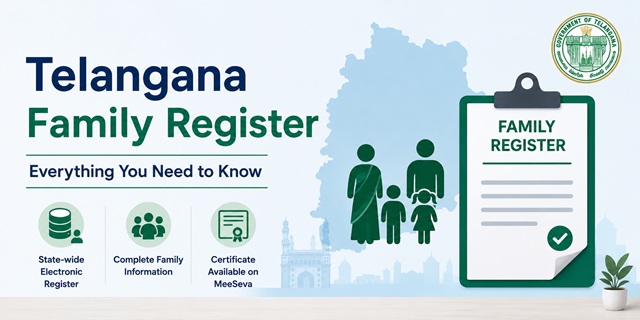
In July 2026 Telangana created something it had never had before: a single, state-wide electronic record of every family in the state.
It is called the Telangana Family Register. It is not a document you hold in your hand. It is a database, maintained by the Revenue Department, that stores who is in your family, how each person is related to the head of the household, and where you live.
The document you can hold is the Family Register Certificate, which is simply a printed copy of your family's entry in that register. If you want to apply for one, read our step by step guide on How to get the Telangana Family Register Certificate on MeeSeva.
This page is about the register itself. What data it holds, where that data comes from, who can see it, what legal weight it carries, why Telangana built it differently from every other state that has tried something similar, and what remains unclear about it.
Quick Facts
| Detail | Information |
|---|---|
| Name | Telangana Family Register |
| Created by | G.O.Ms.No. 172, Revenue (Ser.II) Department, dated 25 July 2026 |
| Issued | By order and in the name of the Governor of Telangana |
| Signed by | Lokesh Kumar D.S., Secretary to Government |
| Maintained by | Revenue Department, Government of Telangana |
| Form | Electronic, state-wide |
| Data source | Food Security Card (ration card) database of the Civil Supplies Department |
| Particulars stored | Eight, per family unit |
| Family Register Identification Number | Same as the family's ration card number |
| Certificate issued through | MeeSeva, under the Revenue Department services category |
| Approving authority for certificates | Tahsildar of the mandal |
| Access granted to ESD | Read access only |
Register or Certificate: Getting the Difference Right
These two terms get used interchangeably in news coverage, and that causes confusion. They are not the same thing.
| Telangana Family Register | Telangana Family Register Certificate | |
|---|---|---|
| What it is | A database | A document |
| Who holds it | The Revenue Department | You |
| Do you apply for it | No. Your family is in it automatically if you have a ration card. | Yes, on MeeSeva |
| Does it cost anything | No | Yes, a service charge |
| Covers | Every family in the ration card database, state-wide | Your family only |
Put simply, the register is the system and the certificate is the printout. You cannot apply to be added to the register directly. You get added by being on a ration card.
What the Register Holds: Eight Particulars
Paragraph 3 of the Government Order lists exactly what the register stores for each family unit. Eight items, no more.
1. Family Register Identification Number
This is the identifier for your family unit in the register. It is the same as your ration card number. Telangana did not generate a new number. This choice has consequences, discussed further down.
2. Name of the Head of the Family
Taken from the Food Security Card/ Ration Card. Whoever is recorded as head of the household there is head of the family here.
3. Name of each member of the family
Every person listed on the ration card appears. Anyone not on the ration card does not exist in the register.
4. Relationship of each member to the Head of the Family
Son, daughter, wife, mother and so on. This is what makes the register genuinely useful, because it maps the household rather than just listing names.
5. Age and date of birth of each member
Both are stored, not just one.
6. Gender of each member
7. Aadhaar number of each member
This is significant and deserves attention. The register does not just hold names. It holds the Aadhaar Card number of every single member of the family, linked together as a household. See the section on privacy below.
8. Present address of the family
The address is stored at a level of detail most government records do not reach. The order specifies door number, street, village or ward, gram panchayat or municipality, mandal and district.
That is a complete residential address, not a general locality. Combined with the Aadhaar numbers of all members, this makes each register entry a fairly complete household profile.
Where the Data Comes From
The register was not built by collecting fresh information from citizens. Nobody surveyed households or asked anyone to fill a form.
Paragraph 4 of the Government Order says the data population of the register is effected by electronically fetching the particulars from the Food Security Card database maintained by the Commissioner of Civil Supplies.
In other words, the Telangana Family Register is a mirror of the ration card database, restructured as a family register and placed under the Revenue Department.
Three things follow from this, and they explain almost every practical question people have:
- If you have a ration card, you are already in the register. You did nothing and you were not asked. Your family entry exists.
- If you do not have a ration card, you are not in the register at all. There is no separate way in.
- Whatever is wrong in your ration card is wrong in the register. A missing member, a misspelt name, an old address. The register inherits every error, because it is a copy.
This also means the register is only as current as the ration card database behind it. It does not learn about a birth, a death or a move on its own.
Why the ID Is the Ration Card Number
This looks like a small technical detail. It is actually the most important design decision in the whole scheme, and it is worth understanding.
Most states that have built family databases created a brand new identifier for each household. Telangana did not. It reused the ration card number as the Family Register Identification Number.
What this gains:
- Nothing new to remember. Families already know their ration card number and already have the card in hand.
- No enrolment drive. No camps, no forms, no queues, no deadline for registration. The register existed the moment the order was signed.
- Immediate coverage. Every ration card holding family in Telangana was covered on day one.
- Simple verification. The Tahsildar checks the application against the same database the number came from, so there is nothing to reconcile.
What this costs:
- Families without a ration card are excluded by design. There is no route in for them, because the identifier itself is a ration card number.
- The register inherits the ration card database's accuracy, whatever that is. It cannot be better than its source.
- Ration card status and family record status are now tied together. A problem with one becomes a problem with the other.
Privacy: Who Can See Your Family Data
Any database holding the linked Aadhaar Card numbers of an entire household deserves a careful look at who has access to it. The Government Order addresses this in a specific way.
Paragraph 17 requests the Commissioner of Civil Supplies to provide read access to the Food Security Card database to the Commissioner, Electronic Service Delivery.
The words read access matter.
- ESD can fetch and display your family's particulars. That is what makes the MeeSeva service work.
- ESD cannot change them. The Civil Supplies database remains the master record and remains under Civil Supplies control.
- Corrections stay where they belong. If your data is wrong, it has to be fixed in the ration card system. No MeeSeva operator and no Tahsildar can edit it through this service.
That last point is the one people run into. It is a limitation, but it is also a safeguard. A system where any operator could rewrite household composition would be considerably more dangerous than one where they cannot.
Who can obtain a certificate. Paragraph 9 restricts this to a member of the family whose particulars are borne in the register, and who is a major. A stranger cannot pull your family's record. A relative not on your ration card cannot either.
What the order does not spell out. It does not describe a data retention policy, an audit trail of who accessed which record, or a mechanism for a citizen to see who has viewed their family entry. This is not unusual for a government order of this kind, but it is worth noting honestly rather than assuming protections that are not stated.
The Legal Weight of the Register
This is the part that matters most, and the part most likely to be misunderstood.
Paragraph 5 of the Government Order states that the register, and any certificate issued from it, is a record of the composition of the family as reflected in the source database. It then says the record:
- shall not, by itself, confer, create, extinguish or determine any right, title or interest in any property
- nor shall it be construed as a determination of legal heirship
- does not confer any right for any claim for benefit under government schemes
Reading that carefully
"By itself" is doing real work in that sentence. The order is not saying the certificate is worthless in a property or heirship matter. It is saying the certificate alone settles nothing. It can sit alongside other evidence. It cannot stand in place of it.
Four verbs, not one. The order says the record shall not confer, create, extinguish or determine any right. That is deliberately wide. It closes off the argument that the certificate might quietly remove someone's claim by leaving them off a list, just as firmly as it closes off the argument that it creates a claim.
Legal heirship is named separately. The drafters clearly anticipated that a document listing family members would be waved around as proof of who inherits. They ruled it out by name. If you need heirship established, you need a legal heir certificate or a succession certificate. Those are different documents with different processes.
Scheme benefits are ruled out too. Being on the register does not qualify you for anything. Each scheme has its own eligibility rules. The certificate can help you prove family composition when a scheme asks for it, which is useful, but it does not decide the outcome.
So what is it good for
Exactly what the order says it is for. A single, uniform, authenticated record of who is in your family, digitally signed by a Tahsildar, that you can produce whenever an office needs family details verified, instead of assembling different documents for each office.
That is a genuine convenience. It is just not a title deed.
A Warning About the MeeSeva Description
If you look up this service on MeeSeva, you will read a description that contradicts the Government Order in three places. Anyone relying on the portal text will form the wrong idea of what they are holding.
| What the MeeSeva description says | What G.O.Ms.No. 172 says |
|---|---|
| Refers to it as a "surviving member certificate" | Shall not be construed as a determination of legal heirship |
| Says it testifies household member status "for varied legal purposes" | Shall not by itself confer, create, extinguish or determine any right, title or interest in any property |
| Says validity is limited and it must be renewed or regenerated after expiry | Prescribes no validity period and no renewal requirement anywhere |
| Says it can be obtained by uploading supporting documents | Requires only the Food Security Card number, with particulars fetched automatically |
Why this has happened. The language reads like text carried over from the older Family Membership Certificate service, which sits in the same Revenue list on MeeSeva. Both services appear in the same dropdown, and the description for the new one appears not to have been rewritten.
What to do about it. Where the portal description and the Government Order disagree, the Government Order is the authority. A service description on a portal is not law. G.O.Ms.No. 172 is the instrument that created this register and this certificate, and paragraph 5 is unambiguous.
If an office tells you the certificate proves heirship because MeeSeva says so, you are entitled to point to the order.
Who Was Told to Do What
The implementation instructions in the order tell you how the system is meant to run, and who to approach when it does not.
| Authority | Responsibility under the order |
|---|---|
| Commissioner, Electronic Service Delivery (ESD) | Establish the API integration with the Civil Supplies Food Security Card database, fetch and populate the family particulars into the register, and configure and enable the certificate service on MeeSeva |
| Commissioner of Civil Supplies | Extend cooperation and provide read access to the Food Security Card database |
| All District Collectors | Communicate the instructions to all Revenue functionaries in their jurisdictions and monitor implementation |
| All Tahsildars | Verify applications against the ration card database, approve by digital signature, and dispose of applications within two working days |
The order was addressed to the ESD Commissioner, the Civil Supplies Commissioner, all District Collectors, all Revenue Divisional Officers and Sub-Collectors, and all Tahsildars in the state through the District Collectors.
One detail worth noticing. Copies went to the Principal Secretaries of the Revenue Department, the ITE&C Department and the Consumer Affairs, Food and Civil Supplies Department, and also to the Secretary, Legal Affairs, Legislative Affairs and Justice, Law Department.
A copy to the Law Department indicates the legal limits in paragraph 5 were not accidental phrasing. They were considered.
How the Register Gets Updated
This follows logically from everything above, but it is worth stating plainly because it is where most people will run into trouble.
You cannot update the Family Register. You update the ration card.
- A child is born. Add the child to the ration card through the Civil Supplies process. The register reflects it once the source database does.
- Someone marries into the family. Same route. Add them to the ration card.
- Someone dies. The removal happens in the ration card records.
- The family moves. Update the address on the ration card. Note that the address also decides which Tahsildar handles your certificate application, so an outdated address sends your application to the wrong mandal.
- A name or date of birth is wrong. Correct it in the ration card. Neither the Tahsildar nor a MeeSeva operator can edit it through the certificate service, because ESD holds read access only.
The order does not state how frequently the register refreshes from the source database, or whether the fetch happens continuously or in batches. In practice, allow time between correcting the ration card and applying for the certificate.
What Is Still Unclear
An honest guide should say what it does not know. Four things about this register are not settled.
The fee. The Government Order names no amount. It refers only to prescribed user charges. The MeeSeva service page shows Rs 40 including GST, while news reports have quoted Rs 62. The likely explanation is that the higher figure includes centre handling charges, but that is inference. Check the payment screen before paying.
Families without a ration card. The order provides no alternative route into the register. Whether one will be created for households outside the Food Security Card system is not addressed.
Refresh frequency. The order does not say how often or how quickly changes in the ration card database appear in the register.
Validity. The order prescribes no validity period and no renewal, despite the MeeSeva description suggesting otherwise. If an office insists on a recently issued copy, the practical answer is simply to apply again, since the process takes two working days.
Why the Register Was Created
The Government Order gives its own reason in the opening paragraph. The government examined the difficulties experienced by citizens in producing an authenticated and reliable record of their family composition when availing government services, and decided to create the register with a view to facilitating service delivery, ensuring uniformity in verification of family particulars, and providing a readily accessible record.
That is the stated purpose, and it is a real problem. Anyone who has applied for a scholarship, a pension, a certificate or a scheme in India has been asked to prove who is in their family, usually with a different combination of documents each time.
What This Could Mean Going Forward
The immediate use of the register is the certificate. The longer term significance is different.
Once a state holds an authenticated, machine readable record of family composition, that record can be consumed by other systems. A scheme that needs to know household size, or the relationship between an applicant and a beneficiary, or the number of dependants, can in principle query the register rather than asking the citizen for documents.
The order does not commit to any of this. It creates the register and one certificate service, and nothing more. But the architecture chosen, an API integration between departments rather than a standalone silo, is the kind that gets extended.
Whether that happens, and with what safeguards, is not something the current order answers.
Add new comment