If someone in your family has died and you need to claim their pension, gratuity, provident fund, insurance or an ex-gratia payment, the document Telangana asks for is the Family Membership Certificate, usually shortened to FMC.
On several Telangana district government websites you will find this certificate described on a page titled Legal Heir Certificate. That is not a mistake. In Telangana, the Family Membership Certificate is what most other states call a legal heir certificate. It is the Revenue Department's official record of who survives a deceased person.
Two things about it surprise people. It takes 30 working days, which is roughly six weeks in real time. And it is completely different from the new Telangana Family Register Certificate, even though both sit next to each other in the same list on MeeSeva. People are applying for the wrong one.
This guide covers what FMC is, the exact documents the live form demands including two that no other guide mentions, the real cost including a hidden charge, and one mistake that can get a property sale set aside in court years later.
Quick Facts
| Detail | Information |
|---|---|
| Certificate name | Family Membership Certificate (FMC) |
| Also known as | Legal Heir Certificate, Family Member Certificate |
| Issued by | Revenue Department, Government of Telangana |
| Competent authority | Tahsildar |
| Where to apply | MeeSeva portal, franchisee centres, government centres |
| Service category on MeeSeva | Certificates, then Revenue Department |
| Service category | Category B, meaning verification and enquiry are involved |
| User charges | Rs 45 base, shown as Rs 80 with GST on the service page |
| Postal charge if you want it couriered | Rs 65 extra |
| Timeline (SLA) | 30 working days |
| Key document | Death Certificate or FIR |
| Upload format | PDF only, up to 3 MB per file |
| Application number prefix | FAMC |
| Help | 040-48560012, [email protected] |
Read This First: FMC Is Not the Family Register Certificate
Both services appear in the same Revenue list on MeeSeva. Their names sound alike. Their MeeSeva descriptions are word for word identical, which makes the confusion worse. But they do completely different jobs.
The simplest way to hold the difference in your head: the Family Membership Certificate is a document about a death. The Family Register Certificate is a record of a living household.
| Point | Family Membership Certificate (FMC) | Family Register Certificate (FRC) |
|---|---|---|
| Who it concerns | A person who has died, and their survivors | A living family, as it stands today |
| When you need it | After a death, to settle the deceased person's claims | Any time you need to prove family composition |
| Key document required | Death certificate or FIR | None |
| Documents to upload | Several, including Aadhaar of the deceased and of every member | Zero |
| Does it identify heirs | Yes, that is its purpose | No, expressly ruled out by the government order |
| How it is processed | Category B, with departmental verification | Automatic fetch from the ration card database |
| Fee | Rs 80 with GST, plus Rs 65 if couriered | Rs 40 with GST |
| Timeline | 30 working days | 2 working days |
| Ration card needed | No, it is optional on the form | Yes, mandatory |
If nobody has died and you simply need a paper listing who is in your household, you want the Family Register Certificate instead. Read our guide on How to apply for the Telangana Family Register Certificate, which takes two working days and needs no documents at all.
What the Family Membership Certificate Is For
Telangana district administrations describe it in identical words on their websites: the Family Membership Certificate is required for the settlement of claims in respect of the deceased, by the family members of the deceased family, and the Tahsildar is the competent authority to issue it.
In practical terms, when a person dies, various offices need an official answer to one question before they release anything: who are this person's surviving family members? The FMC is that answer, given by the Revenue Department.
The Two Types of FMC and Which One to Pick
The very first field on the application form asks you to select the service type. Get this right, because the purpose determines what the certificate will be used for and what the department may ask you to support it with.
Type 1: FMC for Government Employees
Use this when the deceased was a government employee or a former government employee, and the family needs to claim service related benefits:
- Pension
- Gratuity
- Insurance
- Provident Fund
- Compassionate Appointment, meaning employment offered to a dependant
- Other government benefits
Type 2: FMC for Social Security Schemes
Use this when the family is claiming under a welfare or relief scheme in respect of the deceased:
- Apathbandhu Scheme
- Chief Minister Relief Fund
- Prime Minister Relief Fund
- Housing
- Relief Fund
- Ex-gratia
An important correction
Several websites state that FMC is only available where the deceased was a government employee, and that families of private sector workers must go to court instead.
The live application form contradicts that. When the service opens, the operator selects the service type from an option that reads FMC for Govt. Employees / Non Government Employees. Both categories are on the form.
If you were told that FMC is not available to you because the deceased worked in the private sector, ask the centre to open the service and show you the service type dropdown.
Who Can Apply
- A family member of the deceased. The form asks for your relationship to the deceased, and you list yourself among the family members.
- You must be able to produce identity and address proof in your own name.
- A ration card is not required. This is worth stating clearly because many guides say otherwise. On the live form, Ration Card No is an optional field with no mandatory marker. A ration card is merely one of the many documents accepted as address proof, not a condition of eligibility.
That last point is a real difference from the Family Register Certificate, where no ration card means no certificate at all.
Documents You Actually Need
Most guides list three documents. The live form asks for more. Here is the complete list, taken from the upload section and its notes.
Mandatory uploads
- Application Form. Note carefully: the form itself states this is not mandatory for citizen login. If you are applying yourself through the citizen portal, you do not need to upload a filled physical form. If an operator is applying on your behalf at a centre, it applies.
- Death Certificate or FIR. The FIR alternative matters. In cases of accidental or unnatural death where the death certificate has not yet been issued, an FIR is accepted, so you are not blocked while waiting for the certificate.
- Proof of Address. Any one of: Aadhaar Card, EPIC Card, gas bill, electricity bill, bank passbook, ration card, driving licence, voter ID, office account statement, a government issued photo ID card, a PSU issued service photo ID card, or house tax receipt.
- Proof of Identity. Aadhaar Card or EPIC Card.
- Aadhaar Card of the deceased.
- Aadhaar Card of the family members.
Items 5 and 6 are the ones that catch people out. You need the Aadhaar of the person who has died, and the Aadhaar of every family member you are listing. Collect these before you start, because hunting for a deceased parent's Aadhaar copy mid-application is exactly how a submission gets abandoned.
Upload rules
- PDF format only. Photographs and image files are not accepted.
- Maximum 3 MB per file.
- Scan in black and white at a moderate resolution to stay within the size limit. A colour phone scan of a single page can exceed 3 MB on its own.
What the Application Form Asks: Prepare These Before You Start
The FMC form is long. Sitting down with it unprepared is why applications get half filled and abandoned. Here is exactly what it wants.
Applicant Details
- Service type selection, government employee or non government employee
- Application number, generated by the system with the prefix FAMC
- Aadhaar card number
- Applicant name
- Relationship to the deceased
- Gender, with Male, Female and Transgender options
- Date of birth
Permanent Address
- Door number and locality or landmark
- District, then Mandal, then Village or Ward. These are linked dropdowns, so you select them in that order.
- Pin code, mobile number, phone number
- Ration Card number, optional
- Email ID
- Delivery Type, which is mandatory and explained below
Deceased Details: seven mandatory fields
This is the section people are least prepared for.
- Deceased Name
- Father or Husband Name
- Date of Death
- Reason for Death
- Occupation of the deceased
- Reason for Certificate
- Death Place
Two of these need thought beforehand.
Occupation matters because it connects to whether the deceased was a government employee, which decides the service type and which benefits follow.
Reason for Certificate should be decided before you open the form, not while staring at it. Are you claiming pension, gratuity, provident fund, insurance, compassionate appointment, ex-gratia, or a relief fund? State the actual purpose. The office may ask for purpose specific supporting documents, and a vague answer invites a query that costs you weeks.
Family Members Table
For each surviving family member you enter:
- Name of the family member
- Age
- Gender
- Relationship with the deceased
- Marital Status
That last column is more important than it looks. The next section explains why.
Do Not Leave Married Daughters Off the List
This is the single most consequential mistake made on FMC applications in Telangana, and it can unravel a property transaction years later.
Out of long habit, families frequently leave married daughters off the list of surviving members, on the assumption that a daughter who has married is no longer part of the family for inheritance purposes.
That assumption is legally wrong. In Vineeta Sharma versus Rakesh Sharma (2020), the Supreme Court held that a daughter has coparcenary rights by birth, and that her marital status does not affect them. A daughter is a coparcener whether she is married or not.
And the form does not ask you to exclude her. Look again at the family members table. It has a column for Marital Status. The form was designed to record married members, not to filter them out. Anyone who leaves a married daughter off the list is doing so out of habit or by choice, not because the system required it.
Why this matters beyond fairness:
- An FMC that omits an heir is an incomplete record of the survivors.
- Property transactions built on such a certificate can be challenged.
- A sale deed based on a defective heir list can be set aside in a partition suit, sometimes long after the sale.
If you are buying property in Telangana and the seller shows you an FMC, read the list of heirs carefully. A certificate that omits a sibling or a married daughter, accompanied by an assurance that the absent heirs have verbally agreed, is a warning sign, not a reassurance.
List every surviving family member. Record each one's marital status honestly in the column provided.
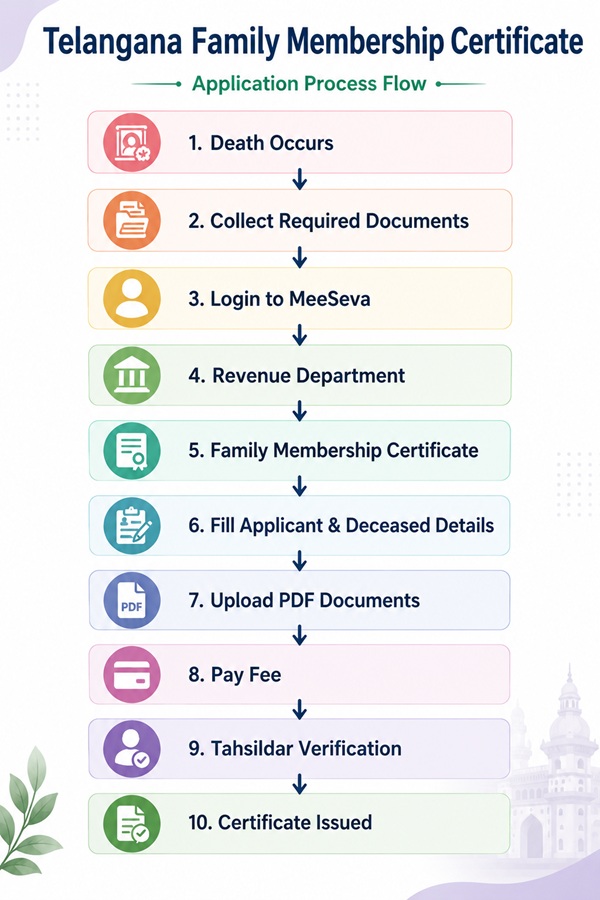
How to Apply for Family Member Certificate in Telangana: Step by Step
Step 1: Get your documents ready as PDFs
Before you touch the portal, prepare these as PDF files under 3 MB each:
- Death certificate or FIR
- Your proof of address
- Your proof of identity, Aadhaar or EPIC
- Aadhaar of the deceased
- Aadhaar of each family member you will list
Step 2: Log in to MeeSeva
Go to ts.meeseva.telangana.gov.in and log in. If you have never used MeeSeva, register first as a new user. The portal works in English and Telugu.
Step 3: Open Certificates, then Revenue Department
After logging in, click the Certificates icon, or type the service name into Search for Service. A list of departments appears. Click Revenue Department.
Step 4: Select Family Membership Certificate
From the Revenue Department services list, select Family Membership Certificate.
Look carefully at what you are clicking. The same list contains Telangana Family Register Certificate at the very bottom. That is the other service. If nobody has died, that is probably the one you actually want.
Step 5: Select the service type
The first field asks you to choose between FMC for Government Employees and Non Government Employees. Choose based on what the deceased did.
Step 6: Fill the form
Complete the applicant details, permanent address, deceased details and the family members table as set out above. Add a row for every surviving family member, including married daughters.
Step 7: Choose your delivery type
This is mandatory and it decides your final cost. See the next section.
Step 8: Upload documents
Upload the mandatory documents. Optional documents can be added if you have them. PDF only, 3 MB maximum per file.
Step 9: Show Payment, then Confirm Payment
Click Show Payment. The payment details appear. Check the amount, including any postal charge, then click Confirm Payment.
Step 10: Pay and save the receipt
Complete the payment. A receipt is generated. Save it and note your FAMC application number. You will be tracking this for the next several weeks.
Delivery Type and the Rs 65 Nobody Mentions
The form makes you choose a delivery type before you pay, and the choice changes what you pay.
| Delivery type | What happens | Extra cost |
|---|---|---|
| Manual | You collect the certificate from the franchisee centre where you applied | Nil |
| Speed Post Local | Couriered to your address within the same area | Rs 65 |
| Speed Post Non-Local | Couriered to an address outside the local area | Rs 65 |
If you select either postal option, a postal details panel opens and you must enter the delivery address.
So the real cost is:
- Rs 80 if you collect it yourself
- Rs 145 if you want it couriered
Choose Manual if you can travel back to the centre. Choose Speed Post if you are applying from another district on behalf of family, or if returning to the centre in six weeks is impractical.
Fee: Rs 45 or Rs 80?
You will see both figures on official sources, so here is the position.
| Source | Amount |
|---|---|
| Service manual, listed as user charges | Rs 45 |
| MeeSeva service page, stated as fee with GST | Rs 80 |
| Courier charge, if you choose Speed Post | Rs 65 additional |
Rs 45 appears to be the base user charge and Rs 80 the total after GST and associated charges. Whichever applies on the day, check the amount on the payment screen before confirming, and take a screenshot or collect a printed receipt.
Payment modes
- Online: net banking, credit card, debit card, Paytm, T-Wallet
- Franchisee centres: cash or T-Wallet
- Government centres: cash, cheque, demand draft, card payments or T-Wallet
A detail worth knowing if you pay cash at a centre. When cash is selected, the amount is debited from the operator's wallet within the system while you hand over cash across the counter. This is normal, but it is also why you should always collect a printed receipt. The receipt is your only proof of what you paid.
Why It Takes 30 Working Days
The service level agreement for FMC is 30 working days. Working days exclude Sundays and public holidays, so in practice you are looking at roughly six weeks.
The reason is that FMC is a Category B service. Category B means the department does not simply pull data from an existing database. It verifies. Your documents are examined, family details are checked and an enquiry may be conducted before the Tahsildar approves.
Compare this with the Family Register Certificate, which takes two working days precisely because it does no verification of this kind. It simply fetches an existing record from the ration card database.
What this means for you:
- Apply the moment you know you will need it. Do not wait until the pension office asks.
- If a claim has a deadline, count backwards from it and add buffer.
- Incomplete documents restart your wait. A query raised in week three does not pause the clock helpfully, it costs you the weeks already spent. Getting the upload right the first time is the single biggest time saver available.
What Happens After You Submit
- The request enters the department official's workflow for processing.
- Documents are verified and the family particulars are checked. Enquiry may be conducted.
- The Tahsildar approves the application.
- If your delivery type was Manual, you collect the certificate from the franchisee centre where you applied.
- If you chose Speed Post, the certificate is dispatched by courier to the address you entered.
Track progress using your FAMC application number through Know Your Application Status on the MeeSeva homepage.
FMC, Legal Heir Certificate and Succession Certificate
These three terms get mixed up constantly. Here is how they relate in Telangana.
| Family Membership Certificate | Succession Certificate | |
|---|---|---|
| Issued by | Revenue Department, Tahsildar | Civil court |
| Nature | Administrative record of survivors | Judicial determination |
| Typically used for | Pension, gratuity, provident fund, insurance, compassionate appointment, relief and ex-gratia claims | Debts and securities such as bank balances, shares and bonds |
| Time | 30 working days | Months |
| Cost | Rs 80, plus Rs 65 if couriered | Court fees and legal costs |
On the term legal heir certificate: in Telangana it is used interchangeably with Family Membership Certificate. District government websites publish the FMC details on pages titled Legal Heir Certificate. If an office asks you for a legal heir certificate, the FMC is normally what they mean. Ask them to confirm, because a small number of matters genuinely need a court issued succession certificate instead.
A practical rule. For routine administrative claims, the FMC is usually enough. Where the estate is contested, where heirs disagree, or where the value involved is substantial, a succession certificate from the civil court may also be needed. The two are not alternatives so much as different instruments for different situations.
Mistakes That Cost You Time or Money
- Applying for the wrong certificate. If nobody has died, you almost certainly want the Family Register Certificate, not this one. It takes two days instead of thirty and costs half as much.
- Leaving out married daughters. The form has a marital status column. Fill it. An incomplete heir list can be challenged years later.
- Forgetting the deceased person's Aadhaar. It is a mandatory upload and it is not on most published document lists.
- Forgetting family members' Aadhaar copies. Also mandatory, also usually missing from published lists.
- Uploading images instead of PDFs. Only PDF is accepted, up to 3 MB.
- Not deciding Reason for Certificate beforehand. A vague purpose invites a query and a query costs weeks.
- Choosing Speed Post without noticing the Rs 65. Check the total on the payment screen.
- Assuming you need a ration card. You do not. It is optional on the form.
- Accepting that private sector families cannot apply. The service type dropdown includes non government employees.
- Leaving a centre without a printed receipt. Cash is debited from the operator's wallet in the system, so the receipt is your only record.
- Applying at the last minute. Thirty working days is roughly six weeks. Start early.
Contact and Help
- MeeSeva call centre: 040-48560012
- Email: [email protected]
- Centre timings: franchisee and government centres, 8:00 AM to 8:00 PM
- Portal: ts.meeseva.telangana.gov.in
- For queries about the certificate itself, the Tahsildar of the concerned mandal is the competent authority.
Keep your FAMC application number ready whenever you call.
Add new comment