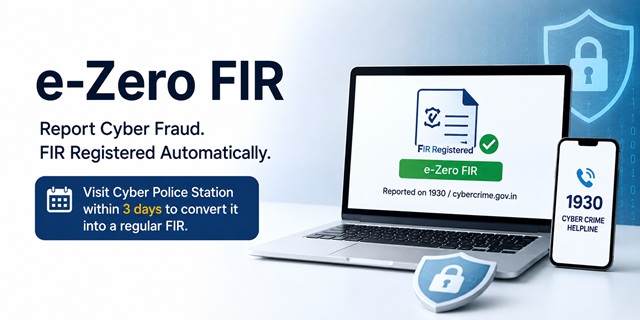
If you lose money to cyber fraud, filing an FIR earlier often meant visiting a police station first and dealing with jurisdiction issues. For eligible high-value cyber financial fraud cases, that process has now changed.
Under the e-Zero FIR initiative, complaints reported through the National Cybercrime Reporting Portal or the 1930 Cyber Crime Helpline can be automatically converted into a Zero FIR, allowing police to begin action much faster without waiting for you to visit a police station first.
However, one important step still remains.
You must visit the concerned cyber police station within three days to get the Zero FIR converted into a regular FIR. Missing this step can delay or affect further legal proceedings.
This guide explains how the e-Zero FIR system works, who can use it, the three-day rule, where it is currently available, and how it helps improve the chances of recovering money lost in cyber financial fraud.
Quick Facts
| Detail | Information |
|---|---|
| What it is | Automatic registration of a Zero FIR for eligible cyber financial fraud complaints |
| Developed by | Indian Cyber Crime Coordination Centre (I4C), Ministry of Home Affairs |
| Current threshold | Cyber financial fraud involving more than ₹10 lakh (pilot phase) |
| How to trigger it | Report the fraud through the National Cyber Crime Reporting Portal or by calling 1930 |
| Where the Zero FIR is registered | e-Crime Police Station, Delhi |
| Next step | Visit the concerned cyber police station within 3 days to convert it into a regular FIR |
| Legal basis | Section 173(1) and Section 173(1)(ii) of the Bharatiya Nagarik Suraksha Sanhita, 2023 |
| Announced | 19 May 2025 |
| Announced by | Union Home Minister Amit Shah |
| Current rollout | Pilot project in Delhi, with nationwide expansion planned |
| Cost | Free |
What Is a Zero FIR?
The entire e-Zero FIR system is built around one legal concept: the Zero FIR.
A Zero FIR allows an FIR to be registered even when the police station receiving the complaint does not have territorial jurisdiction over the offence.
Normally, an FIR is registered by the police station that has jurisdiction over where the offence occurred. Cyber financial fraud rarely follows those boundaries. A victim may be in one city, the fraudster in another state, and the money may move through bank accounts across multiple locations.
Instead of delaying action over jurisdiction, a Zero FIR is registered first and later transferred to the police station that has authority to investigate the case.
e-Zero FIR digitises this process. For eligible cyber financial fraud cases, the initial Zero FIR is generated electronically through the integrated government systems, allowing legal action to begin much faster.
How the e-Zero FIR System Works
The process has four stages. You only need to act at the beginning and once more after the Zero FIR is generated.
- Report the cyber financial fraud by calling 1930 or submitting a complaint through cybercrime.gov.in.
- If the reported financial loss exceeds ₹10 lakh, the system automatically registers an e-Zero FIR at the e-Crime Police Station, Delhi.
- Visit the concerned cyber police station within three days to complete the required formalities and have the Zero FIR converted into a regular FIR.
- After the required verification, the case is transferred through the Crime and Criminal Tracking Network & Systems (CCTNS) to the jurisdictional cyber police station for investigation.
What Happens Behind the Scenes?
The e-Zero FIR system works because three government platforms now communicate with each other automatically.
- National Cybercrime Reporting Portal (I4C) receives your complaint through the website or the 1930 helpline.
- Delhi Police's e-FIR platform automatically generates the Zero FIR for eligible complaints.
- Crime and Criminal Tracking Network & Systems (CCTNS), managed by the National Crime Records Bureau (NCRB), enables the case to be transferred electronically to the jurisdictional police station for investigation.
Earlier, filing an online complaint and registering an FIR were separate processes handled through different systems. The e-Zero FIR initiative connects these platforms so that eligible complaints can move into the criminal justice system much faster.
How to File a Complaint: You Do Not Apply for an e-Zero FIR
This is where most people get confused.
There is no separate application called an e-Zero FIR. You simply report the cyber financial fraud. If your complaint meets the prescribed conditions, the system automatically generates an e-Zero FIR.
Your job is only to report the fraud as quickly as possible and provide the correct details.
Use both of these methods. Calling 1930 helps start the fund-freezing process immediately, while filing the online complaint creates a complete digital record.
Step 1: Call 1930 Immediately
If the money has just been transferred, do this before anything else.
- Dial 1930.
- Tell the executive exactly what happened. Explain how the fraud occurred, when it happened and how much money was lost.
- Share the transaction details such as the UPI reference number, bank transaction ID, account number or wallet details, if available.
- Write down the complaint acknowledgement number carefully before ending the call.
- Complete the online complaint afterwards. The helpline operator may also guide you to do this.
Why call first? The sooner the fraud is reported, the sooner banks and payment intermediaries can be alerted to trace or freeze the money. Every minute matters.
Step 2: File the Complaint on the National Cyber Crime Reporting Portal
- Open cybercrime.gov.in.
- Select the option for Financial Fraud.
- Log in using your mobile number and verify the OTP.
- Enter the incident details, including the date, time, amount lost and payment method.
- Provide whatever details you know about the fraudster, such as the mobile number, UPI ID, bank account, website or social media profile.
- Upload available evidence, including screenshots, transaction receipts, bank statements, emails or chat messages.
- Submit the complaint and save the acknowledgement number safely.
Keep These Documents Ready
- Bank statement or transaction receipt
- UPI reference number or transaction ID
- Account number or UPI ID where the money was sent
- Screenshots of messages, chats, emails or payment confirmation
- Your identity proof and mobile number
Do not delay reporting just because one document is missing. File the complaint immediately with whatever information you have. Additional details can usually be shared later.
What Happens After You Submit the Complaint?
If your complaint falls within the current eligibility criteria for the e-Zero FIR system, the National Cyber Crime Reporting Portal forwards it electronically for automatic registration of an e-Zero FIR at the e-Crime Police Station, Delhi.
Your work is not finished yet. You still need to complete one important step within three days.
The Three-Day Rule Explained
This is the step many people overlook.
The e-Zero FIR helps police start the legal process quickly, but you must still visit the concerned cyber police station within three days to complete the required formalities and have the case taken forward under the regular investigation process.
Do not wait for someone to call you. Visit the cyber police station as soon as possible.
What Should You Carry?
- Your complaint acknowledgement number
- Bank statement showing the fraudulent transaction
- Transaction ID or UPI reference number
- Screenshots of chats, calls, emails or payment confirmations
- Your Aadhaar Card or another valid identity proof
- Your mobile phone, if it contains relevant evidence
What Happens at the Police Station?
- The officer verifies your identity and complaint.
- Your documents and digital evidence are checked.
- The Zero FIR is processed further under the applicable legal procedure.
- The case is transferred through the official system to the cyber police station having territorial jurisdiction for investigation.
If more than three days have already passed, visit the cyber police station without further delay. Do not assume your complaint has become invalid. Explain the reason for the delay and carry all available documents.
Why the Government Introduced e-Zero FIR
The Union Home Ministry introduced the e-Zero FIR system to reduce delays in cyber financial fraud cases, especially those involving large monetary losses.
According to the Ministry, the objective is to improve the conversion of complaints received through the National Cyber Crime Reporting Portal (NCRP) and the 1930 helpline into FIRs, making it easier for law enforcement agencies to begin investigation and improve the chances of recovering the victim's money.
In cyber fraud cases, speed matters. Fraudsters often transfer money through multiple bank accounts within minutes. Any delay in starting the legal process reduces the possibility of freezing the funds before they disappear.
By enabling automatic registration of an e-Zero FIR in eligible cases, the government aims to shorten the time between reporting the fraud and initiating police action.
Where Is e-Zero FIR Available?
The system has not yet been implemented across the country.
| Date | Development |
|---|---|
| 19 May 2025 | e-Zero FIR launched as a pilot project in Delhi by the Ministry of Home Affairs. |
| 23 June 2026 | Assam announced implementation of the system. |
| 24 June 2026 | At the 52nd PRAGATI meeting, the Prime Minister directed wider implementation in coordination with States and Union Territories. |
The Ministry has stated that the pilot will gradually be expanded to other States and Union Territories.
If the system has not yet been implemented in your State, you should still report the fraud immediately through 1930 or the National Cyber Crime Reporting Portal. The complaint remains valid even if automatic FIR generation is not available.
What If Your Loss Is Below ₹10 Lakh?
At present, automatic generation of an e-Zero FIR applies only to eligible complaints involving financial losses above ₹10 lakh.
If your loss is below this amount:
- Report the fraud immediately through 1930 or cybercrime.gov.in.
- Contact your bank without delay to request that the transaction be marked for possible freezing or recovery.
- You may still approach the police for registration of an FIR in accordance with the applicable legal provisions.
Never delay reporting simply because the amount is small. Early reporting significantly improves the chances of tracing or freezing the money.
Legal Basis of e-Zero FIR
The e-Zero FIR system has been introduced using the provisions relating to electronic registration of information contained in the Bharatiya Nagarik Suraksha Sanhita, 2023 (BNSS), particularly Section 173.
These provisions permit information relating to a cognizable offence to be submitted electronically, irrespective of where the offence occurred. The operational framework has been developed jointly by the Indian Cybercrime Coordination Centre (I4C), Delhi Police and the National Crime Records Bureau (NCRB).
What Should You Do After a Cyber Fraud?
- Call 1930 immediately.
- Submit a complaint on cybercrime.gov.in.
- Inform your bank and request immediate action on the transaction.
- If your complaint qualifies for the e-Zero FIR system, follow the instructions provided by the police authorities.
- Visit the concerned cyber police station within the prescribed time to complete the required legal formalities.
- Track your complaint regularly until the investigation progresses.
For detailed guidance on reporting cyber fraud and contacting your bank, see our guide on what to do immediately after cyber fraud.
Getting Your Money Back
Registration of the FIR is only one part of the recovery process.
- If funds have been frozen, you may need to follow the recovery procedure through the appropriate mechanism. Read our guide on MRM Portal money recovery.
- If your own bank account has been frozen during investigation, see our guide on how to release a frozen bank account.
Keep your FIR number, acknowledgement receipt and transaction records safely. They may be required by the police, your bank or during the recovery process.
Add new comment