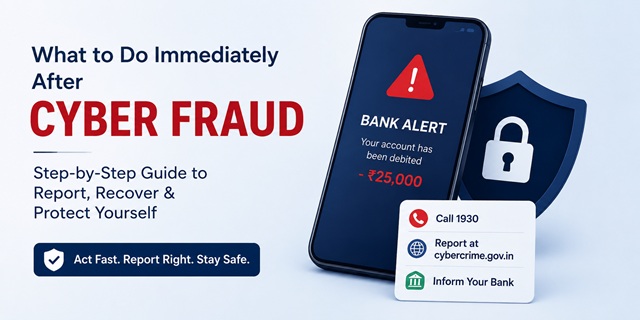
Your phone buzzes. You look down and see a bank alert. Money has left your account that you did not authorise. Or perhaps you have just realised that you transferred money to a fraudster after falling for an online scam. Your heart starts racing, and you are unsure what to do next.
Stop. Take a deep breath. Then read this guide carefully.
The next 60 minutes can make a huge difference. Every minute gives fraudsters more time to move your money through multiple bank accounts, making it much harder for banks and law enforcement agencies to trace or freeze the funds. If you act quickly and follow the correct steps, you may still have a chance to stop the money from moving further and recover it.
This guide explains exactly what you should do, in the correct order, and what information you should keep ready. There is no complicated legal language or confusing advice, only practical steps you can take immediately after discovering a cyber financial fraud.
Why the First 60 Minutes Matter
Financial cyber fraud cases are most likely to succeed when they are reported immediately. Law enforcement agencies and banks work together through the Citizen Financial Cyber Fraud Reporting and Management System (CFCFRMS) to place a hold on suspected fraudulent transactions before the money is withdrawn or transferred further. This critical period is often referred to as the golden hour.
If the amount is successfully put on hold, eligible victims can later submit a money restoration request through the government's Money Restoration Module (MRM), subject to the applicable process and verification. However, if the fraudster withdraws or transfers the money before it is frozen, recovering the amount becomes significantly more difficult.
That is why acting immediately is your biggest advantage. Reporting the fraud without delay gives banks and law enforcement agencies the best possible opportunity to trace the transaction, place a hold on the funds, and begin the recovery process.
Before You Call Anyone: Gather These in 2 Minutes
Before you report the fraud, spend two minutes collecting the key details below. Keeping this information ready will help you file the complaint faster and reduce delays while speaking to the helpline, your bank, or the police.
- The exact amount that was debited or transferred.
- The date and approximate time of the transaction (check your bank SMS or account statement).
- The transaction ID, UTR number, reference number, or bank transaction number.
- The UPI ID, mobile number, bank account number, or beneficiary details where the money was sent, if available.
- Your bank account number and the name of your bank.
- Your registered mobile number linked to the bank account.
Also keep screenshots of the transaction confirmation, bank alerts, payment receipt, chat messages, emails, or any other evidence related to the fraud. These details may be required while filing the complaint and during the investigation.
Do not delete any SMS, WhatsApp message, email, or app notification related to the fraud. Do not contact the fraudster, respond to further messages, or transfer any additional money. Once you have gathered the above details, report the fraud immediately.
Step 1: Call 1930 Immediately
As soon as you discover the fraud, call 1930. This is the National Cyber Crime Helpline for reporting financial cyber frauds in India. The helpline operates 24 hours a day, seven days a week, and you can call it free of charge from anywhere in the country.
Your complaint is registered through the Citizen Financial Cyber Fraud Reporting and Management System (CFCFRMS). The information is immediately shared with the concerned banks and other stakeholders so they can try to place a hold on the suspected fraudulent transaction before the money is withdrawn or moved further. Reporting the fraud as quickly as possible gives you the best chance of preventing further movement of the funds.
Keep the details below ready before speaking to the operator:
- Tell the operator that you are reporting a cyber financial fraud.
- Provide your full name and the registered mobile number linked to your bank account.
- Mention the exact amount that was debited or transferred.
- Share the date and approximate time of the transaction.
- Provide the transaction ID, UTR number, or bank reference number.
- Share the beneficiary details, such as the UPI ID, bank account number, or mobile number, if available.
- Provide your bank's name and your account details, if requested.
After your complaint is successfully registered, you will receive an acknowledgement number. Keep this number safely because you will need it to track the complaint and for any future follow-up. If the disputed amount is successfully put on hold, this acknowledgement may also be required while completing the money restoration process through the government's Money Restoration Module (MRM), wherever applicable.
If you cannot connect to the helpline immediately due to heavy call volumes, do not wait. Proceed to file the complaint through the National Cyber Crime Reporting Portal while continuing to inform your bank about the fraudulent transaction.
Important: If you come across the number 155260 on an old website, social media post, or video, do not use it. That helpline has been replaced. Always report financial cyber fraud by calling 1930 as soon as possible.
Step 2: Inform Your Bank Immediately
After reporting the fraud through 1930, inform your bank without delay. If you are close to your home branch or any branch of your bank, visit it immediately and report the incident in person. If visiting the branch is not possible, call your bank's 24-hour customer care or fraud helpline and report the fraudulent transaction.
Tell the bank that you have been a victim of cyber financial fraud. Ask them to block or place a hold on the transaction wherever possible, secure your account if required, and register a formal complaint. If you visit a branch, submit a written complaint and request an acknowledgement or complaint reference number for your records.
If the fraud involves an unauthorised electronic banking transaction, your rights may also be protected under the Reserve Bank of India's Limited Liability of Customers in Unauthorised Electronic Banking Transactions framework. Under this framework, the time taken to report the unauthorised transaction to your bank can affect your liability.
| When You Report the Unauthorised Transaction | Customer Liability | Bank's Responsibility |
|---|---|---|
| Within 3 working days of receiving the bank's communication | Zero liability, subject to the applicable RBI directions. | The bank processes the claim as per the RBI framework and applicable timelines. |
| Within 4 to 7 working days | Limited liability, depending on the account type and transaction value prescribed by RBI. | The bank examines the claim and processes it according to the applicable rules. |
| After 7 working days | Liability is determined according to the bank's Board-approved policy and the applicable RBI directions. | The bank processes the complaint under its approved policy. |
Remember: The reporting period is generally counted from the date you receive the transaction alert or communication from your bank, not from the time you actually notice the fraud. Delaying your report could affect your rights under the RBI framework.
While speaking to the bank, clearly state that you want to report a cyber financial fraud. If the transaction was not authorised by you, also request the bank to register it as an unauthorised electronic banking transaction and process your complaint in accordance with the applicable RBI customer protection directions.
Before ending the call or leaving the branch, make sure you receive a complaint reference number, service request number, or written acknowledgement. Keep it safely because you may need it while following up with the bank, law enforcement agencies, or during the money restoration process.
Step 3: File a Complaint on cybercrime.gov.in
After reporting the fraud through 1930, submit a detailed complaint on the National Cyber Crime Reporting Portal as soon as possible. The portal is managed by the Indian Cyber Crime Coordination Centre (I4C) under the Ministry of Home Affairs and serves as the official platform for reporting cyber crimes in India.
If you have already called 1930, keep your acknowledgement number ready while filing the online complaint. Use the same personal details, transaction information, and incident description that you shared during the helpline call. Providing consistent information helps avoid unnecessary delays during verification.
How to File a Complaint on cybercrime.gov.in
- Visit cybercrime.gov.in using your mobile phone or computer.
- Select Register a Complaint, then choose Financial Fraud. If your complaint relates to crimes against women or children, select the appropriate category available on the portal.
- Sign in using your mobile number and complete the OTP verification.
- Enter the required complaint details, including:
- Date and approximate time of the incident.
- A clear description of what happened.
- Transaction ID or UTR number.
- Fraud amount.
- Name of the bank, wallet, payment app, or merchant involved.
- UPI ID, bank account number, mobile number, email address, website, or any other details of the suspected fraudster, if available.
- Upload supporting evidence, such as:
- Transaction receipt or bank SMS screenshot.
- UPI payment confirmation or bank statement.
- Chat messages, emails, screenshots, or call records related to the fraud.
- Your identity proof, if required by the portal.
- Review all the information carefully before submitting the complaint.
- After successful submission, save the acknowledgement number generated by the portal. Keep it safely because you may need it to track your complaint, communicate with the investigating agency, or complete the money restoration process if the disputed amount is successfully put on hold.
Important: Make sure the information you provide on the portal matches the details shared with 1930, your bank, and the police. Differences in names, transaction IDs, amounts, dates, or beneficiary details can delay verification and the investigation.
Save Your Evidence Immediately
Before making any changes to your phone or deleting any messages, preserve all available evidence. Even small details can help investigators trace the fraud and support your complaint.
- Take screenshots of all bank SMS alerts, OTP messages, payment confirmations, and any communication related to the fraudulent transaction.
- Capture screenshots of the fraudulent website, app, social media profile, advertisement, QR code, or payment request that led to the fraud.
- Save all conversations from WhatsApp, Telegram, SMS, email, or any other platform used by the fraudster.
- Record the transaction ID, UTR number, or bank reference number from your banking app or account statement. This is one of the most important pieces of evidence.
- Download or save your bank statement showing the disputed transaction.
- Keep call logs, email headers, website URLs, and any payment receipts, if available.
- Write down the complete sequence of events while everything is still fresh in your memory. Include when the fraud started, how the fraudster contacted you, what information was shared, and when the payment was made.
Keep copies of all evidence in more than one place, such as your phone, email account, or secure cloud storage. Never hand over original documents unless they are specifically required by the investigating authority. Whenever possible, submit copies and keep the originals safely with you.
Step 4: Visit the Nearest Cyber Police Station or Police Station
If you have lost a significant amount of money, the fraud involves organised criminal activity, or the investigating agency asks you to appear in person, visit the nearest cyber police station or police station without delay. You can report the incident regardless of where the fraud occurred because cyber crime complaints are not restricted by territorial jurisdiction.
Carry the following documents with you:
- Your acknowledgement number received after reporting the complaint through cybercrime.gov.in.
- Copies of all screenshots and supporting evidence.
- Your bank statement showing the fraudulent transaction.
- Your identity proof.
- A written description of the incident with the date and your signature.
If the police determine that registration of an FIR is required, cooperate fully and provide all the available evidence. In certain cases, an FIR may also be required during the money restoration process, depending on the applicable procedure and the category under which your request is processed. If your money has been successfully put on hold, you can submit a restoration request through the Money Restoration Module (MRM). Read our detailed guide to understand the eligibility, restoration categories, required documents, and step-by-step application process.
Before leaving the police station, request a copy of the FIR (if registered) or obtain a written acknowledgement of your complaint for future follow-up.
Step 5: Track Your Complaint and Follow Up Regularly
Reporting the fraud is only the first step. Continue monitoring your complaint and respond promptly whenever the bank or investigating agency asks for additional information. Timely follow-up can help avoid unnecessary delays during the investigation.
- Check the status of your complaint regularly on cybercrime.gov.in using your acknowledgement number.
- Respond immediately if your bank, the investigating officer, or the cyber police contact you for verification or additional documents.
- Keep copies of every email, complaint reference number, acknowledgement, and written communication exchanged with your bank or the authorities.
- If the disputed amount has been successfully put on hold, complete the money restoration process through the Money Restoration Module (MRM). Our detailed guide explains the eligibility criteria, restoration categories, required documents, and the complete application process.
Know Your Rights Under RBI Customer Protection Rules
If your complaint involves an unauthorised electronic banking transaction, you may be protected under the Reserve Bank of India's customer protection directions on limiting customer liability. The protection available depends on the nature of the transaction, the facts of the case, and how quickly you report it to your bank.
- Report an unauthorised electronic transaction to your bank immediately after discovering it.
- Ask the bank to register your complaint and provide a complaint reference number or written acknowledgement.
- If you are dissatisfied with the bank's response or the complaint is not resolved within the applicable time, you can escalate the matter through the RBI Complaint Management System (CMS) under the RBI Integrated Ombudsman Scheme, wherever applicable.
- Keep all complaint numbers, acknowledgements, transaction details, and supporting evidence until the matter is fully resolved.
While reporting the matter to your bank, clearly mention that you want to report an unauthorised electronic banking transaction, wherever applicable, and request the bank to process your complaint in accordance with the relevant RBI customer protection directions.
Common Mistakes That Can Reduce Your Chances of Recovery
- Delaying the report. Waiting to see whether the money returns on its own gives fraudsters more time to transfer or withdraw the funds. Report the fraud immediately through 1930, your bank, and cybercrime.gov.in.
- Using an outdated helpline number. If you come across 155260 on an old website or social media post, do not use it. The official helpline for reporting financial cyber fraud is 1930.
- Providing inconsistent information. Ensure the details shared with 1930, your bank, cybercrime.gov.in, and the police match exactly. Differences in names, transaction IDs, amounts, or dates may delay verification.
- Paying anyone to recover your money. Be cautious of people claiming they can guarantee fund recovery for an advance fee. Official complaint registration, investigation, and the Money Restoration Module (MRM) process do not require any payment to private agents.
- Sharing OTPs, passwords, or banking credentials. No bank, government department, cyber police, or authorised official will ask for your OTP, internet banking password, or UPI PIN to process your complaint.
- Deleting evidence. Keep all SMS alerts, screenshots, emails, payment receipts, chat messages, call logs, and bank statements until the matter is completely resolved.
- Ignoring follow-up requests. Respond promptly whenever your bank or the investigating agency asks for additional documents or verification.
What Happens After You Report the Fraud
Once you report the fraud through 1930 and the National Cyber Crime Reporting Portal, the complaint is forwarded to the concerned authorities and financial institutions for further action. Depending on the circumstances of your case, you can generally expect the following process:
- Your complaint is forwarded to the concerned bank, payment service provider, and law enforcement agencies for verification and necessary action.
- The concerned financial institution attempts to trace the disputed transaction and, wherever possible, place a hold on the available funds before they are withdrawn or transferred further.
- The investigating agency reviews the complaint, transaction details, and supporting evidence submitted by you.
- If the disputed amount is successfully put on hold, you may become eligible to request restoration of the funds through the Money Restoration Module (MRM), subject to the applicable procedure.
- If the funds cannot be frozen, the complaint continues through the investigation process to identify the persons involved and take legal action in accordance with the applicable law.
Quick Reference: What You Should Do After Discovering a Cyber Financial Fraud
- Call 1930 immediately and save your complaint acknowledgement number.
- Inform your bank immediately by visiting the nearest branch or contacting its customer care or fraud helpline.
- Save all evidence, including SMS alerts, screenshots, chat messages, emails, transaction receipts, and bank statements.
- Submit a detailed complaint on cybercrime.gov.in and keep the acknowledgement number safely.
- Visit the nearest cyber police station or police station if required by the investigating agency or if additional legal action is necessary.
- Track your complaint regularly and respond promptly to any request for additional information.
- If the disputed amount is successfully put on hold, complete the restoration process through the Money Restoration Module (MRM).
- If your complaint with the bank remains unresolved despite following the prescribed process, you may escalate it through the RBI Complaint Management System (CMS), wherever applicable.
Add new comment