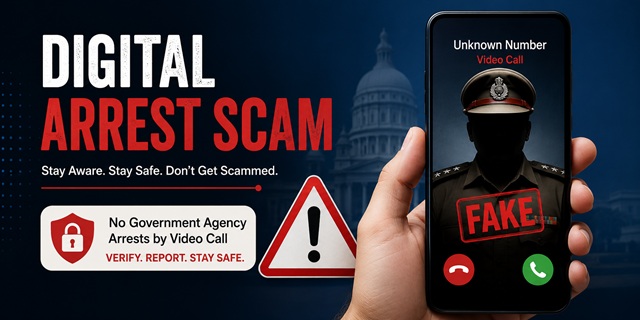
Your phone rings. The caller claims to be from the police, CBI, ED, Customs, or another government agency. They say a parcel booked in your name contains illegal items. They claim your Aadhaar has been linked to a money laundering case. Then comes the biggest lie: you are under digital arrest. They order you to stay on a video call, stop talking to your family, and transfer your savings to a so-called government or RBI verification account.
Every part of that story is fake. There is no legal concept called "digital arrest" in India. No police officer, CBI official, ED officer, customs officer, judge, or government department can place you under arrest through a phone call, WhatsApp message, or video conference.
Despite repeated public warnings, digital arrest scams continue to target people across the country. Fraudsters exploit fear, impersonate government officials, and use forged documents, fake video calls, and psychological pressure to convince victims to transfer their life savings.
The Government of India has repeatedly warned citizens about these scams. Prime Minister Narendra Modi highlighted the growing threat during Mann Ki Baat, while the Supreme Court later directed the CBI to investigate digital arrest scam cases across the country. Authorities have also intensified action against fraudulent SIM cards, mule bank accounts, and organised cybercrime networks.
Awareness is your strongest defence. This guide explains how digital arrest scams work, the warning signs to watch for, what to do if you receive such a call, and how to report the fraud through the official government channels.
The Most Important Thing to Know First
Before you read anything else, remember this one fact:
There is no legal concept called "digital arrest" in India. No provision of the Bharatiya Nyaya Sanhita (BNS), the Information Technology Act, the NDPS Act, the Code of Criminal Procedure (where applicable), or any other law authorises any government agency to place a person under arrest through a phone call, WhatsApp message, or video conference.
No police officer, CBI officer, ED officer, customs official, RBI representative, judge, or court employee will ever ask you to remain on a video call for hours, transfer your money to a so-called verification account, or keep an investigation secret from your family. These are all common tactics used by fraudsters to create fear and force victims into making hurried decisions.
The Government of India has repeatedly advised citizens that government agencies do not conduct investigations or arrests through WhatsApp, Skype, Telegram, or similar messaging platforms. If someone claiming to be a government official demands money, asks you to transfer your savings, or threatens you with a digital arrest over a phone or video call, treat it as a fraud and disconnect immediately.
How Serious Is the Digital Arrest Scam?
Digital arrest scams have become one of the fastest-growing forms of cyber-enabled financial fraud in India. Victims have reported losing amounts ranging from a few thousand rupees to their entire life savings. Senior citizens, professionals, students, business owners, and government employees have all been targeted through these scams.
Government agencies have intensified action against organised cyber fraud networks by blocking fraudulent SIM cards, freezing mule bank accounts, and strengthening coordination between law enforcement agencies and financial institutions. Despite these efforts, fraudsters continue to change their methods, making public awareness the strongest defence against digital arrest scams.
Exactly How the Fraud Works: The 5-Step Script
Most digital arrest scams follow a similar pattern. Fraudsters rely on fear, urgency, and fake authority to manipulate victims into believing they are under investigation. Once you understand this pattern, it becomes much easier to recognise and stop the scam before any money is lost.
Step 1: The Initial Contact
You receive a phone call, WhatsApp message, SMS, email, or automated voice call. The caller claims to represent a government agency, courier company, telecom operator, bank, or law enforcement authority. Common claims include:
- A parcel booked in your name has been intercepted and contains illegal items such as drugs, fake passports, or unauthorised SIM cards.
- Your mobile number has been used to send illegal messages and will be disconnected unless you cooperate.
- Your Aadhaar or PAN has been linked to money laundering, tax evasion, or another serious criminal offence.
- Your bank account has been found in suspicious financial transactions and is under investigation.
The story is deliberately designed to shock you and create immediate fear before you have time to verify the facts.
Step 2: Fake Government Authority
Within minutes, the caller transfers you to another person claiming to be a police officer, CBI officer, ED officer, customs official, cyber crime officer, or judge. They often appear on a video call wearing a police uniform or sitting inside what looks like a police station or government office.
Fraudsters increasingly use forged identity cards, fabricated FIRs, fake arrest warrants, counterfeit court orders, official-looking logos, and, in some cases, AI-generated deepfake technology to impersonate government officials. They may also create convincing backgrounds resembling police stations or courtrooms to make the interaction appear genuine.
The agencies most commonly impersonated include:
- Central Bureau of Investigation (CBI)
- Enforcement Directorate (ED)
- Narcotics Control Bureau (NCB)
- Telecom Regulatory Authority of India (TRAI)
- Indian Customs
- Reserve Bank of India (RBI)
- Income Tax Department
- Mumbai Police, Delhi Police, or other state police forces
- Cyber Crime Police
- In rare cases, even courts or judges
Step 3: Fear and Legal Threats
The fraudsters then accuse you of being involved in a serious criminal offence. They may refer to laws such as the Bharatiya Nyaya Sanhita (BNS), the Prevention of Money Laundering Act (PMLA), the NDPS Act, or other legal provisions. They threaten arrest, criminal prosecution, asset seizure, passport cancellation, or questioning of your family members if you fail to cooperate immediately.
The objective is simple. They want you to panic. Fear reduces your ability to think logically or verify the claims independently.
Step 4: Isolation From Family and Friends
This is one of the most dangerous stages of the scam. The fraudsters try to isolate you completely by giving instructions such as:
- You are under digital arrest and must not disconnect the call.
- The investigation is confidential, and you must not inform your family, friends, employer, or lawyer.
- Keep your camera switched on at all times so they can monitor you.
- If you disconnect the call or speak to anyone, a police team will immediately arrest you.
- The verification process may continue for several hours or even multiple days.
Several reported cases show that victims have been kept on continuous video calls for many hours. During this time, fraudsters repeatedly threaten them, prevent them from contacting family members, and create fake legal proceedings until the victims become mentally exhausted and more likely to obey every instruction.
Step 5: The Demand for Money
Once the victim is frightened and isolated, the fraudsters finally ask for money. They falsely claim that your funds must be transferred to a government-controlled account for verification and that the money will be returned after the investigation is completed.
To make the scam appear genuine, they may describe the destination account as:
- RBI Verification Account
- Government Security Account
- Supreme Court Supervised Account
- Escrow Account
- Safe Account
- Nodal Verification Account
None of these accounts exist for public verification of money. No government department in India asks citizens to transfer money to prove their innocence, verify bank balances, avoid arrest, or clear criminal allegations.
Victims often liquidate fixed deposits, mutual funds, PPF balances, retirement savings, or borrow money from relatives before transferring it to the fraudsters. Once the money is transferred, recovering it becomes much more difficult.
Warning: The moment a caller asks you to stay on a video call, keep the matter secret, or transfer money to avoid arrest or verify your bank account, disconnect the call immediately. Then report the incident by calling 1930, inform your bank, and file a complaint on cybercrime.gov.in. If money has already been transferred, read our guide on recovering money after cyber fraud.
How to Identify a Digital Arrest Scam in Less Than a Minute
If you notice any of the warning signs below, treat the call as a digital arrest scam and disconnect immediately.
- The caller claims you are under digital arrest.
- You are told not to disconnect the call.
- You are instructed not to inform your family or friends.
- You receive threats of immediate arrest or criminal action over a phone or video call.
- The caller shows a fake police ID, arrest warrant, FIR, or court order.
- You are asked to transfer money to a so-called government, RBI, escrow, or verification account.
- You are told your money will be returned after verification.
- The caller pressures you to act immediately without allowing time to verify the claims.
Remember: No police officer, CBI officer, ED officer, customs official, RBI representative, court, or any other government authority in India conducts a digital arrest, asks citizens to stay on a video call for hours, or demands money to verify an investigation.
Real Cases Show Why You Should Never Ignore These Calls
Digital arrest scams are not isolated incidents. Law enforcement agencies across India have investigated numerous cases where victims lost their life savings after believing they were speaking to genuine government officials.
Delhi
A retired government employee was kept on continuous video calls for more than three days by fraudsters impersonating officials from multiple government agencies. The callers used fake police uniforms, forged legal documents, and fabricated court proceedings to create fear. The victim eventually liquidated fixed deposits and other savings before transferring approximately Rs 48.5 lakh. Delhi Police later arrested several accused in connection with the case.
Noida
A woman received a call claiming that a parcel booked in her name had been intercepted while being shipped overseas. The fraudsters alleged that it contained passports, bank cards, laptops, foreign currency, and narcotic substances. They sent forged enforcement notices through WhatsApp and threatened legal action, ultimately cheating her of around Rs 34 lakh.
Karnal
A resident was told that a courier booked in his name had become part of a criminal investigation. During a video call, fraudsters dressed as police officers displayed forged documents bearing official seals and threatened immediate arrest unless he cooperated. The victim later transferred approximately Rs 25 lakh before realising it was a scam.
Bengaluru
In another high-value case, fraudsters posing as telecom officials and cyber police officers convinced a software professional that he was involved in a serious criminal investigation. Through continuous intimidation and fake legal proceedings, the victim transferred several crores of rupees before the fraud was detected, making it one of the country's largest reported digital arrest scams.
Important: These cases followed the same pattern. The fraudsters impersonated government officials, created panic using fake criminal allegations, isolated the victims from their families, and ultimately demanded money in the name of verification. Recognising these warning signs early can prevent significant financial loss.
Warning Signs: You May Be Facing a Digital Arrest Scam If
If you notice even one of the following warning signs, do not ignore it. The more signs that match your situation, the more likely it is that you are dealing with a digital arrest scam.
- Someone claims you are under arrest or a criminal investigation through a phone call or video call.
- The caller appears in a police uniform or claims to represent the CBI, ED, NCB, Customs, RBI, TRAI, or another government agency.
- You are shown fake FIRs, arrest warrants, court orders, or official identity cards on the screen.
- You are instructed not to disconnect the call or speak to your family, friends, employer, or lawyer.
- You are asked to transfer money to a so-called RBI account, escrow account, safe account, government verification account, or Supreme Court supervised account.
- You are promised that your money will be returned after verification or completion of the investigation.
- You are told that your Aadhaar, PAN, mobile number, bank account, or courier parcel has been linked to a serious criminal offence.
- The caller creates extreme urgency and pressures you to make immediate decisions without verifying the facts.
- You are instructed to install remote access applications such as AnyDesk, RustDesk, TeamViewer, or similar software.
- The caller repeatedly tells you that the matter is confidential or sub judice and warns you not to tell anyone.
Remember: No police officer, CBI officer, ED officer, customs official, court, RBI representative, or any other government authority in India conducts a digital arrest through WhatsApp, Skype, Zoom, Telegram, or any other video calling platform. If someone makes such a claim, disconnect the call immediately.
What to Do Immediately If You Receive a Digital Arrest Call
Disconnect the call immediately.
Do not argue with the caller. Do not try to prove your innocence. Do not share personal information. Do not verify your Aadhaar, PAN, bank account, OTP, or UPI PIN. The longer you stay on the call, the more opportunity fraudsters have to manipulate you psychologically.
After disconnecting the call, take the following steps without delay:
- Inform a trusted family member or friend immediately. Fraudsters deliberately isolate victims. Speaking to someone you trust helps break the psychological pressure and makes it easier to recognise the scam.
- Block the caller's number. Do not call back or respond to any further messages, emails, or video call requests.
- Report the incident by calling 1930. Even if you did not lose any money, reporting suspicious calls helps authorities identify and act against fraudulent numbers and organised cybercrime networks.
- Submit a complaint on cybercrime.gov.in. Filing a complaint creates an official record and allows the concerned authorities to investigate the incident.
- Report the suspicious mobile number through Sanchar Saathi. The Government of India's Sanchar Saathi portal allows citizens to report suspected fraudulent telecom resources and supports efforts to curb cyber-enabled fraud.
- If you transferred money before realising the scam, immediately inform your bank and follow our step-by-step guide on how to recover money after cyber fraud to improve the chances of freezing the funds.
If You Already Transferred Money: Take These Emergency Steps Immediately
If you have already transferred money to fraudsters, act without delay. The sooner you report the incident, the better the chances of tracing the transaction and placing a hold on the disputed funds.
- Call 1930 immediately. Tell the operator that you have become a victim of a digital arrest scam. Keep your transaction ID, UTR number, amount transferred, beneficiary account details, and your bank information ready while reporting the incident.
- Inform your bank immediately. Visit the nearest branch if possible or contact your bank's customer care or fraud helpline without delay. Ask the bank to register your complaint, secure your account wherever necessary, and provide a complaint reference number. If the transaction was unauthorised, request the bank to process your complaint in accordance with the applicable RBI customer protection directions.
- Submit a detailed complaint on cybercrime.gov.in. Upload all available evidence, including screenshots, bank transaction details, chat messages, emails, payment receipts, and any fake notices or documents shared by the fraudsters.
- Visit the nearest cyber police station or police station if required. Carry your complaint acknowledgement, identity proof, bank statement, and all supporting evidence. Cooperate with the investigating officer and provide any additional information requested during the investigation.
- If the disputed amount is successfully put on hold, complete the restoration process through the Money Restoration Module (MRM). Our detailed guide explains the eligibility criteria, restoration categories, required documents, and the complete application process.
Important: Do not transfer additional money even if the fraudsters claim it is required for verification, security clearance, tax payment, or to recover your earlier payment. No government department or investigating agency asks victims to deposit money to complete an investigation.
How to Verify Whether a Government Call Is Genuine
Fraudsters rely on fear and urgency. Genuine government agencies follow established legal procedures and do not ask citizens to participate in criminal investigations through WhatsApp or video calls.
| Genuine Government Procedure | Digital Arrest Scam |
|---|---|
| Official notices are generally issued through lawful procedures or official communication channels. | Calls you through WhatsApp, Skype, Zoom, Telegram, or similar platforms. |
| Asks you to appear before the concerned authority, wherever required. | Forces you to remain on a continuous video call. |
| Never asks you to transfer money to avoid arrest or prove your innocence. | Demands immediate transfer of money to a so-called verification or government account. |
| Allows you to seek legal advice and consult your family. | Orders you not to speak to anyone and threatens consequences if you disconnect. |
| Uses official government websites and email domains such as .gov.in or .nic.in wherever applicable. | Uses WhatsApp messages, Gmail addresses, unofficial websites, or fake documents. |
| Never asks you to install remote access software. | Asks you to install AnyDesk, RustDesk, TeamViewer, or similar applications. |
If you receive a suspicious call claiming to be from the police, CBI, ED, RBI, Customs, or any other government authority, disconnect the call immediately. Then visit the agency's official .gov.in or .nic.in website to obtain its published contact details and verify the claim independently. Never rely on the phone number, website, email address, or documents shared by the caller.
How AI Is Making Digital Arrest Scams More Convincing
Digital arrest scams have become increasingly sophisticated in recent years. Fraudsters now use advanced technology, forged documents, fake identities, and, in some cases, AI-generated audio, video, or deepfake technology to make their stories appear genuine.
Victims may receive video calls showing people dressed as police officers or government officials inside realistic-looking police stations, courtrooms, or government offices. Fraudsters also use forged identity cards, fake FIRs, fabricated court orders, official-looking logos, and convincing background sounds to create an illusion of legitimacy.
Although these techniques can appear highly convincing, one fact never changes: no government agency in India can place you under arrest through a phone call, WhatsApp message, Skype, Zoom, Telegram, or any other video calling platform. Whenever you receive such a call, disconnect immediately and verify the claim independently using the official contact details available on the concerned department's .gov.in or .nic.in website.
How You Can Protect Yourself and Your Family
- Save the National Cyber Crime Helpline (1930) in your phone so you can report suspicious incidents without delay.
- Talk to your family members, especially senior citizens, about digital arrest scams. Fraudsters frequently target elderly people by creating fear and urgency.
- Create a family safety rule. If anyone receives a call asking them to keep the matter secret or avoid contacting family members, treat it as a scam until independently verified.
- Lock your Aadhaar biometrics through the UIDAI website or the mAadhaar app whenever you do not need biometric authentication. This helps reduce the risk of biometric misuse.
- Report suspicious mobile numbers and telecom resources through the Sanchar Saathi portal to support government efforts against cyber-enabled fraud.
- Never install remote access applications such as AnyDesk, RustDesk, TeamViewer, or similar software at the request of an unknown caller. These applications may allow fraudsters to access your device and sensitive information.
- Never share your OTP, UPI PIN, internet banking password, debit card PIN, CVV, or screen with anyone, regardless of who they claim to be.
Safety Tip: The easiest way to identify a digital arrest scam is to remember one simple rule: no police officer, CBI officer, ED officer, RBI official, court, or any other government authority asks citizens to transfer money or remain on a video call to avoid arrest.
What the Government Is Doing to Combat Digital Arrest Scams
The Government of India has taken several measures to combat organised cyber fraud and digital arrest scams through public awareness campaigns, stronger coordination among law enforcement agencies, and action against fraudulent telecom and banking infrastructure.
- Public Awareness: Government agencies, including the Ministry of Home Affairs and the Indian Cyber Crime Coordination Centre (I4C), regularly issue advisories warning citizens about digital arrest scams and other cyber frauds.
- Prime Minister's Awareness Campaign: Prime Minister Narendra Modi highlighted digital arrest scams during Mann Ki Baat, advising citizens not to panic and reminding them that no government agency conducts investigations or arrests through video calls.
- Law Enforcement Action: Central and state law enforcement agencies continue to investigate organised cybercrime networks involved in digital arrest scams and take action against fraudulent SIM cards, mule bank accounts, and other infrastructure used by cyber criminals.
- Strengthened Coordination: Government departments, financial institutions, telecom service providers, and law enforcement agencies continue to strengthen coordination to improve cyber fraud reporting, investigation, and fund-freezing mechanisms.
Despite these efforts, public awareness remains the strongest defence. Understanding how digital arrest scams work and reporting suspicious calls immediately can help protect both you and others from becoming victims.
Add new comment