There is a simple question that tells you whether you truly understand the Digital Rupee.
Whose money is the balance in your bank account?
Most people would say it is their money. Economically, that is true. Legally, however, the money deposited in a bank is a liability of the bank to you. In contrast, the cash in your wallet is issued by the Reserve Bank of India (RBI) and is recognised as legal tender. It is central bank money, not a commercial bank liability.
The Digital Rupee (e₹) brings that same concept into digital form. When you hold e₹ in your Digital Rupee wallet, you hold a direct claim on the Reserve Bank of India rather than on a commercial bank. That fundamental legal difference sets the Digital Rupee apart from every other digital payment method available in India today and explains why the RBI introduced a Central Bank Digital Currency (CBDC).
This guide explains what the Digital Rupee (e₹) is, how it is issued, how it works, how it differs from UPI and bank deposits, what programmable and offline Digital Rupee mean in practice, and the current status of the RBI's CBDC pilot.
Quick Facts
| Detail | Information |
|---|---|
| Official name | Digital Rupee (e₹) |
| What it is | India's Central Bank Digital Currency (CBDC) |
| Issued by | Reserve Bank of India (RBI) |
| Legal status | Recognised as legal tender under the Reserve Bank of India Act, 1934 |
| Liability of | Reserve Bank of India |
| Value | Equal to physical Indian Rupee (₹) at a one-to-one value |
| Segments | Retail (e₹-R) and Wholesale (e₹-W) |
| Wholesale pilot launched | 1 November 2022 |
| Retail pilot launched | 1 December 2022 |
| Availability | Through participating banks and authorised non-bank entities under the RBI pilot |
| Interest on balance | None |
| Charges | No RBI charges for using e₹ |
| Minimum balance | None |
| Availability | 24×7 |
| Current status | Pilot implementation |
The Liability Question, Explained Properly
This is the foundation of the Digital Rupee. Once you understand this concept, everything else about India's Central Bank Digital Currency (CBDC) becomes much easier to understand.
Although physical cash, bank balances, payment wallets, and the Digital Rupee can all be used to make payments, they are not legally the same. The key difference lies in whose liability the money represents.
| What You Hold | Whose Liability It Is | If the Institution Faces Financial Stress |
|---|---|---|
| Physical currency (cash) | Reserve Bank of India | It is central bank money and recognised as legal tender. |
| Money in a bank account | Your commercial bank | You are a depositor, and deposits are subject to the applicable deposit insurance framework. |
| Balance in a prepaid payment wallet | The authorised wallet issuer, subject to the applicable regulatory framework | Your claim depends on the wallet issuer and the applicable regulations. |
| Digital Rupee (e₹) in a CBDC wallet | Reserve Bank of India | It is central bank money and recognised as legal tender. |
The Reserve Bank of India clearly states that the Digital Rupee (e₹) is legal tender and a direct liability of the Reserve Bank of India. This makes it fundamentally different from money held in commercial bank accounts or prepaid payment instruments.
Why does this matter? Until the introduction of the Digital Rupee, every digital payment in India ultimately involved commercial bank money. Whether you used UPI, NEFT, IMPS, debit cards, credit cards, or most digital wallets, the payment represented money held with a commercial bank or another regulated payment provider.
The Digital Rupee is different. It is the first digital form of central bank money made available to the public in India. In simple terms, holding e₹ in your CBDC wallet is legally comparable to holding physical currency notes in digital form rather than holding a bank deposit.
Digital Rupee (e₹) vs UPI: Understanding the Real Difference
One of the biggest misconceptions about the Digital Rupee is that it competes with UPI. It does not.
As explained by the Reserve Bank of India (RBI), the Digital Rupee (e₹) is a digital form of the Indian Rupee, whereas UPI is a payment system that enables the transfer of money.
In simple terms, e₹ is money, while UPI is a method of moving money. Comparing them is similar to comparing a currency note with a bank transfer. One is the money itself, and the other is the mechanism used to transfer it.
1. The Digital Rupee Can Be Stored. UPI Cannot.
UPI does not store money. It simply instructs your bank to transfer funds from one account to another. There is no such thing as a UPI balance.
The Digital Rupee works differently. You first load e₹ into your CBDC wallet from your bank account. Once the wallet is funded, the corresponding amount is deducted from your bank account and exists as Digital Rupee in the wallet, similar to withdrawing physical cash from an ATM and keeping it in your wallet.
2. CBDC Wallet-to-Wallet Payments Do Not Debit Your Bank Account
Once your Digital Rupee wallet has been loaded, payments made by scanning a CBDC QR Code are completed directly between Digital Rupee wallets. At the time of payment, the transaction is settled using the Digital Rupee stored in the wallets rather than by debiting the customer's bank account.
This is one of the most important differences between the Digital Rupee and traditional digital payment systems.
3. The Same Digital Rupee App Can Scan Both CBDC and UPI QR Codes
The RBI has enabled interoperability between the Digital Rupee and the existing UPI ecosystem. As a result, many Digital Rupee applications can scan both CBDC QR Codes and UPI QR Codes, allowing users to pay at millions of existing merchant locations.
When you scan a CBDC QR Code, the payment is made using the Digital Rupee stored in your wallet. When you scan a UPI QR Code, the transaction is processed through the UPI infrastructure while maintaining interoperability between the two systems.
Digital Rupee (e₹) vs UPI: Side-by-Side Comparison
| Feature | Digital Rupee (e₹) | UPI |
|---|---|---|
| What it is | Central Bank Digital Currency (CBDC) | Digital payment system |
| Underlying money | Digital Rupee issued by the RBI | Commercial bank deposits |
| Liability | Reserve Bank of India | Commercial bank |
| Can you hold a balance? | Yes, in a Digital Rupee wallet | No |
| Bank account debited at payment? | No, after the wallet has already been funded | Yes |
| Denominations | Available in digital denominations similar to physical currency | No |
| Interest | No | Depends on the bank account |
| Offline payments | Offline functionality is being introduced under the RBI pilot | Internet connectivity is generally required |
| Programmability | Supported for selected use cases under the RBI pilot | Not applicable |
The Digital Rupee and UPI are designed to complement each other, not compete. UPI remains India's primary digital payment infrastructure, while the Digital Rupee introduces a new form of central bank money into the digital economy. Together, they expand the range of secure and efficient digital payment options available to users.
Why the Digital Rupee (e₹) Comes in Denominations
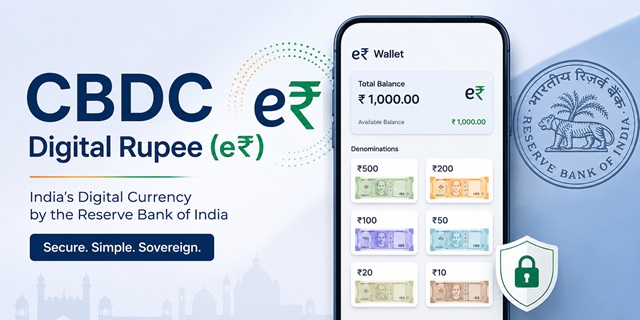
When you open a Digital Rupee (e₹) wallet, you may notice something different from other payment applications. Instead of showing only a balance, many e₹ wallets also display the value in digital denominations that resemble physical currency.
According to the Reserve Bank of India (RBI), the Digital Rupee is available in denominations similar to physical currency to provide users with the same familiarity and convenience as cash.
This is more than just a visual design choice. The retail Digital Rupee (e₹-R) follows a token-based model, where each Digital Rupee token represents a specific value, much like a physical currency note or coin. The Digital Rupee therefore behaves much more like digital cash than a traditional bank balance.
A common question is what happens if your wallet contains a higher denomination than the amount you want to pay. For example, if you need to pay ₹15 while your wallet contains a ₹20 denomination.
The Digital Rupee wallet automatically calculates the required value during the transaction. The recipient receives the exact payment amount, while the remaining value continues to remain available in your wallet. As a user, you do not need to worry about carrying the exact digital denominations.
Payments can also be made for amounts containing paise, allowing transactions up to two decimal places wherever supported.
How the Digital Rupee Is Created and Issued
The issuance process of the Digital Rupee closely resembles the way physical currency is introduced into circulation, with the main difference being that everything happens digitally.
- The Reserve Bank of India creates the Digital Rupee. As India's central bank, the RBI issues Digital Rupee (e₹) to participating banks under the ongoing CBDC pilot.
- Participating banks distribute it to customers. Eligible users can obtain a Digital Rupee wallet through participating banks and load it with e₹ after completing the required onboarding process.
- You load your wallet using your bank account. When you add money to your Digital Rupee wallet, the corresponding amount is debited from your bank account and converted into Digital Rupee, similar to withdrawing physical cash from an ATM.
- You use the Digital Rupee for payments. Once the wallet is funded, you can make person-to-person (P2P) and person-to-merchant (P2M) payments, or redeem the remaining Digital Rupee back into your linked bank account whenever supported.
Although participating banks help distribute the Digital Rupee and provide wallet services, the e₹ stored in your wallet remains a direct liability of the Reserve Bank of India. This is one of the most important differences between the Digital Rupee and money held in a commercial bank account.
Retail CBDC (e₹-R) and Wholesale CBDC (e₹-W): Understanding the Difference
When people talk about the Digital Rupee, they usually mean the Retail Digital Rupee (e₹-R) that individuals use for everyday payments. However, the Reserve Bank of India has introduced another version called the Wholesale Digital Rupee (e₹-W), designed specifically for financial institutions and wholesale financial markets.
Although both are forms of the Digital Rupee, they serve different purposes and operate in different environments.
| Feature | Retail CBDC (e₹-R) | Wholesale CBDC (e₹-W) |
|---|---|---|
| Primary users | Individuals, merchants and businesses | Banks and other eligible financial institutions |
| Primary purpose | Everyday digital payments and transactions | Interbank settlement and wholesale financial transactions |
| Objective | Digital cash, convenience and financial inclusion | Improving settlement efficiency and reducing settlement risk |
| Availability | Available through the RBI's ongoing pilot with participating institutions | Restricted to eligible institutions participating in the pilot |
| Pilot launch | 1 December 2022 | 1 November 2022 |
| Participants | Customers onboarded through participating banks and authorised entities under the RBI pilot | Eligible financial institutions approved by the RBI for the wholesale pilot |
How the Wholesale Digital Rupee (e₹-W) Is Being Used
The Wholesale Digital Rupee is not meant for everyday consumers. Instead, it is being tested for improving the efficiency of India's financial markets and settlement systems.
According to the Reserve Bank of India, major pilot use cases include:
- Settlement of secondary market transactions in Government Securities (G-Secs). This was the first use case introduced with the wholesale pilot in November 2022.
- Settlement of inter-bank borrowing and lending transactions in the call money market. This use case was added later as the pilot expanded.
- Tokenised issuance and settlement of Certificates of Deposit (CDs). The pilot is also evaluating how tokenised financial instruments can improve settlement efficiency.
Why does this matter if ordinary citizens never use e₹-W?
The Wholesale Digital Rupee enables participating financial institutions to settle eligible transactions using central bank money. This has the potential to improve settlement efficiency, reduce operational friction, and lower settlement-related risks within the financial system. While most people will never directly interact with e₹-W, improvements in the underlying settlement infrastructure can contribute to a more efficient and resilient financial ecosystem.
Programmable Money: The Feature That Redefines How Money Can Be Used
Programmability is one of the most innovative features of the Digital Rupee (e₹) and one of the least understood aspects of India's Central Bank Digital Currency (CBDC).
According to the Reserve Bank of India (RBI), the programmability feature allows the sponsor entity (such as a government or corporate) or the user to ensure that funds in a CBDC wallet are used for a specific, designated purpose.
Unlike ordinary money deposited in a bank account, programmable Digital Rupee can carry predefined conditions that determine where, when, or for what purpose it may be used. This makes it possible to design targeted payments without changing the nature of the Digital Rupee itself.
What Can Be Programmed?
The RBI has identified several programmable parameters that can be applied to Digital Rupee transactions for approved use cases, including:
- Expiry date - Funds remain valid only until a specified date.
- Geo-location - Funds can be used only within a defined geographical area.
- Merchant Category Codes (MCC) - Payments can be restricted to specific categories of merchants.
- Merchant VPA - Funds may be used only with designated merchants or payment addresses.
Where Has Programmable Digital Rupee Been Tested?
According to the RBI's 2025-26 Annual Report, programmable Digital Rupee pilots were expanded across multiple government programmes and institutional use cases.
During 2025-26, the RBI conducted welfare-linked CBDC pilots in Gujarat, Puducherry, and Chandigarh, where eligible beneficiaries received food subsidies under the Public Distribution System (PDS) using programmable Digital Rupee. The programmability feature ensured that the funds could be used only for their intended purpose through designated merchants.
In addition, multiple government agencies started pilot projects under various Direct Benefit Transfer (DBT) schemes to evaluate how programmable Digital Rupee could improve the targeted delivery and utilisation of public funds. The RBI is also exploring programmability for interest subvention schemes, lending programmes, employee allowances, and other purpose-specific payments.
Why Does Programmability Matter?
Programmability allows funds to be used for the purpose for which they were issued. For example, a government subsidy intended for food distribution can be configured for use only at authorised fair price shops or designated merchants participating in the programme.
This capability can improve transparency, reduce misuse of public funds, and help ensure that welfare benefits reach their intended purpose. At the same time, the conditions attached to programmable Digital Rupee depend entirely on the specific policy or pilot under which it is issued. The Digital Rupee itself remains the same; only the approved usage conditions differ for particular programmes.
Offline Digital Rupee: Can It Work Without the Internet?
One of the biggest advantages of physical cash is that it works even when there is no internet or mobile network. For the Digital Rupee (e₹) to serve as a digital alternative to cash, it must eventually offer a similar capability.
According to the Reserve Bank of India (RBI), offline functionality is being developed to enable Digital Rupee transactions in areas with limited or no internet connectivity. The objective is to make digital payments more accessible in remote locations and during network outages.
As part of the ongoing pilot, the RBI is evaluating multiple technological approaches, including:
- Solutions that can operate without internet connectivity while using alternative communication technologies where applicable.
- Near Field Communication (NFC)-based payments using compatible merchant acceptance devices.
Offline functionality is still under pilot implementation and may vary depending on the participating institution, wallet application, and use case. The RBI will expand these capabilities based on the outcome of pilot testing.
What Does the Digital Rupee Cost?
The RBI has kept the Digital Rupee simple and cash-like. Three important points are worth remembering.
- No usage charges. The RBI does not prescribe any charges for using the Digital Rupee or maintaining an e₹ wallet.
- No interest on wallet balances. Like physical cash, the Digital Rupee does not earn interest while it remains in your wallet.
- No minimum balance requirement. Users are not required to maintain any minimum balance in an e₹ wallet.
Why doesn't the Digital Rupee earn interest?
The RBI designed the Digital Rupee to function like physical currency rather than a savings account. Cash in your wallet does not generate interest, and the same principle applies to e₹. This approach also helps maintain the balance between Digital Rupee adoption and the traditional banking system.
For most users, the practical approach is simple. Keep only the amount you expect to spend in your Digital Rupee wallet and continue using your savings account for funds that you want to earn interest on.
Digital Rupee (e₹) vs Cryptocurrency
Many people assume that the Digital Rupee is simply India's version of cryptocurrency. In reality, the two are fundamentally different.
| Feature | Digital Rupee (e₹) | Private Cryptocurrency |
|---|---|---|
| Issued by | Reserve Bank of India | No central issuer |
| Legal status | Recognised as legal tender | Not legal tender in India |
| Value | Equal to the Indian Rupee (₹1 e₹ = ₹1) | Market-driven and may fluctuate significantly |
| Liability | Direct liability of the Reserve Bank of India | Not a liability of any central bank |
| Primary purpose | Digital form of sovereign currency for payments and transactions | Varies depending on the cryptocurrency and its intended use |
| Price volatility | No. It always maintains parity with the Indian Rupee. | Yes. Prices may rise or fall significantly. |
| Regulation | Issued and regulated by the Reserve Bank of India | Not issued by the RBI |
The Digital Rupee is not an investment product or a cryptocurrency. It is simply the digital form of India's sovereign currency. One Digital Rupee is always equal to one physical Indian Rupee, making it suitable for everyday payments rather than speculative trading.
Current Status of the Digital Rupee (e₹) Pilot
The Digital Rupee is still under a pilot phase. The Reserve Bank of India (RBI) describes it as a limited-scale, controlled rollout designed to evaluate the technology, architecture, scalability, security, use cases, user acceptance, and the complete lifecycle of issuing, distributing, and using the Digital Rupee before any wider deployment.
Who can currently use it?
The Retail Digital Rupee (e₹-R) is available to customers onboarded by participating banks and authorised entities under the RBI's ongoing pilot. The list of participating institutions continues to evolve as the pilot expands, and availability may differ depending on your bank and location.
Current adoption.
The Digital Rupee remains in the pilot stage and is not intended to replace existing payment systems immediately. UPI continues to be India's primary retail digital payment infrastructure, processing billions of transactions every month. The RBI has consistently clarified that the Digital Rupee is designed to complement existing payment systems rather than replace them.
Where is the Digital Rupee seeing the most progress?
Current pilot projects are focused on areas where the Digital Rupee offers capabilities beyond conventional payment systems. These include programmable government benefit transfers, offline payments, wholesale financial market settlements, and selected experiments involving tokenisation of financial assets. The RBI continues to expand these pilot use cases while evaluating their operational and policy implications.
The practical reality.
The Digital Rupee is not a replacement for UPI, debit cards, or internet banking. Instead, it introduces a new form of sovereign digital money into India's payment ecosystem. As the pilot evolves and additional features become available, its role is expected to expand alongside existing payment systems rather than replace them.
Who Should Consider Using the Digital Rupee?
The Digital Rupee (e₹) is still under the RBI's pilot programme, so it may not yet replace your existing payment methods. However, it can be useful for certain users and situations.
- People who want to experience central bank digital money and understand how India's CBDC works in practice.
- Users whose banks participate in the RBI pilot and who want to make everyday payments using an e₹ wallet.
- Merchants who wish to accept Digital Rupee payments alongside existing UPI-based payments.
- Beneficiaries of selected government pilot programmes where programmable Digital Rupee is being tested for welfare schemes or Direct Benefit Transfer (DBT) use cases.
- People living in areas with limited internet connectivity, once offline Digital Rupee functionality becomes available under the RBI pilot.
For most users today, the Digital Rupee should be viewed as an additional payment option rather than a replacement for cash, UPI, debit cards, or internet banking. As the RBI expands the pilot and introduces new features, its practical use cases are expected to grow.
Should You Use the Digital Rupee?
Whether you should use the Digital Rupee depends on how you make payments and whether your bank currently participates in the RBI pilot.
Reasons to try the Digital Rupee:
- No RBI charges for using the Digital Rupee.
- No minimum balance requirement.
- Available 24 hours a day, seven days a week.
- It is a digital form of sovereign currency issued by the Reserve Bank of India.
- Interoperability with UPI QR codes allows payments at many existing merchant locations.
Things to keep in mind:
- The Digital Rupee does not earn interest while stored in your wallet.
- The pilot is still expanding, so availability depends on participating institutions.
- Dedicated CBDC acceptance infrastructure is still growing.
- Offline functionality remains under phased implementation as part of the RBI pilot.
A practical approach.
Think of the Digital Rupee as digital cash rather than a savings account. Keep only the amount you expect to spend in your e₹ wallet and continue using your bank account for savings that earn interest. This reflects the way the Digital Rupee has been designed by the RBI.
If your bank participates in the Digital Rupee pilot and you would like to start using e₹, read our detailed guide on CBDC Wallet: Supported Banks, Registration Process and How to Use the Digital Rupee.
Add new comment