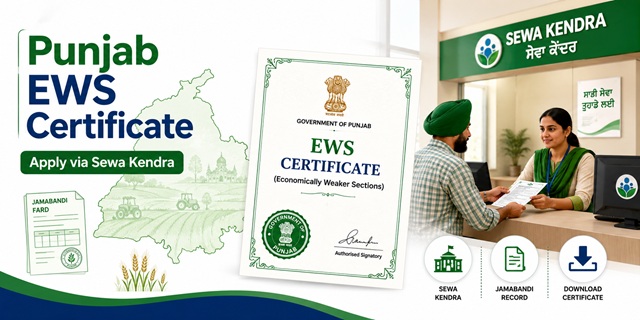
The EWS Certificate in Punjab is officially called the Income and Asset Certificate for Economically Weaker Sections. It is issued under the Department of Social Justice, Empowerment and Minorities, Government of Punjab, through the Tehsildar at the tehsil level and the Naib Tehsildar at the sub-tehsil level.
With this certificate, eligible general category residents of Punjab can claim 10% reservation in central and state government jobs, IITs, NITs, central universities, NEET All India Quota seats, PPSC (Punjab Public Service Commission) exams, PSSSB (Punjab Subordinate Services Selection Board) recruitments, and state government admission processes.
Applications in Punjab are submitted at Sewa Kendras, which are Punjab's government-run service delivery centres located across all 23 districts. Punjab also has the e-Sewa portal at esewa.punjab.gov.in for tracking status and downloading the certificate after issuance. The official EWS application form is published by the Government of Punjab and is available for download at punjab.gov.in under the forms section of the Department of Social Justice, Empowerment and Minorities. The eSewa helpline is 1100.
Eligibility Criteria
To be eligible for an EWS certificate in Punjab, all of the following conditions must be satisfied:
- You must be a permanent resident of Punjab and belong to the general (unreserved) category. You must not belong to SC, ST, or OBC categories
- Your family's gross annual income from all sources must be below Rs. 8 lakh for the financial year preceding the year of application. Income includes salary, agriculture, business, profession, rent, and any other source
- Your family must not own 5 acres of agricultural land or more
- Your family must not own a residential flat of 1,000 sq ft or more
- Your family must not own a residential plot of 100 sq yards or more in a notified municipality
- Your family must not own a residential plot of 200 sq yards or more outside notified municipalities
All four asset conditions must be satisfied alongside the income condition. Income is always calculated on a gross basis for the financial year prior to the year of application. "Family" includes the applicant, parents, siblings below 18 years, spouse, and children below 18 years. Property held by family members in different locations is clubbed together when checking asset limits.
Official Application Form
Punjab uses a prescribed EWS application form that includes a Self-Declaration section (2 pages) to be filled by the applicant stating annual family income from all sources and asset details. The form is available for download at punjab.gov.in under the forms section. Search for "Income and Asset Certificate for EWS" under the Department of Social Justice, Empowerment and Minorities. The facilitation charge printed on the official form is Rs. 50. Fill the form completely in both English and Punjabi as printed on the form before visiting the Sewa Kendra.
Documents Required
The following documents are required as per the official Punjab EWS application form. All photocopies must be self-attested:
- Self-Declaration Form (2 pages included in the official application form): A signed declaration stating annual family income from all sources and confirming asset limits are not exceeded
- Aadhaar Card of the applicant
- Residence proof: Driving Licence, Bank Passbook, Kisan Passbook, Post Office Passbook, Ration Card, Income Tax Assessment Order, Water or Electricity or Telephone or Gas Connection Bill in the name of the applicant or immediate family member, Rent Agreement, or any postal mail delivered to the applicant's address through Indian Postal Department
- Income Certificate for the previous financial year showing family income from all sources. This includes salary slips, Form 16, Income Tax Returns, or Fard (land revenue record showing agricultural income)
- Jamabandi (Fard): Punjab's primary land ownership and revenue record maintained by the Patwari. The Jamabandi shows the land owner's name, khasra number, and area of agricultural land held. Obtain the Jamabandi Fard from the Punjab Land Records Society portal at jamabandi.punjab.gov.in. If no agricultural land is owned, submit a self-declaration
- J-Form: The annual cultivation statement maintained by the Patwari showing crops grown and agricultural activity. This is also accepted as income proof for farmers
- Property documents: Property tax receipt or sale deed showing area of any residential property owned by family members. If no property is owned, include this in the self-declaration
- PAN Card of the applicant and earning family members
- Voter ID Card as additional identity proof
- Passport-size photograph of the applicant
Method 1: Apply at a Sewa Kendra
Sewa Kendras are Punjab's government-operated service delivery centres. They are the primary and most widely used channel for applying for EWS certificates in Punjab. Sewa Kendras are located in all 23 districts across urban and rural areas.
- Download the official EWS application form from punjab.gov.in under the forms section of the Department of Social Justice, Empowerment and Minorities
- Fill in Part 1 of the form with personal details: applicant's name, father's name, address, tehsil, district, and mobile number
- Fill in Part 2 with family income details from all sources: salary or wages, agricultural income, business income, income from property, and any other income for all family members
- Fill in Part 3 with asset details: agricultural land held in acres, residential flat or plot area, and whether any property is in a notified municipality
- Fill and sign the two-page Self-Declaration section of the form. This is a mandatory declaration confirming income and assets
- Attach self-attested photocopies of all required documents: Aadhaar card, residence proof, income proof (salary slip or ITR or Fard), Jamabandi (if land is owned), property documents (if applicable), and passport-size photograph
- Visit your nearest Sewa Kendra. To find the nearest Sewa Kendra in your district, go to connect.punjab.gov.in/about-sewa-kendra
- Submit the completed form with all attached documents at the Sewa Kendra counter
- Pay the facilitation charge of Rs. 50 at the counter
- Collect the acknowledgement receipt with your Application Reference Number. Keep this number safely for tracking status and downloading the certificate
- The Sewa Kendra enters the application into the e-Sewa system. The application is forwarded to the Tehsildar (for tehsil-level applications) or Naib Tehsildar (for sub-tehsil level applications) for verification and issuance
- The Tehsildar reviews the self-declaration, income documents, and land records. The Patwari and Kanungo field reports may also be obtained for land verification
- Once the Tehsildar approves the certificate, it is digitally signed and made available on the e-Sewa portal. You receive an SMS notification on your registered mobile number
Method 2: Apply Through the e-Sewa Portal, Connect Punjab (Online Track and Download)
Currently the EWS certificate application in Punjab is submitted physically at a Sewa Kendra. However, once submitted, citizens can track the application status and download the certificate online through the e-Sewa portal or the Connect Punjab portal.
To register on Connect Punjab portal for online tracking:
- Go to connect.punjab.gov.in
- Click Citizen Login and then click Don't have an account? Register Now
- Enter your name, email ID, mobile number, gender, and create a password. Click Register
- An OTP is sent to your mobile number. Enter the OTP and click Validate
- An OTP is sent to your email address. Enter the email OTP and click Validate. Registration is complete
- Log in using your credentials to track applications and access services
Method 3: Apply Offline at the Tehsil Office
- Download the EWS application form from punjab.gov.in under the forms section
- Fill in the complete form including the two-page self-declaration section with full income and asset details
- Attach self-attested photocopies of all required documents
- Visit the Tehsil office in your tehsil headquarters. If you are in a sub-tehsil area, visit the sub-tehsil office headed by the Naib Tehsildar
- Submit the completed form and documents at the revenue counter. Provide your mobile number on the form for SMS alerts
- The Tehsil office issues an acknowledgement receipt with an application number
- The Tehsildar initiates Patwari and Kanungo verification of land records and income. The Patwari verifies Jamabandi records and submits a report. The Kanungo countersigns and forwards to the Tehsildar
- The Tehsildar issues the EWS certificate after verifying all documents and field reports
- The certificate is made available on the e-Sewa portal for download or collect a signed printed copy from the Tehsil office
Role of Patwari and Kanungo in Punjab EWS Verification
Punjab's revenue administration has a unique two-officer field verification system:
- The Patwari (village revenue officer) maintains Jamabandi land records at the village level, verifies agricultural land held, and submits a field report on the applicant's income and land details
- The Kanungo (senior revenue official above the Patwari) countersigns and reviews the Patwari's report before it reaches the Tehsildar. The Kanungo supervises multiple Patwaris across a circle
- The Tehsildar reviews both reports and issues the certificate after verification
The Patwari-Kanungo-Tehsildar chain is specific to Punjab's revenue system and ensures two levels of field verification before the certificate is issued.
Application Fee
The facilitation charge for the EWS certificate in Punjab is Rs. 50 as printed on the official Government of Punjab EWS application form published on punjab.gov.in. This is paid at the Sewa Kendra counter when submitting the application. No additional fee is charged for downloading the certificate after approval. For the income certificate separately, the fee is Rs. 75 per copy as confirmed from official sources.
Processing Time
The EWS certificate in Punjab is typically issued within 7 to 15 working days of application submission. The Tribune India confirmed that district administrations have directed all Tehsildars and Naib Tehsildars to process these applications. Applications where Patwari and Kanungo field verification is completed promptly are processed within 7 to 10 working days. Incomplete documents or income verification issues extend the processing time.
Validity of the EWS Certificate in Punjab
The EWS certificate is valid for one financial year (April 1 to March 31). It must be renewed every year by applying fresh with updated income documents for the previous financial year. For PPSC, PSSSB, and other state exam document verification, check the specific notification for validity requirements. For NEET state quota counselling in Punjab, a Punjab-issued EWS certificate is mandatory since certificates from other states are not accepted for the state 85% quota. For NEET All India Quota (15%), the central format EWS certificate issued by any state Tehsildar is accepted.
How to Track Application Status
- Go to esewa.punjab.gov.in/trackStatus_Progress
- Enter your Application Reference Number received from the Sewa Kendra
- Click Search. The current status of your application is displayed
You can also log in to esewa.punjab.gov.in with your credentials, go to View Status of Application, click Track Application Status, and check the status against your application reference number.
How to Download the Certificate
- Go to esewa.punjab.gov.in/certificateDownload
- Enter your Application Reference Number
- Click Send OTP. An OTP is sent to your registered mobile number
- Enter the OTP and click Download
- The digitally signed certificate is downloaded in PDF format
To verify the certificate after download, go to esewa.punjab.gov.in/certificateVerification, enter the application reference number and token number from the certificate, and click Download Certificate.
Add new comment