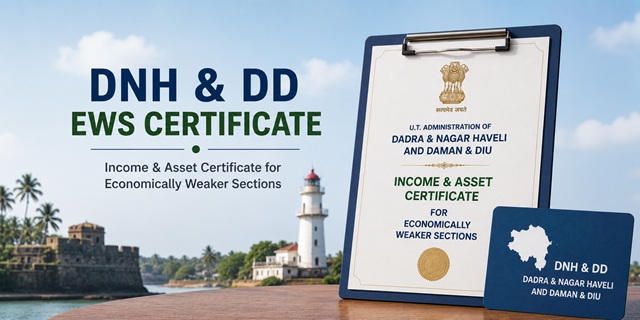
Following the merger of Dadra and Nagar Haveli with Daman and Diu into a single Union Territory in 2020, residents of all three districts can apply for an Income and Asset Certificate to claim benefits available under the Economically Weaker Section (EWS) reservation framework. The certificate serves as official proof that the applicant's family falls within the income and asset limits prescribed for EWS reservation.
The document is commonly required for admissions to higher educational institutions, competitive examinations, scholarship programmes, and government recruitment where EWS eligibility must be established. In the Union Territory, applications are processed through the revenue administration system operating across Silvassa, Daman, and Diu, with services available through both online and offline channels.
Dadra and Nagar Haveli and Daman and Diu became a single Union Territory on 26 January 2020 following the merger of the former separate UTs of Dadra and Nagar Haveli and Daman and Diu. The Revenue Department of the merged UT is managed through Mamlatdar offices in each of the three districts: Dadra and Nagar Haveli (headquartered at Silvassa), Daman, and Diu.
With this EWS Certificate, eligible general category residents can claim 10% reservation in central government jobs, IITs, NITs, central universities, NEET All India Quota seats, and admissions to UT institutions including Government Polytechnic and Government Engineering colleges under the Directorate of Higher and Technical Education (DHTE) DNH and DD.
Applications are submitted through the SUGAM portal at sugam.dddgov.in, which is the official Revenue Department portal of the UT Administration. The SUGAM portal is confirmed live and directly lists the EWS Certificate service under both Mamlatdar Daman Services and Mamlatdar Diu Services. For DNH (Silvassa), the Revenue Department is accessible through the Mamlatdar office. Applications can also be submitted at CSC centres or offline at the Mamlatdar office.
Three Districts and Their Mamlatdar Offices
The UT has three districts, each with a Mamlatdar office handling revenue certificates:
- Dadra and Nagar Haveli District (Silvassa): The Mamlatdar office is at Silvassa. The Revenue Department website for this district is at dnh.gov.in. The Talati is the field verification officer at the village level in DNH. EWS certificate is available through the SUGAM portal
- Daman District: The Mamlatdar Daman office handles revenue certificates for Daman residents. Service available through SUGAM at sugam.dddgov.in/mamlatdar-daman
- Diu District: The Mamlatdar Diu office handles revenue certificates for Diu residents. Service available through SUGAM at sugam.dddgov.in/mamlatdar-diu
Your application must be submitted to the Mamlatdar of the district where your permanent residence is located.
Eligibility Criteria
To be eligible for an EWS certificate in DNH and DD, all of the following conditions must be satisfied:
- You must be a permanent resident of Dadra and Nagar Haveli and Daman and Diu and belong to the general (unreserved) category. You must not belong to SC, ST, or OBC categories
- Your family's gross annual income from all sources must be below Rs. 8 lakh for the financial year preceding the year of application. Income includes salary, agriculture, business, profession, rent, and any other source
- Your family must not own 5 acres of agricultural land or more
- Your family must not own a residential flat of 1,000 sq ft or more
- Your family must not own a residential plot of 100 sq yards or more in a notified municipality
- Your family must not own a residential plot of 200 sq yards or more outside notified municipalities
All four asset conditions must be satisfied alongside the income condition. Income is always on a gross basis. "Family" includes the applicant, parents, spouse, children below 18 years, and unmarried siblings below 18 years.
Talati: The Field Verification Officer in DNH
In Dadra and Nagar Haveli, the village-level revenue officer is called the Talati (the same title used in Gujarat, which borders DNH). The Talati maintains village revenue records including land records (Form 7 and Form 12 in DNH and DD) and conducts field verification for revenue certificate applications. After you submit the EWS application at the Mamlatdar office or through the SUGAM portal, the Mamlatdar forwards it to the Talati for local field verification. The Talati checks income sources, land holdings, and residential details and submits a report to the Mamlatdar for final approval.
Land Records in DNH and DD
DNH and DD uses specific land record forms that are required as supporting documents for EWS applications involving land ownership:
- Form 7 (Record of Rights): The primary land ownership document in DNH and DD showing the owner's name, survey number, and area of land. Available online and for verification at the SUGAM portal
- Form 12 (Cultivable Land Record): Shows agricultural land use and cultivation details. Both Form 7 and Form 12 for DNH and DD can be printed from the services.india.gov.in/service/detail/print-form-7-and-form-12 service for DNH and DD residents
If your family owns no agricultural land, submit a self-declaration instead of land records.
Documents Required
Keep the following documents ready. For online applications through SUGAM, files must be in PDF or JPEG format. For offline applications at the Mamlatdar office, carry self-attested photocopies and originals:
- Aadhaar Card of the applicant
- Voter ID Card as identity and residence proof
- Domicile Certificate of DNH and DD: Required to prove permanent residency in the UT. The Domicile Certificate is also issued by the Mamlatdar through SUGAM. If you do not have one, apply for it first
- Ration Card showing family members and DNH and DD address
- Income proof: Salary slips or Form 16 for salaried persons; Income Tax Returns; or a self-declaration affidavit of income for farmers and self-employed persons
- Form 7 (Record of Rights): Land record showing agricultural land held by family members. If no land is owned, submit a self-declaration
- Property documents: Property tax receipt or sale deed showing area of residential property owned by family members. If none owned, include in the self-declaration
- Self-declaration affidavit stating total family income from all sources is below Rs. 8 lakh and all asset limits are within prescribed thresholds
- Passport-size photograph of the applicant
- PAN Card of earning family members
Method 1: Apply Online Through SUGAM Portal
- Go to sugam.dddgov.in
- Click Login / Registration at the top right of the homepage. If you are a new user, register using your name, mobile number, email ID, and Aadhaar details. Create a password. Submit and verify via OTP. Your account is created
- Log in with your registered credentials
- On the portal homepage, click Services in the navigation menu, then click All Services
- Under Mamlatdar Daman Services (for Daman residents), Mamlatdar Diu Services (for Diu residents), or use the DNH Revenue portal for Silvassa residents, click on EWS Certificate
- You are redirected to the login if not already logged in. After login, the application form opens
- Fill in your personal details: name, father's name, address, district, village or ward, and mobile number
- Fill in income details: enter gross income from all sources separately for all family members. Enter total annual family income
- Fill in asset details: agricultural land held in acres and residential property owned by family members
- Upload all required documents within the portal's size limits. Upload Aadhaar, Voter ID, domicile certificate, ration card, income proof, Form 7 (if land owned), and passport-size photograph
- Submit the application. An Application Reference Number is generated. Save this for tracking
- The application goes to the Mamlatdar for verification. The Talati conducts the local field enquiry. The Mamlatdar issues the certificate after approval
- Once approved, log in to the SUGAM portal and download the digitally signed certificate
Method 2: Apply Offline at the Mamlatdar Office
- Visit the Mamlatdar office in your district: Mamlatdar office at Silvassa for DNH residents, Mamlatdar Daman office for Daman residents, or Mamlatdar Diu office for Diu residents
- Download the EWS application form from the DNH Revenue Department downloads page at erevenue.dnhgov.in/Downloads or collect it from the Mamlatdar office counter
- Fill in all details: applicant's name, father's name, address, district, family income from all sources separately, and details of all agricultural land and residential property owned by family members
- Attach self-attested photocopies of all required documents: Aadhaar card, Voter ID, domicile certificate, ration card, income proof, Form 7 land record (if applicable), property documents (if applicable), and passport-size photograph
- Submit the completed form with all attachments at the Mamlatdar office counter. Provide your mobile number for communication
- The counter staff registers your application and issues an acknowledgement receipt with your application reference number
- The Mamlatdar forwards the application to the Talati for local field verification. The Talati verifies income sources, land holdings through village records, and residence details
- The Talati submits the field report to the Mamlatdar. The Mamlatdar reviews the report and issued documents and approves the certificate
- The approved digitally signed certificate is uploaded to the SUGAM portal. Download it using your application reference number or collect from the Mamlatdar office
Method 3: Apply Through CSC (Common Service Centre)
- Locate your nearest CSC centre in your district. CSCs are present across Silvassa, Daman, and Diu areas
- Carry your Aadhaar card, Voter ID, domicile certificate, income proof, Form 7 (if land owned), and passport-size photograph
- Tell the CSC operator you need the EWS Income and Asset Certificate
- The operator submits the application through the SUGAM portal on your behalf. Documents are scanned and uploaded
- Pay the applicable fee plus the CSC service charge. Collect the Application Reference Number from the operator
- Track status and download the approved certificate using the Reference Number on the SUGAM portal
Certificate Verification
To verify any certificate issued through the SUGAM portal:
- Go to sugam.dddgov.in/sugamverify
- Enter the certificate number or scan the QR code on the issued certificate
- Click Verify. Full certificate details are displayed if the certificate is genuine
Application Fee
Confirm the exact government fee at the SUGAM portal payment step when applying online, as fees are displayed at the point of submission. For offline applications at the Mamlatdar office, confirm the applicable fee at the counter. CSC operators charge an additional service fee for their assistance.
Processing Time
The EWS certificate in DNH and DD is typically issued within 7 to 15 working days of application submission. The Talati's local field verification and the Mamlatdar's approval process determine the timeline. Applications with complete and consistent documents are processed faster. For grievances or delays, use the SUGAM portal's grievance mechanism at sugam.dddgov.in/grievance.
Validity of the EWS Certificate in DNH and DD
The EWS certificate is valid for one financial year (April 1 to March 31). It must be renewed every year by applying fresh with updated income documents for the previous financial year. For DHTE admissions to Government Polytechnic and Government Engineering College in DNH and DD, check the specific admission notification for validity requirements. For NEET All India Quota counselling in June or July, apply for a fresh certificate after April 1 of that year.
Add new comment