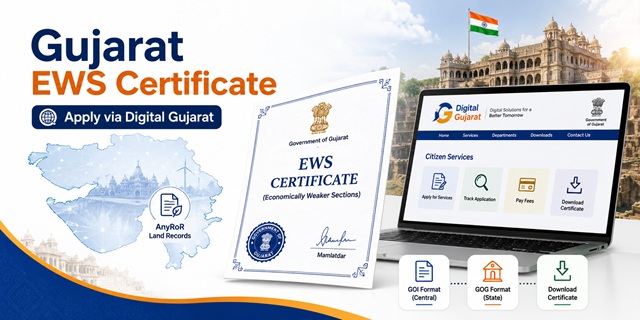
The EWS Certificate in Gujarat is officially called the Income and Asset Certificate for Economically Weaker Sections. Gujarat holds a distinction that no other state can claim: it was the first state in India to implement the EWS reservation law, passing the enabling legislation on 14 January 2019, just two days after the 103rd Constitutional Amendment received presidential assent on 12 January 2019.
The certificate is issued by the Revenue Department through the Mamlatdar (for rural areas and small towns) or the Zonal Officer (for urban municipal corporation areas). It entitles eligible general category residents to 10% reservation in central and state government jobs, IITs, NITs, central universities, NEET All India Quota seats, GPSC (Gujarat Public Service Commission) exams, and state government schemes including the EBC/EWS scholarship on the Digital Gujarat portal.
Applications are submitted through the Digital Gujarat portal at digitalgujarat.gov.in, through ATVT/Jan Seva Kendras at every Mamlatdar office across all 33 districts of Gujarat, or offline at the Mamlatdar office directly. The helpline for Digital Gujarat services is 1800-233-5500 (toll free).
Eligibility Criteria
To be eligible for an EWS certificate in Gujarat, all of the following conditions must be satisfied:
- You must be a permanent resident of Gujarat and belong to the general (unreserved) category. You must not belong to SC, ST, SEBC (Socially and Educationally Backward Classes, which is Gujarat's term for OBC), or any other reserved category
- Your family's gross annual income from all sources must be below Rs. 8 lakh for the financial year preceding the year of application. Income includes salary, agriculture, business, profession, rent, and any other source
- Your family must not own 5 acres of agricultural land or more
- Your family must not own a residential flat of 1,000 sq ft or more
- Your family must not own a residential plot of 100 sq yards or more in a notified municipality
- Your family must not own a residential plot of 200 sq yards or more outside notified municipalities
All four asset conditions must be satisfied alongside the income condition. Income is always calculated on a gross basis. "Family" includes the applicant, parents, spouse, children below 18 years, and unmarried siblings below 18 years.
SEBC is Gujarat's classification for socially and educationally backward communities, which is equivalent to OBC in other states. If your community is listed in the Gujarat SEBC schedule, you are not eligible for EWS.
Two Certificate Formats in Gujarat
Gujarat is one of the few states where two separate EWS certificate formats are officially available, and the Ahmedabad Collectorate website lists them under two distinct services:
- GOI format (Government of India / Central format): Required for UPSC, SSC, central government jobs, IIT, NIT, central university admissions, and NEET All India Quota seats. This follows the DoPT-prescribed Annexure-I format
- GOG format (Government of Gujarat / State format): Required for GPSC exams, state government jobs, state college admissions through ACPC (Admission Committee for Professional Courses), and Gujarat state welfare schemes
If you need the certificate for both state and central purposes, apply for both formats. Both are issued by the Mamlatdar through the Digital Gujarat portal. Always check the specific exam or admission notification to confirm which format is required.
Documents Required
Keep the following documents ready before starting the application. All uploaded documents must be in PDF or JPG format and each file must be under 200 KB:
- Aadhaar Card of the applicant. All details on the application must exactly match the name as on Aadhaar. Even minor spacing differences cause rejection
- Passport-size photograph of the applicant
- Income proof for the previous financial year: salary slips and Form 16 for salaried persons; Form 16-A and ITR for the last three years for business and self-employed applicants; or a Talati-issued income declaration for agricultural and informal workers
- 7/12 Utara (Satbara Utara): Gujarat's primary agricultural land record maintained through the AnyRoR (Any time Any where Record of Rights) system. It shows the owner's name, survey number, and area of land. Download it from the AnyRoR Gujarat portal at anyror.gujarat.gov.in. If your family owns no agricultural land, obtain a nil-land certificate or submit a self-declaration
- Property documents: Property tax receipt or sale deed showing the area of residential property owned by family members. If no property is owned, include this in the self-declaration
- Residence proof: Ration card, electricity bill, or Aadhaar Card showing Gujarat address
- PAN Card of the applicant and earning family members
- Self-declaration affidavit: Declaring that total family income from all sources is below Rs. 8 lakh and that all asset limits are within the prescribed limits
Only Mamlatdar-issued certificates and documents are accepted as valid income and asset proof. Certificates issued by a Sarpanch, company HR, or CA without Mamlatdar countersigning are not accepted. For rural applicants, the Talati's signature on income-related documents is required.
How to Apply Online Through Digital Gujarat Portal
The Digital Gujarat portal allows self-application online and the process is free of charge.
- Go to digitalgujarat.gov.in
- If you are a new user, click New Registration and register using your Aadhaar-linked mobile number. Complete mobile OTP verification. Registration is free
- Log in with your registered credentials
- Click on Citizen Services on the homepage, then navigate to the Revenue Department services
- Select Income and Asset Certificate for EWS. Choose whether you need the GOI format (central purposes) or GOG format (state purposes) based on your requirement
- Fill in the application form carefully. Enter applicant's name exactly as on Aadhaar. Enter family income from each source separately. Enter agricultural land details and residential property details for all family members
- Upload all required documents in PDF or JPG format, each under 200 KB. Partially visible, shadowed, or blurred documents fail verification. Use a scanner or a document scanning app in good lighting
- Generate the Application Reference Number and save it
- Pay the applicable fee online if prompted. Online self-application through the portal is generally free. Confirm at the payment step before submitting
- Submit the application. The application goes to the Mamlatdar office for verification. You receive SMS updates on your registered mobile number as the application progresses
- Once approved, log in to the portal, go to My Services, check the status column for Approved, and download the certificate in PDF format
How to Apply Through ATVT/Jan Seva Kendra
Every Mamlatdar office and Panchayat office in Gujarat has an ATVT (Anytime, Anywhere) or Jan Seva Kendra that provides assisted digital services. This is Gujarat's version of the Common Service Centre. If you cannot apply online on your own, this is the most reliable option.
- Visit the ATVT or Jan Seva Kendra at your nearest Mamlatdar office or Taluka Sewa Sadan
- Tell the operator you need the EWS Income and Asset Certificate (specify GOI format for central exams or GOG format for state purposes)
- Carry all original documents. The operator submits the application through the Digital Gujarat portal on your behalf
- Pay the applicable service charge. Collect the printed acknowledgement with your Application Reference Number
- Receive SMS updates on your mobile as the application moves through verification stages
How to Apply Offline at the Mamlatdar Office
For applicants who prefer to submit a paper application directly:
- Visit your nearest Mamlatdar office (for rural areas and smaller towns) or the concerned Zonal Officer's office (for major municipal corporation areas such as Ahmedabad, Surat, Vadodara, and Rajkot)
- Download the EWS application form from the Digital Gujarat portal at digitalgujarat.gov.in or collect it from the office counter
- Fill in all details including complete family income from all sources and all land or property held by family members
- Attach self-attested photocopies of all required documents
- Submit the form at the receiving counter and collect the acknowledgement receipt with your reference number
- Provide your mobile number on the form to receive SMS alerts on application status
- The Mamlatdar verifies documents, coordinates with the Talati for rural land records, and may conduct a field inquiry before issuing the certificate
- Collect the certificate from the Mamlatdar office on the notified date. Sign the registry when collecting
Verification Process in Gujarat
After submission, the following steps take place:
- The Mamlatdar's office verifies income documents and land records. For rural applicants, the Talati cum Mantri (village revenue officer, also called Talathi) verifies land records through the 7/12 Utara and confirms income through village accounts
- For urban applicants under municipal corporation areas, the concerned Zonal Officer handles verification
- After satisfactory verification, the Mamlatdar approves and digitally signs the certificate
- The approved certificate is uploaded to the Digital Gujarat portal and made available for download under My Services
- Issued certificates are also uploaded to the district website
Application Fee
Online self-application through the Digital Gujarat portal is free of charge. There is no government fee for the EWS certificate on the portal. If applying through the ATVT/Jan Seva Kendra at the Mamlatdar office, the operator charges a nominal service fee for assisted application. The Digital Gujarat helpline is 1800-233-5500 (toll free) for any queries including fee clarification.
Processing Time
The EWS certificate in Gujarat is typically issued within 7 to 14 working days of application submission. Applications with complete, consistent, and clear documents where the Talati's verification is completed quickly are processed faster. Inconsistent name spellings across documents, unclear uploads, or income documents without proper signatures cause delays and rejections. In busy periods such as admission season (May to July), processing may take slightly longer.
Validity of the EWS Certificate in Gujarat
The EWS certificate is valid for one financial year (April 1 to March 31). It must be renewed every year by applying fresh with updated income documents for the previous financial year. For ACPC state admissions and GPSC exams, always check the specific notification for validity requirements. For NEET All India Quota counselling in June or July, apply for a fresh certificate after April 1 of that year.
How to Track Application Status
To check the status of your EWS certificate application on Digital Gujarat:
- Go to digitalgujarat.gov.in and log in
- Click on My Services on the dashboard
- Your application and its current status appear in the status column. When the status shows Approved, the certificate is ready for download
How to Verify a Certificate
To verify an EWS certificate issued through Digital Gujarat:
- Go to digitalgujarat.gov.in
- Look for the certificate verification option on the portal
- Enter the certificate number printed on the issued certificate
- Certificate details are displayed instantly if it is genuine
EWS Certificate for EBC Scholarship in Gujarat
The Digital Gujarat portal also offers an EBC/EWS scholarship for general category students whose family income is below Rs. 6 lakh. This is a separate scholarship scheme for students in Classes 1 to 12 and higher education. To apply for this scholarship, you need the EWS Income and Asset Certificate along with other documents. The scholarship application is also submitted through the Digital Gujarat portal. Students who already have the EWS certificate for reservation purposes can use the same certificate for the scholarship application as well, provided it is valid for the current financial year.
Add new comment