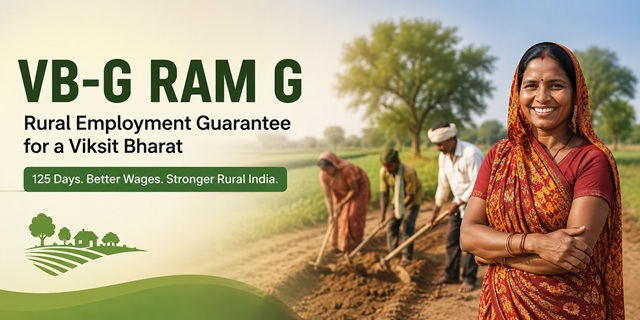
The Mahatma Gandhi National Rural Employment Guarantee Act (MGNREGA), 2005, which governed rural wage employment in India for nearly two decades, has now been replaced by the Viksit Bharat - Guarantee for Rozgar and Ajeevika Mission (Gramin) Act, 2025, popularly known as VB-G RAM G. The new law came into force on 1 July 2026, introducing a revised legal framework for providing guaranteed wage employment and creating rural assets across the country.
The Union Government has also released an interim allocation of more than Rs. 95,600 crore to States and Union Territories to support a smooth transition to the new scheme and ensure that employment generation continues without interruption. If you are an existing MGNREGA worker or plan to seek work under the new law, understanding these changes will help you know what benefits remain the same, what has changed, and what you should expect from 1 July 2026 onwards.
MGNREGA vs VB-G RAM G: Key Changes at a Glance
The table below compares the major provisions of the earlier MGNREGA with the new VB-G RAM G framework. It highlights the key changes that directly affect rural workers, including the number of guaranteed workdays, wage structure, funding pattern, payment timelines, administrative expenditure and job card arrangements.
| Particular | Under MGNREGA | Under VB-G RAM G |
|---|---|---|
| Guaranteed employment | 100 days in a financial year | 125 days in a financial year |
| Minimum wage floor | State-specific wage rates | National wage floor of Rs. 300 per day |
| Time limit to provide employment | Within 15 days of demanding work | Within 15 days of demanding work |
| Wage payment timeline | Within 15 days | Weekly or within 15 days |
| Funding pattern (Most States) | 100% Central funding for wages | 60:40 Centre-State cost sharing |
| Funding pattern (North Eastern & Himalayan States) | 100% Central funding | 90:10 Centre-State cost sharing |
| Administrative expenditure | Up to 6% of the approved budget | Up to 9% of the approved budget |
| Job card status | MGNREGA Job Card | Existing e-KYC verified job cards remain valid until new Gramin Rozgar Guarantee Cards are issued |
What You Get Under VB-G RAM G
The new VB-G RAM G framework retains several important protections available under MGNREGA while introducing new benefits for rural workers. From more guaranteed workdays to a higher national wage floor and continued direct bank payments, the scheme aims to provide greater financial security to eligible rural households.
125 Days of Guaranteed Employment
One of the most significant changes is the increase in the employment guarantee from 100 days to 125 days in a financial year. Every eligible rural household whose adult members are willing to undertake unskilled manual work can now claim up to 125 days of wage employment under the new law. For families that rely on government-supported employment, these additional workdays can provide a valuable source of income during periods when regular employment opportunities are limited.
National Wage Floor of Rs. 300 Per Day
VB-G RAM G introduces a national wage floor of Rs. 300 per day for work carried out under the scheme. Earlier, wages were determined separately for each state under MGNREGA, resulting in considerable variation across the country. The new wage floor establishes a common minimum benchmark while allowing states to notify higher wages wherever applicable under the relevant rules.
Unemployment Allowance if Work is Not Provided
The legal right to demand work continues under the new law. If employment is not provided within 15 days of submitting a valid work application, eligible workers become entitled to an unemployment allowance. During the initial 30 days of delay, the allowance must be at least one-fourth of the applicable wage rate, as provided under the scheme.
Direct Payment of Wages into Your Bank Account
Workers will continue to receive their wages through Direct Benefit Transfer (DBT) directly into their linked bank or post office account. As per the new framework, wages are to be paid every week or within 15 days after the closure of the muster roll. If payment is delayed beyond the prescribed period, eligible workers may receive delay compensation in accordance with the applicable provisions.
Existing Job Cards Continue During the Transition
If you already possess an e-KYC verified MGNREGA Job Card, you do not need to apply for a new card immediately. The Government has provided for a phased transition, under which existing verified job cards will continue to remain valid until the new Gramin Rozgar Guarantee Cards are issued. Ongoing works and registered beneficiaries will continue without disruption during this period.
Gram Panchayats Will Prepare Local Employment Plans
The planning of development works will continue to begin at the village level through the Gram Panchayat. Under VB-G RAM G, every Gram Panchayat prepares a Viksit Gram Panchayat Plan, which identifies local development priorities and employment-generating works. These plans are designed to align with broader infrastructure and rural development objectives while focusing on water conservation, rural infrastructure, livelihood assets and measures to address the impact of extreme weather events.
Crop Holidays During Peak Farming Seasons
The new law also introduces the concept of crop holidays. During important agricultural seasons such as sowing and harvesting, the Government may notify periods when scheme-related works will not be scheduled. This helps ensure that agricultural workers remain available for farm operations and prevents labour shortages during critical farming activities.
What Remains Unchanged Under VB-G RAM G
While VB-G RAM G introduces several new provisions, many of the core rights and protections available to rural workers continue without major changes. If you were already working under MGNREGA, the following benefits remain available under the new framework. You can also find official updates and scheme information on the VB-G RAM G Portal.
- Right to demand work: Every eligible adult member of a rural household can continue to demand unskilled wage employment under the scheme.
- Employment within 15 days: The Government is still required to provide employment within 15 days of receiving a valid work application. If employment is not provided within this period, eligible workers can claim unemployment allowance as per the provisions of the Act.
- Direct payment of wages: Wages continue to be credited directly into workers' bank or post office accounts through the Direct Benefit Transfer (DBT) system, ensuring greater transparency and reducing delays in payment.
- Social audits and transparency: Social audits, public disclosure of records and other transparency measures continue to remain an important part of the scheme to ensure accountability at every level.
- Priority for women: Women's participation continues to receive special importance, and eligible works can continue to be implemented through Self Help Groups (SHGs) wherever applicable.
- Digital attendance: Mobile-based attendance and face authentication of workers continue in accordance with the Government's prescribed guidelines.
Who Will Benefit from VB-G RAM G?
The VB-G RAM G scheme is meant for rural households across India whose adult members are willing to undertake unskilled manual work. It is being implemented in all rural areas through the respective Gram Panchayats, ensuring that eligible families continue to receive guaranteed wage employment under the new legal framework.
If you already have an active and eligible MGNREGA job card, you will continue to be covered during the transition to VB-G RAM G. Existing beneficiaries are not required to submit a fresh registration immediately, as the Government has provided for a phased migration to the new system. However, workers should keep their Aadhaar, bank account and job card details updated to avoid any interruption in receiving wages and other benefits.
New Funding Pattern Under VB-G RAM G
Another important change introduced under the new law is the funding pattern between the Central and State Governments. Under MGNREGA, wage expenditure was largely borne by the Central Government. Under VB-G RAM G, programme costs are now shared between the Centre and the States according to the category of the State or Union Territory.
- Most States: Programme expenditure will be shared in a 60:40 ratio between the Central Government and the State Government.
- North Eastern and Himalayan States: The funding pattern will continue to be more favourable, with the Centre bearing 90% of the programme cost and the State contributing the remaining 10%.
- Union Territories without a Legislature: Programme expenditure will continue to be borne entirely by the Central Government.
The revised funding structure aims to increase the participation of State Governments in planning, implementing and monitoring rural employment works while ensuring that financial support from the Centre continues for the effective implementation of the scheme.
What Rural Workers Should Do Now
- Keep your Aadhaar-linked bank or post office account active so that wages can be credited without delay.
- Complete e-KYC and ensure your existing MGNREGA Job Card details are accurate wherever required.
- Stay in touch with your Gram Panchayat for updates on the implementation of VB-G RAM G in your village.
- Demand work through the prescribed process whenever employment is required and keep a record of your application.
- Regularly check official notifications because some operational provisions may be implemented in phases by the respective State Governments.
Official Portal and Resources
- VB-G RAM G Official Portal
- Ministry of Rural Development
- MGNREGA Portal (Archived/Transition Information)
Conclusion
The introduction of VB-G RAM G marks one of the biggest reforms in rural employment since MGNREGA was launched in 2005. While several important features such as the right to demand work, DBT-based wage payments and social audits continue, the new law also introduces additional guaranteed employment, a national wage floor and a revised funding model. Existing workers do not need to panic, as the transition has been planned to ensure that employment and wage payments continue without interruption.
Add new comment