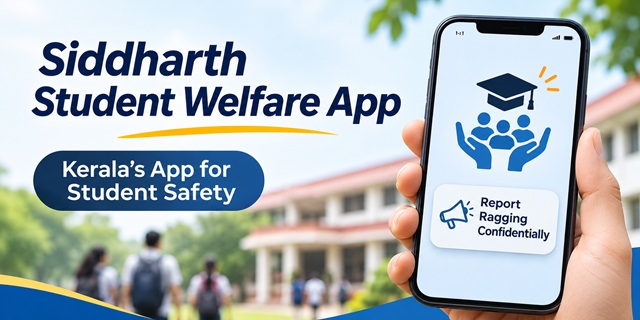
Keralam has launched the Siddharth Student Welfare App to help students report ragging, campus harassment and other problems without revealing their identity. Chief Minister V. D. Satheesan launched the app on 4 November 2026 at Government Women's College in Thiruvananthapuram. Digital University Keralam designed the application.
Students can use the platform to send confidential complaints, record audio messages without disclosing their identity and share safety-related information with the concerned authorities. The government has also confirmed that students can seek help when they face mental distress.
Latest update - 5 November 2026: Keralam has officially launched the app, but an independently verifiable public download link has not been included in the government's launch announcement. Students should wait for a download link published by the Keralam Government or their educational institution. Until then, they can report ragging through the existing college complaint system and the UGC National Anti-Ragging Helpline.
Quick Information About Siddharth Student Welfare App
Siddharth Student Welfare App Highlights |
|
|---|---|
| App Name | Siddharth Student Welfare App |
| Also Known As | Siddharth Distress App / Sidharthan App |
| Launched On | 4 November 2026 |
| Launched By | Chief Minister V. D. Satheesan |
| Launched At | Government Women's College, Thiruvananthapuram |
| Developed By | Digital University Keralam |
| Concerned Department | Higher Education Department, Government of Keralam |
| Main Objective | To provide students with a confidential platform to report ragging, campus problems and mental distress |
| Major Facility | Confidential complaints and audio messages without disclosing the sender's identity |
| Proposed Law | Siddharth Anti-Ragging Act |
| Download Link | Not yet verified through a public government download announcement |
| Official Information | Keralam Government Launch Announcement |
What Is the Siddharth Student Welfare App?
The Siddharth Student Welfare App is a student safety initiative launched by the Government of Keralam. It provides students with another way to inform the authorities about ragging, harassment, campus-related problems and personal distress.
Students may send complaints confidentially through the app. They can also record audio complaints without disclosing their identity and share safety-related information with the authorities concerned.
The government wants students to have a way to seek help when they feel uncomfortable approaching college authorities directly. The app is also intended to strengthen the response against ragging and other activities that affect students' safety on campus.
According to the official Keralam Government launch announcement, the app can be used to report ragging and other problems confidentially and to seek help for mental difficulties.
Why Has Keralam Named the App After Sidharthan?
The app carries the name of Sidharthan, a student who studied at the Veterinary College in Wayanad. His death brought renewed attention to ragging and student safety in educational institutions.
During the launch, Chief Minister V. D. Satheesan said that the idea behind the app came from the wish expressed by Sidharthan's mother that no other student should have to experience what her son went through.
His mother also attended the launch programme. The Chief Minister described the app as a way of assuring students that they are not alone when they face difficulties.
The name appears in different forms in government announcements and public searches, including Siddharth, Sidharthan and Siddharthan. These references relate to the same student safety initiative.
When Was the Siddharth App Launched?
The app was first proposed as part of the Keralam Government's plan to strengthen anti-ragging measures. The following timeline explains how the initiative progressed.
| Date | Development |
|---|---|
| 22 July 2026 | The Keralam Cabinet decided to introduce a new anti-ragging law for colleges and professional educational institutions. It also proposed the Siddharth Distress App to make it easier for students to report ragging complaints. |
| 4 November 2026 | Chief Minister V. D. Satheesan officially launched the Siddharth Student Welfare App at Government Women's College, Thiruvananthapuram. |
| 4 November 2026 | A demonstration at the launch showed a message sent from a student's phone reaching the concerned authorities in real time. |
| Current position | The government has confirmed the launch. The draft Siddharth Anti-Ragging Act remains under government consideration. |
The Cabinet's decision is available in the Keralam Government announcement dated 22 July 2026. The subsequent launch was reported through PRD Live on 4 November 2026.
Key Features of the Siddharth Student Welfare App
The app is designed to give students a convenient way to report problems and seek assistance. Its main features, as described in the government's launch announcement, include the following.
1. Confidential Ragging Complaints
Students can use the app to report ragging and related campus problems without revealing their name to the people receiving the complaint. This facility may help students who hesitate to approach college authorities directly.
2. Audio Complaint Facility
The app allows students to record complaints in their own voice without disclosing their identity. This gives students another way to explain what happened instead of relying only on written messages.
3. Reporting Other Campus Problems
The app is not limited to ragging complaints. Students can also send messages about other problems affecting their safety and well-being on campus.
4. Support During Mental Distress
Students who experience mental difficulties can send a message through the app and seek assistance. The government has described this as one of the purposes of the student welfare platform.
5. Sharing Safety-Related Information
Students can use the application to pass safety-related information to the concerned authorities. This may help the responsible officials become aware of problems that need attention.
6. Real-Time Message Demonstration
During the launch programme, officials demonstrated how a message sent from a student's phone reached the concerned authorities in real time. This showed the communication facility of the app, although the government has not yet published a formal complaint-response timeline.
Who Can Use the Siddharth Student Welfare App?
The Keralam Government has described the application as a platform for students. The Cabinet announcement specifically refers to preventing ragging in colleges and professional educational institutions across the state.
However, the government has not yet published complete user-registration instructions or detailed eligibility conditions. It has also not clarified whether school students, students from institutions outside the state or every category of private educational institution will be able to access the platform.
Students should check the official instructions when the government publishes the app's download and registration details. Until then, they can contact their college administration or anti-ragging nodal officer for assistance.
How Does Anonymous Complaint Reporting Work?
One of the most important features of the Siddharth Student Welfare App is its facility for sending complaints without disclosing the sender's identity.
The government has confirmed that the sender's name will not be revealed and that students can record audio complaints without disclosing their identity. The launch demonstration also showed a message reaching the concerned authorities.
However, the government has not yet published the complete technical and operational details of this facility. In particular, the following information remains to be clarified:
- Which officer or department will receive each category of complaint.
- Whether students need to register or sign in before sending a complaint.
- How the authorities will acknowledge and investigate complaints.
- What response time will apply to complaints submitted through the app.
- How the app stores complaint messages and audio recordings.
- What data-protection and access-control measures the app uses.
Therefore, students should understand the government's confirmed assurance about not revealing the sender's name without assuming that every technical detail about anonymity and data protection has already been published.
Siddharth Student Welfare App Download Link
Students and parents are searching for the Siddharth Student Welfare App download link after its launch. The Keralam Government has announced the launch, but the public launch announcement does not provide a Play Store listing, App Store listing or direct APK download.
| Download Information | Current Status |
|---|---|
| Google Play Store | Official public listing not verified |
| Apple App Store | Official public listing not verified |
| Direct APK Download | No official APK link provided in the launch announcement |
| Official App Website | Not identified in the launch announcement |
| Launch Announcement | View on Keralam PRD Live |
Important: Do not download an APK file or install an application from an unknown website merely because it uses the Siddharth or Sidharthan name. Wait for a link published by the Keralam Government or your educational institution.
Where to Check the Official Download Link
Students can check the following government channels for an official announcement:
- Keralam PRD Live - the Information and Public Relations Department's news portal.
- Higher Education Department, Keralam - the department responsible for higher education-related government information.
- Your college or university's official website and notices.
How to Identify a Fake Siddharth App
Until the government publishes the official download link, students should be careful about applications and APK files circulating on social media.
- Download the app only through a link published by the Keralam Government or your institution.
- Do not install APK files received through WhatsApp, Telegram or unknown websites.
- Check the developer's name against the information published by the government.
- Never share your banking password, OTP or financial details with an application claiming to be the Siddharth app.
- Do not pay anyone who claims to provide special access to the government app.
What Is the Siddharth Anti-Ragging Act?
Along with launching the student welfare app, the Keralam Government is preparing a new law to strengthen action against ragging in colleges and professional educational institutions.
The proposed legislation is called the Siddharth Anti-Ragging Act. The Keralam Cabinet decided on 22 July 2026 to introduce the law in the name of Sidharth, the former Veterinary College student from Wayanad.
The proposed law is intended to provide a legal foundation for the student safety initiative and establish a State Anti-Ragging Commission.
However, the draft Act is still under government consideration, as stated in the official launch announcement dated 4 November 2026. The government has not yet published its complete provisions, proposed penalties or commencement date.
It is important to distinguish the proposed Siddharth Anti-Ragging Act from the existing Keralam Prohibition of Ragging Act, 1998. The proposed legislation is not yet in force, but the 1998 law already prohibits ragging in the state.
What Does the Existing Keralam Anti-Ragging Law Say?
Students do not have to wait for the proposed Siddharth Anti-Ragging Act to receive legal protection. The Keralam Prohibition of Ragging Act, 1998 already prohibits ragging within and outside educational institutions in Keralam.
The Act provides for punishment, dismissal of convicted students and action by the head of an educational institution when someone submits a written complaint.
Definition of Ragging Under Section 2
Section 2 defines ragging as disorderly conduct towards a student that causes or is likely to cause physical or psychological harm, fear, shame or embarrassment.
The definition also covers teasing, abusing, playing practical jokes, causing hurt and asking a student to perform an act that they would not ordinarily do willingly.
Ragging Is Prohibited Under Section 3
Section 3 prohibits ragging both inside and outside an educational institution. Therefore, the prohibition is not limited to activities that take place within the college campus.
Punishment for Ragging Under Section 4
Under Section 4, a person who commits, participates in, abets or promotes ragging can face the following punishment upon conviction:
- Imprisonment for a term of up to two years.
- A fine of up to ₹10,000.
Dismissal of a Convicted Student Under Section 5
Section 5 provides that a student convicted of ragging must be dismissed from the educational institution. The student cannot be admitted to another educational institution for three years from the date of the dismissal order.
Action on a Written Complaint Under Section 6
Section 6 explains the responsibility of the head of an educational institution when someone reports ragging in writing.
- A student, parent, guardian or teacher can submit a written complaint to the head of the institution.
- The head must enquire into the complaint within seven days of receiving it.
- If the complaint appears prima facie true, the accused student must be suspended.
- The complaint must then be forwarded immediately to the police station having jurisdiction over the institution.
- If the enquiry finds no prima facie substance in the complaint, the complainant must receive written information about that finding.
Responsibility of the Institution Head Under Section 7
Section 7 also makes the head of an educational institution accountable for failing or neglecting to take the action required under Section 6. Such failure is treated as deemed abetment of the ragging offence and can attract the punishment provided under Section 4.
You can read the complete law in the Keralam Prohibition of Ragging Act, 1998 - official India Code PDF.
How to Report Ragging in Keralam Before the App Becomes Available
Students do not need to wait for the Siddharth app to report ragging. Keralam's existing law and the UGC anti-ragging system already provide ways to raise complaints.
1. Submit a Written Complaint to the Principal
Write a complaint addressed to the principal or head of your educational institution. Explain what happened, when and where the incident took place, and provide the available details about the people involved.
Submit the complaint in writing and keep a dated copy or acknowledgement. Under Section 6 of the Keralam Prohibition of Ragging Act, 1998, the head of the institution must enquire into the complaint within seven days.
2. Contact the College Anti-Ragging Committee
Students can approach their institution's anti-ragging committee, anti-ragging squad or designated nodal officer. These bodies handle complaints and help institutions implement anti-ragging measures.
Check your college website, student handbook, notice board or hostel office for the contact details of the responsible officer.
3. Call the National Anti-Ragging Helpline
The University Grants Commission operates a 24-hour toll-free National Anti-Ragging Helpline. Students can use it to report ragging incidents and seek assistance.
| Helpline | 1800-180-5522 |
| Availability | 24 hours |
| Charges | Toll-free |
| [email protected] | |
| Official Website | University Grants Commission |
The UGC's official website lists 1800-180-5522 as its 24x7 anti-ragging helpline. Students can also check the UGC website for anti-ragging information.
4. Approach the Police in Serious Cases
If ragging involves physical assault, threats, serious harassment or immediate danger, contact the nearest police station. Do not delay seeking help while waiting for an app response or an internal college enquiry.
If a student is injured or faces an immediate threat, arrange medical assistance and contact the police as soon as possible.
Support for Students Experiencing Mental Distress
Ragging and harassment can affect a student's mental well-being. A student who feels frightened, isolated or emotionally overwhelmed should speak to someone they trust and seek professional support when needed.
The Government of India's Tele-MANAS service provides tele-mental health support through the following numbers:
- 14416
- 1-800-891-4416
Students can use the service to seek mental health assistance. For immediate danger or a medical emergency, contact the appropriate emergency service or visit the nearest hospital.
More information is available through the Ministry of Health and Family Welfare.
What Parents Should Do If Their Child Faces Ragging
Parents can play an important role in identifying and reporting ragging. A student may hesitate to discuss the problem because of fear, pressure or concern about what might happen after making a complaint.
Parents can take the following steps:
- Speak with the child regularly and listen calmly when they describe a problem.
- Look for changes in behaviour, such as fear of attending college, withdrawal from family, sleep problems or unexplained injuries.
- Keep available evidence, including messages, photographs, medical records and details of incidents.
- Submit a written complaint to the principal or head of the institution.
- Keep a copy or acknowledgement of the complaint.
- Contact the UGC National Anti-Ragging Helpline at 1800-180-5522 if further assistance is required.
- Seek counselling or professional mental health support if the child is experiencing distress.
Section 6 of the Keralam Prohibition of Ragging Act, 1998 specifically allows a parent or guardian to submit a written ragging complaint to the head of the institution.
Responsibilities of Colleges Under Anti-Ragging Rules
The launch of the Siddharth Student Welfare App does not replace the existing responsibilities of educational institutions. Colleges and universities must continue to follow the applicable UGC anti-ragging regulations and directions.
UGC's anti-ragging framework requires institutions to maintain arrangements for preventing ragging and responding to complaints. These include:
- Constituting an anti-ragging committee and an anti-ragging squad.
- Appointing responsible officers and making their contact details available to students.
- Displaying anti-ragging information and warnings at appropriate locations on campus.
- Obtaining the prescribed anti-ragging undertakings from students and their parents or guardians.
- Conducting awareness activities and counselling programmes.
- Taking appropriate action when a ragging complaint is received.
Students can check the UGC's official website for its anti-ragging regulations, notices and related guidance.
Important Official Links
| Purpose | Official Link |
|---|---|
| App Launch Announcement | Keralam PRD Live 4 November 2026 |
| Cabinet Decision on the App and Proposed Law | Keralam PRD Live 22 July 2026 |
| Keralam Higher Education Department | Official Website |
| Keralam Prohibition of Ragging Act, 1998 | Read the Act on India Code |
| National Anti-Ragging Helpline | University Grants Commission |
| Tele-MANAS Information | Ministry of Health and Family Welfare |
Add new comment