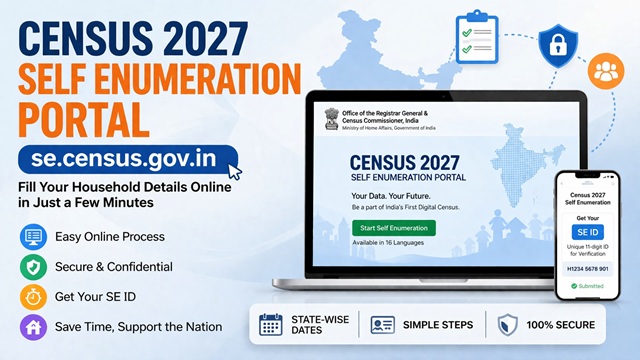
The Government of India has launched the Census 2027 Self Enumeration Portal at se.census.gov.in to let citizens submit their household details online before a census officer visits their home. This is India's first digital census, and self-enumeration is one of its most important new features.
This guide explains how to do Census 2027 self-enumeration online step-by-step, how to log in to se.census.gov.in, how to generate your SE ID, state-wise last dates, required details, and important rules. If you are searching "how to fill census form online" or "self enumeration kaise kare", this article will help you complete the process easily.
Census 2027 Self Enumeration – Overview
- Conducted By: Office of the Registrar General & Census Commissioner, India (ORGI), Ministry of Home Affairs
- Census Number: 16th Census of India, 8th since Independence
- Type: India's First Digital Census
- Self Enumeration Portal: https://se.census.gov.in/
- Phase I Period: April 1 to September 30, 2026 (HLO)
- Phase II: February 2027 (Population Enumeration)
- Reference Date: 00:00 hours of March 1, 2027
- Total Budget Approved: ₹11,718.24 crore
- Languages Supported: 16 (Hindi, English, and 14 regional languages)
What is Census 2027 Self Enumeration?
Self Enumeration (SE) is a new facility introduced for Census 2027 that allows any household to fill their official census data online through the government portal at se.census.gov.in. You do not need to wait for a census officer to visit your home.
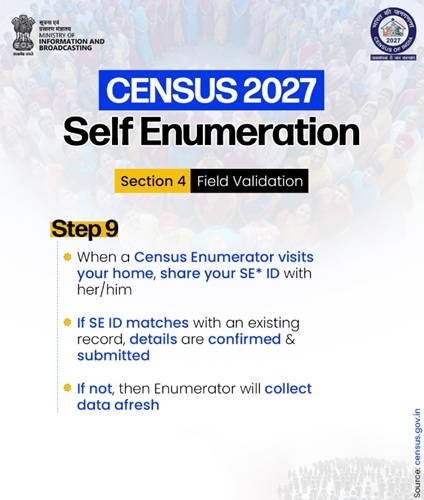
After you submit the form, a unique 11-digit Self Enumeration ID (SE ID) starting with the letter "H" is generated. You share this SE ID with the enumerator when they visit your home for field verification. Your data is then confirmed and included in the census.
The entire process takes approximately 15 to 20 minutes. The portal works on both mobile phones and computers, though using a laptop or desktop is recommended for the map-marking step.
Why Was Census Delayed Until 2027?
The previous Census of India was conducted in 2011. Census 2021 was planned but had to be postponed due to the COVID-19 pandemic. The Government of India officially notified the intent to conduct Census 2027 in the Gazette of India on June 16, 2025. Census 2027 will cover 36 States and UTs, 7,092 sub-districts, 5,128 statutory towns, 4,580 census towns, and approximately 6,39,902 villages.
Census 2027 Phases
Phase I – Houselisting and Housing Census (HLO): April 1 to September 30, 2026. Each State and UT gets a 30-day window for door-to-door field work, preceded by a 15-day self-enumeration window. This phase collects data on housing conditions, amenities, and household assets through 33 notified questions.
Phase II – Population Enumeration (PE): February 2027 (for Ladakh, snow-bound areas of J&K, Uttarakhand, and Himachal Pradesh — September 2026). This phase collects demographic, socio-economic, education, migration, and fertility data from each individual. Caste enumeration will also be done in this phase, for the first time since Independence.
State-Wise Self Enumeration and HLO Dates (Phase I)
The self enumeration window opens 15 days before the door-to-door survey begins in your state or UT. Check the table below to find your state's dates.
| State / UT | Self-Enumeration Period | Houselisting & Housing Census Period |
|---|---|---|
|
1 April to 15 April | 16 April to 15 May |
|
5 April to 19 April | 20 April to 19 May |
|
10 April to 24 April | 25 April to 24 May |
|
16 April to 30 April | 1 May to 30 May |
|
17 April to 1 May | 2 May to 31 May |
|
26 April to 10 May | 11 May to 9 June |
|
30 April to 14 May | 15 May to 13 June |
|
1 May to 15 May | 16 May to 14 June |
|
7 May to 21 May | 22 May to 20 June |
|
17 May to 31 May | 1 June to 30 June |
|
1 June to 15 June | 16 June to 15 July |
|
16 June to 30 June | 1 July to 30 July |
|
17 July to 31 July | 1 August to 30 August |
|
2 August to 16 August | 17 August to 15 September |
|
17 August to 31 August | 1 September to 30 September |
|
To be notified | To be notified |
|
To be decided | To be decided |
What Information Is Collected in Phase I?
Phase I has 33 notified questions covering the following categories:
- Building and Housing: Materials used for floor, walls, and roof; condition of the house; number of rooms; ownership status
- Amenities: Drinking water source, toilet facility, electricity, cooking fuel
- Assets: Radio, television, internet access, laptop or computer, telephone or mobile phone, bicycle, two-wheeler, four-wheeler
- Household basics: Number of usual residents, head of household details, number of married couples, caste or tribe category
- New in 2027: Internet access, main cereal consumed, mobile number for census communication
Note: Individual details like name, age, education, and occupation of family members will be collected in Phase II (Population Enumeration), not in Phase I.
Documents and Details Required
- Mobile number of any household member (for OTP verification - one number per household, cannot be reused for another household)
- Email address (optional - to receive SE ID by email)
- Basic address details - district, PIN code, locality or village name
- Information about your house type, rooms, amenities, and assets
- Aadhaar card or PAN card can be kept handy to fill details accurately
How to Fill Census 2027 Self Enumeration Form Online – Step by Step
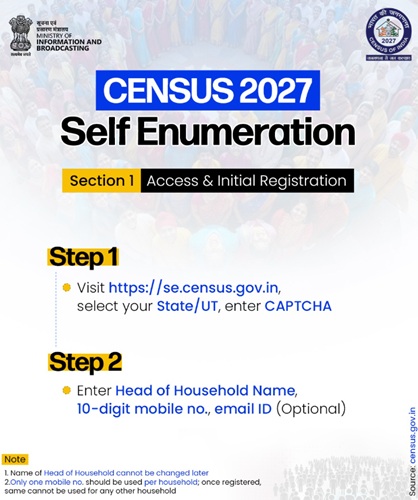
- Visit the official portal: https://se.census.gov.in/
- Select your State/UT from the dropdown and enter the captcha to proceed.
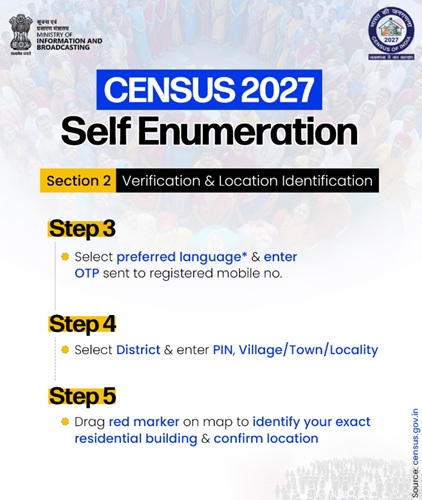
- Choose your preferred language. (This cannot be changed after confirmation, so select carefully)
- Enter the name of the Head of Household - this name cannot be changed after registration.
- Provide a mobile number and optionally an email address. Enter the OTP sent to your mobile to verify.
- Select your District, enter PIN code, and provide your village, locality, or street name. Click Search to locate your area.
- Mark your house location on the digital map. (Using a desktop is easier for this step)
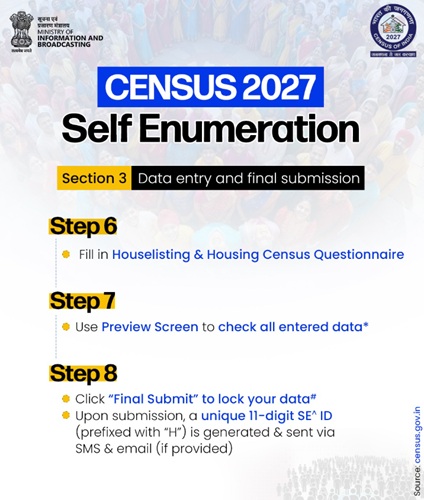
- Fill in all 33 housing details carefully. Tooltips are available on the portal for each question to guide you.
- You can save the form as a draft and return to complete it before the closing date.
- Review all details and click "Final Submit" - no changes can be made after this step.
- Your unique 11-digit SE ID (prefixed with "H") will be generated and displayed. It is also sent by SMS and email. (if provided)
- Save the SE ID or take a screenshot. You can also retrieve it later from the portal using your registered mobile number.
What is SE ID and Why Is It Important?
SE ID (Self Enumeration ID) is a unique 11-digit number starting with "H" that is generated after successful form submission. It serves as proof that you have completed self-enumeration.
- Share it with the census enumerator when they visit your home for field verification.
- The enumerator matches your SE ID with their device record to confirm your data.
- If there is no match, the enumerator will collect your data manually.
- You can retrieve your SE ID at any time from the portal using your registered mobile number.
- Do not share your SE ID publicly.
Is Self Enumeration Mandatory?
No. Self-enumeration is optional. Even if you do not self-enumerate, a census officer will visit your home and collect your data through the door-to-door survey. However, self-enumeration helps you save time and contributes to faster, more accurate data collection for the country.
Self Enumeration Participation So Far
As of April 10, 2026, more than 5.72 lakh households across India had already used the self-enumeration facility. On the very first day (April 1, 2026), approximately 55,000 households submitted their details online. President Droupadi Murmu was the first citizen to complete self-enumeration, followed by Vice-President C.P. Radhakrishnan, Prime Minister Narendra Modi, and Home Minister Amit Shah.
Data Security and Privacy
All data collected under the Census Act, 1948 is strictly confidential. The digital tools used for Census 2027 are equipped with robust encryption and multi-factor authentication. Data entered in the self-enumeration portal is protected and will not be shared publicly. Providing deliberately false information is a punishable offence under the Census Act, 1948.
Important Instructions
- Use only one mobile number per household. The same number cannot be used for any other household.
- Enter the Head of Household's name carefully - it cannot be changed after registration.
- Select your language carefully before proceeding - it cannot be changed after confirmation.
- Do not click Final Submit until you have reviewed all details. No edits are possible after final submission.
- The last date of submission is displayed as a scrolling notice on all portal pages. Complete before this date or your submission will not be considered valid.
- Save or screenshot your SE ID immediately after submission.
Common Mistakes to Avoid
- Entering an incorrect name for the Head of Household. (cannot be corrected later)
- Using a mobile number that belongs to another household.
- Missing the final submission deadline - a saved draft is not the same as a completed submission.
- Not noting down the SE ID before closing the browser.
- Selecting the wrong language at the start of the process.
Important Links
- Self Enumeration Portal: https://se.census.gov.in/
- Official Census India Website: https://censusindia.gov.in/
Difference Between Self-Enumeration and Enumerator Survey
- Self Enumeration: You fill your data online yourself before the survey.
- Enumerator Survey: A government officer visits your house and collects data manually.
- Verification: Even after self enumeration, enumerator verification is mandatory.
- Convenience: Self enumeration saves time and reduces errors.
Conclusion
The Census 2027 Self Enumeration Portal at se.census.gov.in allows you to complete your census process in just 15–20 minutes from home. It is simple, secure, and helps the government collect accurate national data. Check your state's self-enumeration dates, complete your form before the deadline, and keep your SE ID safe for verification.
Add new comment