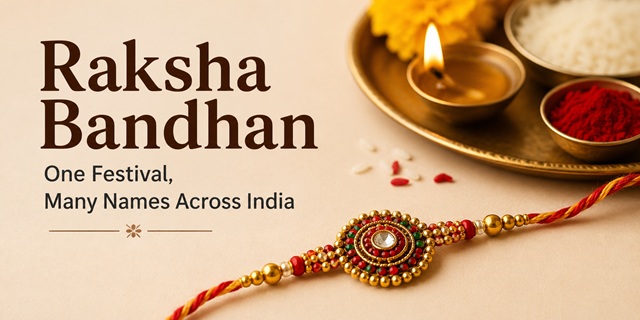
Most people know this festival as Raksha Bandhan. However, on the same day, different parts of India celebrate it under completely different names and traditions.
On 28 August 2026, the full moon day of Shravan Purnima will be observed across the country. In North India, sisters will tie Rakhi on their brothers' wrists. In Maharashtra, coastal communities will celebrate Narali Purnima. In Tamil Nadu, Kerala, Andhra Pradesh and parts of Karnataka, Brahmins will observe Avani Avittam and change their sacred thread. In Odisha, people will celebrate Gamha Purnima, while several farming communities across central India will mark the occasion with agricultural rituals.
One full moon. One date. Many names and traditions.
This guide explains what Raksha Bandhan is called in different states of India, why the same festival has multiple names, and how each region celebrates Shravan Purnima in its own unique way.
Quick Facts
| Detail | Information |
|---|---|
| Date in 2026 | 28 August 2026 (Friday) |
| Main Hindu lunar occasion | Shravan Purnima (Full Moon of the Shravan month) |
| Most common name in North India | Raksha Bandhan / Rakhi Purnima |
| Popular regional names | Narali Purnima, Avani Avittam, Gamha Purnima, Kajari Purnima, Pavitropana and others |
| Purnima Tithi Begins | 27 August 2026 |
| Purnima Tithi Ends | 28 August 2026 |
| Observed across India | Yes |
| Primary significance | Sibling bond, protection rituals, sacred thread ceremonies and regional harvest traditions |
What Is Raksha Bandhan Called in Different Parts of India?
| Name | Where It Is Celebrated | Main Tradition |
|---|---|---|
| Raksha Bandhan / Rakhi | North India and most parts of the country | Sisters tie Rakhi on the wrists of their brothers and pray for their wellbeing |
| Rakhi Purnima | West Bengal, Odisha and parts of Eastern India | The Rakhi festival observed on the Shravan Purnima full moon day |
| Rakhri / Rakhdi | Punjab and Rajasthan | Regional names commonly used for Rakhi and Raksha Bandhan celebrations |
| Saluno / Silono | Punjab, Himachal Pradesh and some parts of Uttar Pradesh | Local Raksha Bandhan traditions combined with protective rituals |
| Narali Purnima | Maharashtra and the Konkan Coast | Fisherfolk offer coconuts to the sea and pray for safety and prosperity |
| Kajari Purnima | Madhya Pradesh, Bihar, Chhattisgarh and Jharkhand | Women and farming communities pray for family wellbeing and a good agricultural season |
| Pavitropana | Gujarat | Devotees offer sacred threads to Lord Shiva and perform special worship |
| Avani Avittam | Tamil Nadu and Kerala | Brahmin men renew their sacred thread and perform Vedic rituals |
| Jandhyala Purnima | Andhra Pradesh and Telangana | Sacred thread renewal ceremony observed by Brahmin communities |
| Shravani / Upakarma | Various Brahmin communities across India | Annual renewal of the Yajnopavita (sacred thread) and Vedic study rituals |
Although these celebrations have different names and customs, they all fall on Shravan Purnima, the full moon day of the Hindu month of Shravan. This is why a single date can carry so many different cultural identities across India.
Rakhi and Rakhi Purnima
This is the name most of India now uses, and the one that has travelled furthest.
Raksha Bandhan literally means the bond of protection. A sister ties a decorated thread on her brother's wrist, applies tilak on his forehead, and prays for his wellbeing. He gives her a gift and promises to protect her.
In eastern India, particularly West Bengal and Odisha, it is called Rakhi Purnima, naming the day by its full moon rather than by the act.
The custom has spread well beyond blood siblings. Cousins, close friends and neighbours tie rakhis, and families increasingly include anyone who would otherwise be left out of the day.
Rakhri and Rakhdi
In Punjab and Rajasthan, the thread itself is called a rakhri or rakhdi, and the festival takes its name from it.
This is a linguistic variation rather than a different ritual. If you hear someone in Punjab say they are going home for Rakhri, they mean Raksha Bandhan.
Saluno and Silono
In parts of Punjab, Himachal Pradesh and western Uttar Pradesh, the day is known as Saluno or Silono.
These names appear alongside Rakhi and Rakhri as the recognised alternative names for the festival. The core ritual remains the same, with sisters tying threads on their brothers' wrists, but the local name and the customs around it differ from village to village.
Narali Purnima: The Coconut Offered to the Sea
This is the most visually distinct celebration of the day, and it has nothing to do with siblings.
Along the Maharashtra coast and the Konkan, fishing communities observe Narali Purnima. Naral means coconut.
What happens:
- Fishermen offer a coconut to the sea, in honour of Varuna, the god of the waters
- The offering marks the end of the monsoon fishing ban
- Boats are decorated, and deep sea fishing resumes after the monsoon months
- Prayers are offered for a safe and successful fishing season
Why the coconut. The monsoon makes the Arabian Sea dangerous, and fishing communities stay ashore for weeks. Narali Purnima is the day the sea is formally asked for safe passage before boats go out again. It is a working calendar marker as much as a religious observance.
In coastal Maharashtra, families observe both. The coconut goes to the sea, and the rakhi is tied at home.
Kajari Purnima: The Farmers' Full Moon
In Madhya Pradesh, Bihar, Chhattisgarh and Jharkhand, the day is Kajari Purnima, also written Kajri Purnima.
What happens:
- Farming families pray for a good harvest and for the wellbeing of the household
- The day is associated with the sowing of wheat, which begins around this point in the agricultural calendar
- Prayers are offered for prosperity and rain in the right measure
The logic is agricultural. Shravan Purnima falls at the turn of the monsoon, when the rains are ending and the next sowing season is about to begin. For a farming household, that is a moment worth marking, and the full moon provides the date.
Like coastal Maharashtra, these regions observe both. Kajari Purnima and Rakhi run on the same day.
Pavitropana: Sacred Threads for Shiva
In Gujarat, Shaivites observe Pavitropana on this day.
What happens: sacred threads, called pavitra, are offered to Shiva. It is a day of ritual purity, and the observance sits within the wider devotion to Shiva that runs through the month of Shravan.
Gujarat observes the rakhi custom alongside it.
Note the pattern. Gujarat's version also involves a sacred thread, but the thread goes to a deity rather than onto a wrist. That connection is not a coincidence, and the next section explains why.
Avani Avittam and Upakarmam: Changing the Sacred Thread
In Tamil Nadu and Kerala, the day is Avani Avittam, also known as Upakarmam.
What happens:
- Brahmin men change the sacred thread, the Yagnopavit or janeu
- The old thread is ritually discarded and a new one is sanctified and worn
- The day involves Vedic recitation and prayers, including the Gayatri Mantra
- It marks the beginning of a new cycle of Vedic study
Avani is the Tamil month and Avittam is the star, which is how the day gets its name in the Tamil calendar.
In much of South India, this is the observance. The sibling rakhi ritual arrived later and is now widely followed, but Avani Avittam is what the day traditionally means there.
Jandhyala Purnima
In Andhra Pradesh and Telangana, the same ceremony is called Jandhyala Purnima.
Jandhyam is the Telugu word for the sacred thread. The main ritual of the day is changing the Jandhyam or Yagnopaveetham, exactly as in Avani Avittam further south.
Shravani and Upakarma
In North and West India, and among Brahmin communities across the country, the day is known as Shravani, and the ceremony as Shravani Upakarma.
It is the annual renewal of the Yagnopavit, the same observance as Avani Avittam and Jandhyala Purnima under a different regional name.
In Rajasthan and elsewhere in the north, Brahmin families observe Shravani on the same day that the rest of the household ties rakhis.
Why One Day Has So Many Names
This is the question the lists never answer, and the answer explains the whole pattern.
Look at what most of these names actually describe.
- Avani Avittam: changing the sacred thread
- Jandhyala Purnima: changing the sacred thread
- Shravani Upakarma: changing the sacred thread
- Pavitropana: offering sacred threads to Shiva
Four of them are about a thread. And Raksha Bandhan is also about a thread.
At its base, Shravan Purnima is a Vedic full moon observance centred on the sacred thread, renewed once a year, marking the start of a fresh cycle of study. That is the older layer, and it survives across the south, in Gujarat, and in Brahmin communities everywhere under different local names.
The sibling rakhi is a later layer added on top. Threads tied for protection appear in early texts, offered before a journey or a battle. Over centuries the custom settled into the brother and sister ceremony, took hold in northern India, and from there spread across the country.
So the many names are not ten separate festivals that happen to collide. They are different layers of the same full moon, some older than others, some agricultural, some maritime, some Vedic, all landing on the same night.
Narali Purnima and Kajari Purnima sit slightly apart from that thread lineage. Those are working calendars, the sea and the soil, marking the end of the monsoon in the way each community actually experiences it.
Why the Date Is the Same Everywhere
This surprises people who know how inconsistent Hindu festival dates can be.
Many festivals fall on different dates in different states, because North India follows the Purnimanta calendar and Gujarat, Maharashtra and the South follow the Amanta calendar. Those two can diverge by weeks.
Raksha Bandhan escapes that problem. It is anchored to Shravana Purnima, the full moon itself, and the moon becomes full at one moment for everyone. There is nothing for the two calendars to disagree about.
That is why the whole country observes it on Friday, 28 August 2026, whatever it calls the day.
Timing in 2026
- Purnima tithi begins: 9:08 AM on 27 August 2026
- Purnima tithi ends: around 9:48 AM on 28 August 2026
- Bhadra: ends before sunrise on 28 August
- Window for tying the rakhi: from sunrise until the tithi ends, roughly 6:23 AM to 9:48 AM
This year is unusually easy. Bhadra, the period traditionally avoided for tying a rakhi, ends before sunrise in 2026. There is no waiting for it to pass, which in some years pushes the ceremony into the afternoon or evening.
But the window is a morning one. The tithi ends before 10 AM, so families who plan for an evening ceremony out of habit should check the timing this year.
A correction on the date
Some websites list Raksha Bandhan 2026 as 9 August or 19 August. Both are wrong. 9 August was the 2025 date. In 2026 the festival falls on 28 August.
Where It Is a Bank Holiday
Raksha Bandhan is a bank holiday in Uttar Pradesh, Gujarat, Rajasthan, Madhya Pradesh, Chhattisgarh and Haryana.
Bank holidays in India are notified state by state, so a holiday in one state does not mean banks are shut in another. If you have a payment, a cheque clearance or a branch visit planned around 28 August, check your own state rather than assuming, and confirm against the current Reserve Bank of India holiday list for your state.
Related Festivals of the Sibling Bond
Raksha Bandhan is not the only day in the Indian calendar that marks the brother and sister relationship.
- Bhai Duj, observed after Diwali, when sisters apply tilak and pray for their brothers' long life
- Bhai Tika, the Nepali observance of the same occasion
- Sama Chakeva, celebrated in Mithila in Bihar and in parts of Nepal, a folk festival of the sibling bond told through birds and song
Between them, these festivals mark the same relationship at different points in the year and in very different registers.
Add new comment