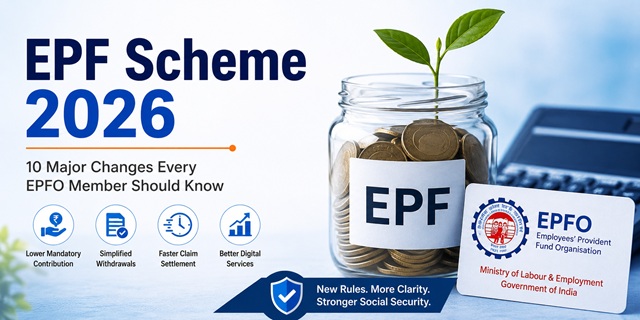
The Government of India has notified the Employees' Provident Funds Scheme, 2026, replacing the Employees' Provident Funds Scheme, 1952, under the framework of the Code on Social Security, 2020. The new scheme operates under the Code on Social Security, 2020 and brings the most significant changes to provident fund rules in decades. If you are a salaried employee contributing to EPF, here is exactly what has changed and what it means for your salary and savings.
What Changed at a Glance
| What Changed | Old Rule | New Rule (2026) |
|---|---|---|
| Mandatory contribution cap | Often deducted on full basic salary | Compulsory only on Rs. 15,000 (max Rs. 1,800/month) |
| Voluntary PF above ceiling | Legally ambiguous | Formally recognised as voluntary |
| Withdrawal categories | 13 separate categories | Simplified to 3 categories |
| Maximum withdrawal | Percentage-based per category | Up to 100% of eligible balance (25% must stay) |
| Pension claim settlement | 30 days | 20 days (with 12% interest for delays) |
| Auto-settlement limit | Rs. 1 lakh | Rs. 5 lakh |
| Legal framework | EPF Act, 1952 | Code on Social Security, 2020 |
Change 1: Your Mandatory PF Contribution is Now Capped at Rs. 1,800
This is the most talked-about change. Under the EPF Scheme, 2026, the mandatory employee contribution is 12% of the statutory wage ceiling of Rs. 15,000 per month, which works out to Rs. 1,800. Any contribution above this amount is now formally voluntary.
What this means in practice:
- If your basic salary is Rs. 15,000 or below, nothing changes for you. You continue contributing Rs. 1,800 per month.
- If your basic salary is Rs. 30,000, your employer was likely deducting Rs. 3,600 (12% of Rs. 30,000). Under the new rules, only Rs. 1,800 is compulsory. The extra Rs. 1,800 is now voluntary.
- If your basic salary is Rs. 1 lakh, even then only Rs. 1,800 is the mandatory contribution.
However, do not assume your take-home salary will automatically increase. Many private companies have EPF policies built into salary structures that deduct PF on actual basic pay. Those policies remain in place unless the employer revises them or you formally request a change. Talk to your HR team before assuming you will see more money in your account.
Employees who want to continue saving more can still do so through the Voluntary Provident Fund (VPF). But the employer is no longer legally required to match contributions above the Rs. 1,800 statutory amount unless your employment contract says otherwise.
Change 2: PF Withdrawal is Now Simpler - 3 Categories Instead of 13
Earlier, EPFO had 13 separate withdrawal categories, each with its own eligibility conditions and documentation. This created confusion and delayed claims. The EPF Scheme, 2026 consolidates all of them into three broad categories:
- Essential needs - covers illness, higher education, and marriage
- Housing needs - covers house purchase, construction, home loan repayment, and renovation
- Special circumstances - covers unemployment, natural disasters, and other exceptional situations
This change reduces paperwork, removes confusion about which category to apply under, and speeds up online claim processing. Members no longer need to match their reason to a specific numbered category from a long list.
Change 3: You Can Now Withdraw Up to 100% of Your Eligible Balance
Under the new scheme, EPFO members can withdraw up to 100% of their eligible balance for qualifying purposes. The key condition is that at least 25% of total contributions must remain in the account at all times during active service.
So if your total eligible EPF balance is Rs. 1 lakh, you must keep Rs. 25,000 in the account. The remaining Rs. 75,000 is available for withdrawal subject to the applicable category rules.
This 25% protected balance continues to earn interest, which means your retirement corpus grows even after you make a partial withdrawal.
Change 4: Pension Claims Must Be Settled in 20 Days
The old EPS-95 scheme had a 30-day limit for settling pension claims. The new Employees' Pension Scheme, 2026 has brought this down to 20 days. But the more significant change is the accountability mechanism that comes with it.
If EPFO delays settling a valid pension claim without sufficient reason, the organisation must pay 12% annual interest on the delayed amount. More importantly, this interest is recovered from the salary of the responsible EPF Commissioner. This introduces personal accountability for administrative delays, which was absent under the previous framework.
For existing pensioners, the current pension amounts and payment schedules remain unchanged. New EPS members joining from 29 June 2026 will be governed by the 2026 scheme rules.
Change 5: Auto-Settlement Limit Raised to Rs. 5 Lakh
EPFO's auto-settlement system processes eligible claims automatically without manual review. The limit for this has been raised from Rs. 1 lakh to Rs. 5 lakh under the 2026 upgrade.
This means claims up to Rs. 5 lakh from KYC-compliant accounts can be processed within hours to a few days, without any manual intervention from an EPFO officer. Claims above Rs. 5 lakh will still go through the standard manual review process.
To benefit from auto-settlement, your UAN must have Aadhaar, PAN, and bank account verified and digitally approved in your EPFO profile. If your KYC is incomplete, auto-settlement will not work even for small claims.
What is EPFO 3.0 and When Will UPI Withdrawal Start
EPFO 3.0 is the digital infrastructure upgrade that runs alongside the new EPF Scheme, 2026. It is built on a cloud-based IT platform and is designed to support features that will eventually let members withdraw PF directly via UPI and dedicated EPFO ATM cards.
Testing of the UPI and ATM withdrawal facility has been completed. Labour and Employment Minister Mansukh Mandaviya confirmed this in recent statements. However, EPFO has not announced an official launch date for public rollout. Until official guidelines are published, treat UPI and ATM-based PF withdrawal as an upcoming feature, not a live one.
Other confirmed EPFO 3.0 improvements already live or rolling out include:
- Face authentication through the UMANG app for identity verification without visiting offices
- KYC updates using Aadhaar OTP instead of physical visits
- Passbook Lite for quick balance and transaction checks
- UAN activation using face authentication on the UMANG app
- Annexure-K download directly from the EPFO Member Portal
- Claim submission without uploading cheque leaf or bank passbook copy
EPF Interest Rate for FY 2025-26
The Central Board of Trustees has approved an EPF interest rate of 8.25% for FY 2025-26. This rate applies to all active EPF accounts. The interest is calculated on the monthly running balance and credited to accounts at the end of the financial year. No action is needed from members for interest credit.
What Stays the Same Under EPF Scheme 2026
Despite the wide coverage this update has received, most day-to-day aspects remain unchanged. The 12% contribution rate continues. Withdrawal rules for retirement, resignation, and transfers are the same. EPF interest rates continue to be decided by the Central Board of Trustees. Tax treatment, nomination rules, and transfer of PF balances are all unchanged. Existing members do not need to re-register or take any action.
What You Should Do Right Now
- Log in to the EPFO member portal at unifiedportal-mem.epfindia.gov.in and check that your Aadhaar, PAN, and bank account are linked and show Digitally Approved status.
- Verify that your name, date of birth, and other details match exactly across your Aadhaar Card, PAN, and EPFO records. Mismatches cause claim rejections under both old and new rules.
- Check your UPI ID is active with the same bank account linked to your EPFO profile. This will matter when UPI withdrawals go live.
- If your basic salary exceeds Rs. 15,000 and you want to change your PF contribution, speak to your HR or payroll team about what is permissible under your company policy.
- Download the UMANG app and link your UAN for access to face authentication and Passbook Lite features already available.
- If you are a pensioner, check that your bank account linked to your EPS pension is active and updated in your EPFO profile.
How to Access EPFO Services
The EPFO Member Portal is available at unifiedportal-mem.epfindia.gov.in. Log in using your UAN and password. For pension-related services, visit epfindia.gov.in. The UMANG app (available on Android and iOS) provides mobile access to most EPFO services. For queries, call the EPFO helpline at 14470.
Add new comment