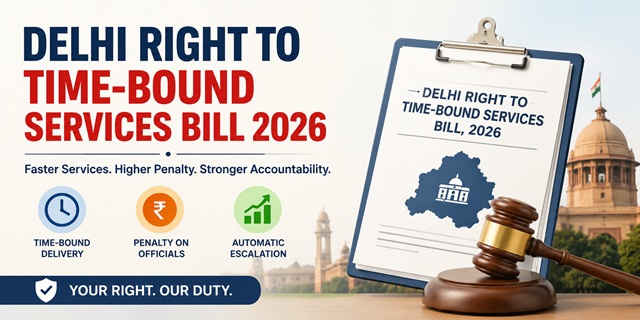
The Delhi Cabinet approved the Delhi (Right of Citizen to Time Bound and Ease of Delivery of Services) Bill, 2026 on 15 July 2026. Chief Minister Rekha Gupta chaired the cabinet meeting where the Bill was cleared. The Bill will now be introduced in the upcoming Monsoon Session of the Delhi Legislative Assembly before it becomes law.
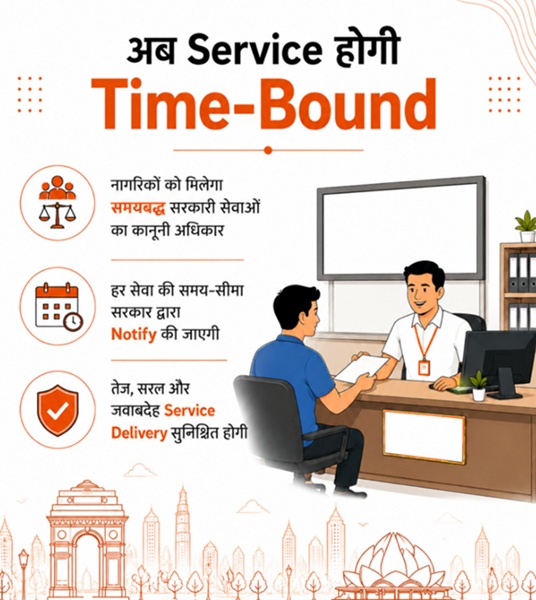
In simple terms, this Bill makes it a legal right for every Delhi resident to receive government services within a fixed time limit. If any government official delays your service without a valid reason, they face a financial penalty. If the delay is not fixed at the department level, your complaint automatically escalates to a higher authority without you having to file anything separately.
The Bill replaces the older Delhi Right of Citizen to Time Bound Delivery of Services Act, 2011, which had lower penalties and no automatic escalation system.
Quick Facts
| Detail | Information |
|---|---|
| Full name of Bill | Delhi (Right of Citizen to Time Bound and Ease of Delivery of Services) Bill, 2026 |
| Cabinet approval date | 15 July 2026 |
| Approved by | Delhi Cabinet chaired by CM Rekha Gupta |
| Replaces | Delhi Right of Citizen to Time Bound Delivery of Services Act, 2011 |
| Services currently covered | 560 government services |
| Penalty for delay | Rs 250 per day, maximum Rs 5,000 |
| Penalty for rejection without reason | Rs 250 to Rs 5,000 (one-time) |
| Next step | Introduction in Monsoon Session of Delhi Assembly |
What Problem Does This Bill Solve
If you have ever visited a Delhi government office to get a caste certificate, income certificate, ration card, trade licence, or any other document, you know the experience. Multiple visits, no clear timeline, no one accountable, and no way to escalate quickly if things stall.
The 2011 Act tried to fix this but had two big weaknesses. The penalty on officials was only Rs 10 to Rs 200 per day, which was not strong enough to push accountability. And there was no automatic escalation, meaning if an official ignored your complaint, you had to separately find and approach a higher authority yourself.
The 2026 Bill fixes both of these. It raises the daily penalty to Rs 250, uses technology to deliver services entirely online, and makes escalation automatic so your complaint moves up the chain without any extra effort from you.

What Changes for You as a Delhi Resident
You get a legal right to services on time. Once the Bill becomes law, Delhi will notify which services fall under it, the exact timeline for each, and which officer is responsible. If your application is not processed within that time, the law protects you.
You apply online and get a tracking number. The entire service delivery process moves online. You submit your application digitally, receive a unique application number, and track the status in real time on your phone or computer. You do not need to visit any office.
Delay automatically becomes a complaint. If your service is not delivered on time, the system treats it as an appeal automatically. You do not need to file a separate complaint. The case moves to the Citizen Grievance Redressal Authority of the concerned department on its own.
If that level fails, it escalates again automatically. If the department authority does not resolve the matter within 30 days, it automatically goes to the Delhi Right to Service Commission. Again, you do not need to do anything for this escalation to happen.
560 Services Covered: What Does That Include
The Delhi government currently covers 560 services under the time-bound delivery mechanism. Services span all major departments that citizens interact with regularly. Common examples include:
- Revenue department: caste certificates, income certificates, domicile certificates, and land records
- Food and civil supplies: ration card issuance and corrections
- Transport: driving licences and vehicle registrations
- Trade and taxes: trade licences and business registrations
- Urban development: building approvals and NOCs
- Public utilities: water connections and electricity connections
In June 2026, just before the Bill was approved, the Delhi government added 23 more services to the system. These include approvals for new factory plans, sewage connection approvals, and permissions for shooting films in Delhi, all within a 15-day limit. More services will be added by government notification over time.
How the Three-Level System Works
The Bill sets up a clear three-level structure for service delivery and complaint resolution.
Level 1: Designated Officer
Every notified service has a Designated Officer responsible for processing and delivering it within the prescribed time. This is the first point of contact. If the officer delivers the service on time, the process ends here. If the timeline is crossed without a valid reason, the case automatically moves to Level 2.
Level 2: Citizen Grievance Redressal Authority
Every government department will have a Citizen Grievance Redressal Authority. When a delay is detected, the application is automatically treated as an appeal before this authority. No separate filing is needed from you. The authority must dispose of all appeals within 30 days. The authority can direct delivery of the service, determine which officer caused the delay, and start penalty proceedings where required.
Level 3: Delhi Right to Service Commission
If the department-level authority does not resolve the matter within its stipulated period, the case automatically escalates to the Delhi Right to Service Commission. This is an independent statutory body that works above all departments. It hears second appeals and has broader powers to enforce accountability across the entire system.
Penalty on Government Officials
The penalty provisions are stronger than the 2011 Act and apply in two situations.
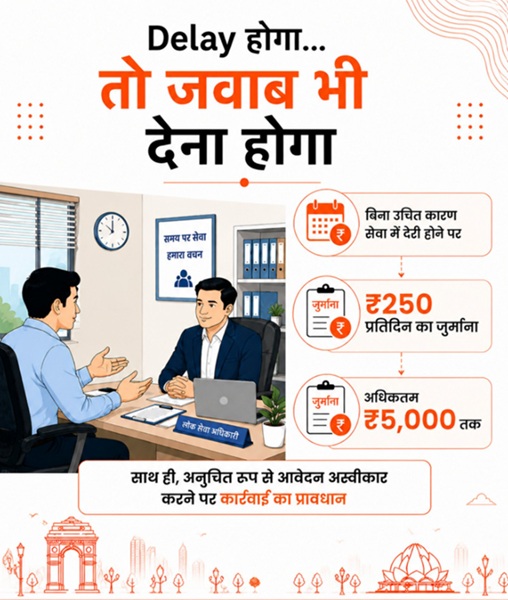
Delay in service delivery: If a Designated Officer fails to deliver a notified service within the prescribed timeline without a valid justification, they can be fined Rs 250 per day. The maximum penalty is Rs 5,000 per case.
Rejection without proper reason: If an officer rejects your application without a proper and valid justification, a one-time penalty ranging from Rs 250 to Rs 5,000 can be imposed.
In both cases, the officer is given a full opportunity to present their explanation before any penalty is imposed. This follows the principle of natural justice, meaning no official can be penalised without being heard first.
What the Delhi Right to Service Commission Will Do
The Bill creates an independent statutory Delhi Right to Service Commission comprising a Chairperson and members. This body operates above all departments and has the following powers and responsibilities:
- Hear second appeals when department-level authorities fail to resolve cases
- Oversee effective implementation of the law across all departments
- Inspect government offices to check compliance
- Recommend departmental action against negligent officials
- Suggest addition of new services under the Act
- Recommend administrative reforms to improve service delivery
- Conduct suo motu inquiries when required, without waiting for a complaint
- Review its own decisions in accordance with the law
- Publish an annual report on service delivery performance and the implementation of the legislation

Old Law vs New Bill: What Has Changed
| Feature | 2011 Act | 2026 Bill |
|---|---|---|
| Daily penalty on officials | Rs 10 to Rs 200 per day | Rs 250 per day |
| Maximum penalty | Rs 5,000 | Rs 5,000 |
| Service delivery mode | Offline and online both | Fully online |
| Application tracking | Limited | Real-time, unique application number |
| Escalation on delay | Manual, citizen must file separately | Automatic, no action needed from citizen |
| Department-level authority | Not specified | Citizen Grievance Redressal Authority in every department |
| Independent oversight body | Not provided | Delhi Right to Service Commission |
| Penalty for rejection without reason | Not specifically provided | Rs 250 to Rs 5,000 one-time |
Current Status of the Bill
The Bill was approved by the Delhi Cabinet on 15 July 2026. It has not yet become law. It will be introduced in the upcoming Monsoon Session of the Delhi Legislative Assembly. After passing the Assembly and completing other constitutional requirements, it will come into force on a date notified by the Delhi government.
Once in force, the government will separately notify the specific services covered, the exact timelines for each, and the Designated Officers responsible. Until those notifications are issued, the existing 2011 Act and its provisions continue to apply.
Add new comment