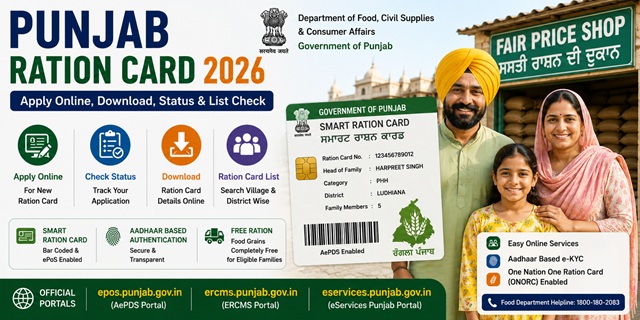
Punjab is one of the few states in India where eligible ration card holders receive their food grains completely free of cost. Whether you hold an AAY (Antyodaya Anna Yojana) card or a PHH (Priority Household) card under the National Food Security Act (NFSA), there is no charge for the monthly wheat entitlement. At present, more than 39 lakh Smart Ration Cards are active across Punjab and are linked with 16,576 Fair Price Shops (FPS) spread across all 23 districts, including Malerkotla.
One important rule that many applicants are not aware of is that for NFSA ration cards, the eldest adult female member of the family is treated as the Head of Family (HoFN). Most online ration card services are therefore linked to her details. If you are applying for a new card or making changes to an existing one, make sure the details of the eldest adult woman in the household are correct and updated.
Punjab's ration card system has seen major improvements in 2026. In April 2026, the government launched the Meri Rasoi Yojana, under which around 40 lakh eligible families receive free nutrition kits every three months. Later, on 22 July 2026, the state opened applications for 10 lakh new ration cards to include newly eligible families, migrant workers, and e-Shram card holders under the food security system.
Applications for new ration cards, member additions, corrections, and other services are now managed through the ERCMS (Electronic Ration Card Management System) portal at ercms.punjab.gov.in. Citizens who are unable to apply online can also use the Punjab Government's Door Step Delivery Service by calling 1076, where a representative assists with the application process from home.
All ration distribution, Aadhaar authentication, beneficiary records, and Fair Price Shop transactions are managed through Punjab's AePDS (Automated Electronic Public Distribution System) available at epos.punjab.gov.in, while citizen-facing services are available through the ERCMS Portal.
Latest Updates 2026
If you are planning to apply for a new ration card or already have one, these are the most important updates you should know before proceeding.
- 10 lakh new ration cards - applications started from 22 July 2026. Chief Minister Bhagwant Singh Mann announced a Transparent Ration Card Inclusion Drive based on the principle of "No Cash, No Farmaish". Under this initiative, around seven lakh newly eligible families and three lakh migrant workers and e-Shram beneficiaries are being brought under the NFSA system.
- Meri Rasoi Yojana - launched in April 2026. Eligible Blue Ration Card families now receive free nutrition kits every three months. The kit includes essential household items such as chana dal, sugar, salt, turmeric, and mustard oil. No separate application is required, but Aadhaar seeding and eligibility verification are mandatory.
- 2,800 new ration depots approved in July 2026. These additional Fair Price Shops are expected to benefit nearly 5.5 lakh beneficiaries by reducing travel distance and improving access to monthly ration distribution.
Key Details at a Glance
| Detail | Information |
|---|---|
| Issuing Authority | Dept. of Food, Civil Supplies and Consumer Affairs, Govt. of Punjab |
| Apply for New Ration Card | ercms.punjab.gov.in/serviceDetail/Ration_card |
| AePDS Portal | epos.punjab.gov.in |
| ERCMS Portal | ercms.punjab.gov.in |
| Income Limit to Apply | Family annual income below Rs. 8,00,000 from all sources |
| Total Ration Cards | 39,05,916 (live data, epos.punjab.gov.in) |
| Total Fair Price Shops | 16,576 |
| Monthly Entitlement (PHH) | 5 kg wheat per person per month, completely free of cost |
| Monthly Entitlement (AAY) | 35 kg food grains per family per month, completely free of cost |
| Meri Rasoi Nutrition Kit | Free nutrition kit once every three months for eligible Blue Ration Card holders |
| Door Step Delivery Helpline | 1076 |
| Toll Free Helpline | 1800-300-11007 |
| PDS Helpline | 1967 |
| Department Address | Anaj Bhawan, Sector 39-C, Chandigarh 160036 |
Types of Ration Card in the State
Punjab issues different types of ration cards depending on a family's economic condition and eligibility under the National Food Security Act (NFSA). The type of card you receive decides how much ration your family can get every month and what additional benefits you may be entitled to receive.
| Type | Who Gets It | Monthly Entitlement | Cost |
|---|---|---|---|
| AAY (Antyodaya Anna Yojana) | Poorest of the poor families, people with no stable source of income, widows, elderly persons without support, and persons with disabilities | 35 kg per family per month | Free (Rs. 0) |
| PHH (Priority Household) | Low-income families identified under NFSA eligibility criteria | 5 kg wheat per person per month | Free (Rs. 0) |
| Non-NFSA (APL) | Families above NFSA eligibility limits who require a ration card mainly as an identity or address proof document | No food subsidy | No subsidy |
According to the entitlement details available on epos.punjab.gov.in, both AAY and PHH beneficiaries receive their food grains at Rs. 0. In simple words, eligible families do not pay anything for their monthly wheat allocation. In Punjab, people often refer to NFSA cards as Blue Ration Cards, a term commonly used for both AAY and PHH households.
10 Lakh New Ration Cards: Applications Open Now
If your family has never received a ration card before or has recently become eligible, this is an important opportunity. On 22 July 2026, Chief Minister Bhagwant Singh Mann announced a major inclusion drive under which 10 lakh new ration cards will be issued across Punjab.
The objective is to ensure that every eligible family receives food security benefits without having to depend on recommendations or middlemen. Applications for new ration cards as well as inclusion of eligible family members in existing cards started on the same day.
The entire campaign is based on the principles of "No Cash, No Farmaish". This means you do not need to pay anyone and you do not need any recommendation from a politician, official, or local representative to become eligible.
| Detail | Information |
|---|---|
| Total new cards | 10 lakh |
| Newly eligible families | 7 lakh |
| e-Shram and migrant workers brought under NFSA | 3 lakh |
| Applications opened | 22 July 2026 |
| What each beneficiary gets | 5 kg wheat per month plus the Meri Rasoi Nutrition Kit |
| Priority | Vulnerable sections of society |
How Your Application Will Be Verified
Many applicants wonder what happens after they submit their form. Punjab has introduced multiple verification layers to ensure that benefits reach only genuine and eligible families.
- Physical household verification is conducted at the address mentioned in your application.
- Geo-tagged and time-stamped inspections record the exact location and time of the verification visit.
- API-based verification checks the information against other government databases.
- A complete digital audit trail is maintained for every approval and rejection.
- SMS acknowledgements and updates are sent to the registered mobile number for easy tracking.
In simple terms, every action taken on your application is digitally recorded. Because of this, approvals and rejections cannot be made secretly. If your application is rejected, the reason for rejection is also recorded in the system and can be reviewed.
Meri Rasoi Yojana: Free Nutrition Kit Every Three Months
The Punjab Government launched Meri Rasoi Yojana to provide additional nutritional support to families already covered under NFSA. While beneficiaries continue receiving free wheat every month, they also receive a free nutrition kit once every three months.
The scheme was announced by Chief Minister Bhagwant Singh Mann in February 2026 and distribution started in April 2026. Around 40 lakh NFSA families are covered under this initiative.
What Is Inside the Kit
Every nutrition kit contains essential food items commonly used in daily cooking:
- 2 kg chana dal
- 2 kg sugar
- 1 kg iodised salt
- 200 grams turmeric powder
- 1 litre mustard oil
These items are supplied in addition to the regular wheat entitlement and are intended to improve nutritional intake for eligible households.
The kits are prepared and packed by Markfed and distributed through the Department of Food, Civil Supplies and Consumer Affairs using the same Fair Price Shops where monthly ration is collected. Regular quality inspections are carried out before distribution. The scheme has an estimated allocation of around Rs. 900 crore during the financial year 2026-27.
Who Gets It and What You Must Do
The good news is that most eligible families do not need to submit any separate application.
- Eligibility: Every family holding a Blue Ration Card under AAY or PHH categories.
- No application required. Eligible families are automatically covered under the scheme.
- Aadhaar linking is mandatory. If your ration card is not properly linked with Aadhaar, you may not receive the nutrition kit. This is one of the most common reasons beneficiaries miss the benefit.
How to Collect Your Meri Rasoi Kit
Collecting the nutrition kit is simple. Just follow these steps when distribution begins in your area.
- First confirm that your ration card is linked with Aadhaar. You can check the status at nfsa.gov.in or ask your Fair Price Shop dealer.
- Visit the same Fair Price Shop from where you normally collect your monthly ration.
- Carry your Smart Ration Card and the Aadhaar of the family member whose biometric authentication is registered.
- Complete fingerprint or biometric verification on the ePoS machine.
- Collect the nutrition kit and check that all five items are included and properly packed before leaving the shop.
If your Aadhaar is not linked with the ration card, complete the Aadhaar seeding process first. You can refer to the Aadhaar linking section below or read the complete guide on ration card e-KYC for detailed instructions.
Important Rule: HoFN (Head of Family as per NFSA)
Punjab follows a slightly different system from many other states. Before applying for a ration card or making any changes online, it is important to understand who is allowed to access these services. The official ERCMS portal at ercms.punjab.gov.in clearly explains this rule.
- For NFSA cards (AAY and PHH): The HoFN (Head of Family as per NFSA) is generally the eldest adult female member of the family who is 18 years of age or older. Think of her as the official representative of the family for ration card services. Only the HoFN can register, log in, and use most online NFSA ration card services. Her Aadhaar must be properly seeded and verified in the system.
- If there is no woman above 18 years of age in the family, the system allows another eligible family member to be recorded as the Head of Family. The application form itself provides this option.
- For Non-NFSA cards: The Head of Family (HoF) does not have to be female. The registered HoF can access online services after Aadhaar verification.
- Other Aadhaar-verified family members can usually view ration card details, but important actions such as adding members, deleting members, corrections, or applying for benefits can only be done through the HoF or HoFN account.
In simple words, Punjab wants one officially verified family representative to handle ration card services so that records remain accurate and duplicate requests are avoided.
Who Can Apply
Before applying, make sure your family satisfies the eligibility conditions. Many families think they are not eligible when they actually are, so read these points carefully.
Income Condition
The total annual income of the family from all sources combined must be below Rs. 8,00,000. Here, family income means the combined earnings of everyone living in the household, not just the Head of Family.
For example, if two family members earn income, both incomes are counted together while checking eligibility.
Government Employment Condition
This is one of the most misunderstood rules in Punjab.
Families are not eligible if any family member is working as a regular or permanent government employee in:
- A department of the Government of India or the Government of Punjab
- A board or corporation
- A municipal committee
- A trust or similar institution
But there is an important exception.
If a family member works in any of the above organisations on a contract basis, outsourced basis, work-charged basis, or daily wage basis, the family can still apply. Only permanent and regular government employment makes a family ineligible.
This is where many people get confused. Simply working in a government office does not automatically disqualify you. The type of employment matters.
Other Conditions
- Must be a permanent resident of Punjab.
- The Head of Family must be at least 18 years old.
- The family must not already have a valid ration card anywhere else in India.
- Newly married couples who do not yet have a ration card can apply for a new card.
- If a child is born in the family, the newborn can be added to an existing ration card.
- Family members who were left out earlier and are not included in any ration card can apply for inclusion.
Think of the ration card as one family record. Every eligible family member should be included in that record so that nobody misses their benefits.
Special Circumstances Punjab Specifically Asks About
The Punjab ration card application form contains a separate section for families facing difficult social or economic situations. These questions help the government identify households that may need additional attention and support.
For each question, simply answer Yes or No honestly.
- Did any farmer or landless member of the family die by suicide due to economic distress?
- Are there children in the family who lost both parents during the COVID-19 pandemic?
- Did the family lose its earning member during the COVID-19 pandemic?
- Is any family member currently undergoing de-addiction treatment, or has any member undergone de-addiction treatment during the past one year?
Do not worry if you answer "Yes". These questions are not meant to reject your application. Their purpose is to help identify vulnerable families who may require priority support under government welfare programmes.
Under the current inclusion drive, Punjab is giving special attention to vulnerable sections of society, and these questions help the system understand the family's circumstances.
The application also separately records whether the Head of Family:
- Has a disability of 40 percent or more
- Is suffering from a long-term illness
- Is an orphan below 21 years of age
If any of these situations apply, provide accurate information and supporting documents wherever required.
Documents You Need to Apply
Before starting the application, keep all documents ready. Having everything prepared in advance makes the process faster and helps avoid rejection due to missing information.
Mandatory for Everyone
These documents are generally required for every applicant family:
- Aadhaar cards of all family members. Aadhaar must be current, valid, seeded, and verified in the ration card system.
- Passport-size photograph of the Head of Family.
- Group family photograph. This is a special Punjab requirement that many applicants overlook.
- Passport-size photographs of all family members listed in the application.
- Latest electricity bill as proof of residence.
- Mobile number linked with Aadhaar, which is needed for OTP verification and status updates.
Conditional Documents
Some documents are needed only in specific situations. Submit them only if they apply to your family.
- Proof of address if your current residence address is different from the address shown on Aadhaar.
- LPG or gas booklet copy if the household has an LPG connection.
- Fard (land record) if the family owns agricultural land.
- Illness or disability certificate issued by a government institution or registered medical practitioner, wherever applicable.
- Death certificate if the Head of Family is a widow or if the family includes an orphan child below 21 years of age.
- Marriage certificate when adding a newly married spouse to the ration card.
- Birth certificate when adding a newborn child.
- Old ration card number if you are converting an existing paper ration card into a Smart Ration Card.
A simple way to avoid delays is to scan or photograph every document clearly before applying. Blurred images, incomplete documents, or mismatched details are among the most common reasons applications take longer to process.
How to Apply for a Punjab Smart Ration Card
Punjab has made the application process quite flexible. Whether you are comfortable using a computer, prefer visiting a service centre, or cannot leave your home, there is an option for everyone. The good part is that all official application methods are free. Simply choose the one that feels easiest for you.
Method 1: Apply Online on the ERCMS Portal
If you have a mobile phone or computer with internet access, you can apply from home through the ERCMS portal at ercms.punjab.gov.in/serviceDetail/Ration_card. The entire process is digital, so there is no need to submit physical documents separately.
The application form is divided into seven parts. Just complete them one by one carefully.
Part 1: Applicant Details
This section tells the department who is submitting the application.
- Select what the application is for.
- Enter the applicant's full name in English and Punjabi. Both languages are mandatory.
- Specify whether you are applying for yourself.
Part 2: Head of Family Details
This is the most important section because the ration card is issued in the name of the Head of Family (HoF/HoFN).
- Name of the Head of Family in English and Punjabi.
- Date of birth. The system automatically calculates age.
- Gender and marital status.
- Aadhaar number (12 digits).
- Father's name and mother's name in English and Punjabi.
- Mobile number and email ID of the Head of Family.
- MGNREGA status.
- Whether the Head of Family belongs to the e-Shram category.
- Whether the Head of Family has 40 percent or more disability.
- Whether the Head of Family is suffering from a long-term illness.
- Whether the Head of Family is an orphan below 21 years of age.
- Educational qualification and occupation.
Fill these details carefully because they are used during eligibility verification.
Part 3: Mobile and Aadhaar Verification
This step confirms that the application is genuine.
- Verify the Head of Family's mobile number by entering the OTP received.
- Accept the Aadhaar consent declaration so that the department can securely verify Aadhaar details through UIDAI.
Part 4: Category and Income Details
Here the government checks whether the family falls within the eligibility criteria.
- Select your category.
- Enter the family's total annual income from all sources.
- Mention whether any family member owns agricultural land.
Part 5: Household Details
This section collects basic information about your family and residence.
- House ownership status.
- Type of family.
Part 6: Complete Current Address of the Head of Family
Enter your full address exactly as you currently live there.
- Area type - urban or rural.
- House number in English and Punjabi.
- Ward number or street number.
- State, district, tehsil or sub-tehsil.
- Vidhan Sabha constituency.
- PIN code.
- Post office name in English and Punjabi.
Make sure the address matches your supporting documents wherever possible.
Part 7: Special Circumstances and Document Upload
This final section is where you upload documents and provide any additional information.
- Answer the four special circumstances questions honestly.
- Add any other relevant information in English and Punjabi (up to 200 characters each).
- Upload the passport-size photograph of the Head of Family.
- Upload Aadhaar card copies of all family members.
- Upload address proof if the current address is different from Aadhaar.
- Upload the group family photograph.
- Upload the latest electricity bill.
Once everything is complete, submit the application. An SMS acknowledgement containing your application reference number is sent to your registered mobile number. Keep this number safe because you will need it to track your application later.
Method 2: Door Step Delivery, Call 1076
Many people are not aware of this facility, but it is one of the most convenient options available in Punjab.
If you are elderly, have difficulty travelling, have a disability, or simply want assistance at home, you can use the Door Step Delivery service.
- Call 1076.
- Request a Door Step appointment for a new ration card application.
- Provide your name, address, and contact details.
- A government representative will visit your home on the scheduled date.
- The representative will help fill the application, collect documents, and complete the submission process at your doorstep.
Before the visit, keep Aadhaar cards, photographs, electricity bill, and other required documents ready. This helps complete the entire process smoothly in a single visit.
The 1076 helpline can also guide you on various Punjab Government services if you need additional assistance.
Method 3: Seva Kendra
If you prefer face-to-face assistance, visit any Seva Kendra with your documents.
The operator will help you fill the application, upload documents, and submit the form correctly. After submission, you will receive an acknowledgement receipt for future tracking.
This option is ideal for applicants who want professional assistance but can easily travel to a service centre.
Method 4: Common Service Centre (CSC)
Common Service Centres (CSCs) across Punjab also accept ration card applications under the current inclusion drive.
Simply carry all required documents. The CSC operator will enter your details, upload documents, and submit the application on your behalf.
This is a useful option if a CSC is closer to your home than a Seva Kendra.
Method 5: District Food Office
You can also apply directly through your District Food Office.
This option is especially useful when:
- You want to discuss your eligibility in person.
- Your application has been pending for a long time.
- You need clarification about documents or verification.
- Your application has been rejected and you want to understand the reason.
The District Food Office is the main authority handling ration card matters in your district, so it is often the best place to visit when a case requires detailed discussion or manual assistance.
How to Check Application Status
After submitting your ration card application, there is no need to visit offices repeatedly to ask whether it has been approved or not. Punjab provides online tracking so you can check the progress yourself from home. Every applicant receives an SMS acknowledgement containing a reference number, which is used for tracking.
- Go to ercms.punjab.gov.in.
- Log in using the same credentials that were used while submitting the application.
- Open the application tracking section and enter your Application Number.
- The system displays the current status and shows which stage your application has reached.
You can also track your application through eservices.punjab.gov.in by selecting Check Your Application Status and entering the Application Number. If you are unable to access the internet, simply call 1076 and provide your reference number for assistance.
Under Punjab's transparent verification system, every approval and rejection is digitally recorded. If an application is rejected, you have the right to know the official reason recorded in the system.
How to Check the Ration Card List
If you want to see whether your family's ration card is included in the official beneficiary records, Punjab allows you to check the complete Fair Price Shop (FPS) list online.
- Go to epos.punjab.gov.in.
- Under the Reports section, click Beneficiary Details.
- Select your District from Punjab's districts.
- Select your Block or Town.
- Select your Village or Ward.
- Select your Fair Price Shop (FPS).
- The complete list of ration card holders attached to that FPS appears on the screen.
This is useful if you want to verify that your card is active and mapped to the correct ration depot.
You can also check the RC Drawl Status on the same portal. This report shows whether ration has already been collected during the current month.
How to Check Beneficiary Details and Ration Transactions
The Punjab AePDS system records every ration transaction electronically. This means you can see exactly when ration was collected, from which depot, and how much was issued.
- Go to epos.punjab.gov.in/SRC_Trans_Int.jsp.
- Enter your 12-digit Smart Ration Card Number.
- Your complete transaction history is displayed, including ration collection details.
This feature is especially helpful if you want to verify that your monthly entitlement has been issued correctly or if there is any dispute regarding ration distribution.
Note on old ration card numbers: If your old card number is in a format such as FAZ1234567, replace the first three letters with 03000 and search using 030001234567. If the record still does not appear, contact your Fair Price Shop dealer to obtain your new Smart Ration Card number.
How to Download Your Smart Ration Card
Once your ration card is approved, you do not always need the physical card. A digital copy can also be downloaded whenever required.
Via ERCMS Portal
- Go to ercms.punjab.gov.in.
- Log in using your 12-digit Ration Card Number and Aadhaar-verified credentials. For NFSA cards, the login must be done through the registered HoFN account.
- Open your ration card details and download the PDF copy.
The downloaded copy can be saved on your phone for future use.
Via DigiLocker
If you already use DigiLocker, you can keep your ration card safely stored there along with other government documents.
- Go to digilocker.gov.in or open the DigiLocker app.
- Log in using your Aadhaar-linked mobile number.
- Search for Ration Card and select Food, Civil Supplies and Consumer Affairs Department, Punjab.
- Enter your ration card number and district.
- Click Get Document. The Punjab Smart Ration Card is saved in your DigiLocker account.
How to Add or Remove a Family Member
Family details often change over time. A child may be born, a new spouse may join the family, or a member may shift elsewhere. Punjab allows these updates through the ration card system, and every request goes through the same transparent verification process.
To Add a Member
- Go to ercms.punjab.gov.in/serviceDetail/Ration_card and log in using HoFN credentials for NFSA cards or HoF credentials for non-NFSA cards.
- Select the Add Member service.
- Enter the new member's Aadhaar number, name in English and Punjabi, date of birth, and relationship with the Head of Family.
- Upload the required supporting document. Use the birth certificate for a newborn and the marriage certificate for a newly married spouse.
- Upload a passport-size photograph of the new member.
- Submit the request and save the acknowledgement number.
After verification, the member is added to the ration card record.
To Remove a Member
- Log in on the same portal using HoFN or HoF credentials.
- Select the Remove Member service.
- Choose the member whose name needs to be removed.
- Select the reason, such as death, marriage, or shifting to another household.
- Upload the supporting document, such as a death certificate or marriage certificate.
- Submit the request and note the acknowledgement number.
If you are not comfortable using the portal, you can visit a Seva Kendra, a CSC, or call 1076 to request Door Step assistance.
How to Link Aadhaar
Aadhaar linking is one of the most important requirements in Punjab's ration card system. Without Aadhaar verification, beneficiaries may face problems receiving monthly ration, completing e-KYC, or getting benefits under schemes such as Meri Rasoi Yojana.
All Aadhaar seeding is handled through the Punjab AePDS system at epos.punjab.gov.in.
- Visit your designated Fair Price Shop with the Aadhaar cards of all family members.
- Ask the FPS dealer to complete Aadhaar seeding through the ePoS machine.
- Each family member provides fingerprint authentication for verification.
- An ONORC eKYC report is available at epos.punjab.gov.in/ONRC_eKYC.jsp.
- You can check Aadhaar seeding status anytime at nfsa.gov.in.
Think of Aadhaar linking as connecting your family's identity with the ration system. Once this connection is verified, ration distribution becomes smoother and benefits reach the correct beneficiaries.
For the complete guide: How to Link Ration Card with Aadhaar Card. For the full e-KYC process at the Fair Price Shop, read Ration Card e-KYC.
Using Your Card in Another State (ONORC)
If you move outside Punjab for work, studies, or any other reason, you do not lose your ration benefits. Under the One Nation One Ration Card (ONORC) scheme, eligible NFSA beneficiaries can collect ration from any participating Fair Price Shop anywhere in India.
For example, a family member working in Delhi, Mumbai, Bengaluru, or any other city can continue receiving ration using the same Punjab ration card.
The Portability Details report is available at epos.punjab.gov.in, where ONORC transactions can be viewed.
In most cases, Aadhaar authentication at the Fair Price Shop is all that is required.
For complete details: One Nation One Ration Card (ONORC) Complete Guide.
How to File a Grievance
If you face any problem related to your ration card, ration distribution, Aadhaar linking, Meri Rasoi kit, or application processing, Punjab provides several complaint channels.
- Door Step and General Assistance: 1076
- Toll Free Helpline: 1800-300-11007
- PDS Helpline: 1967
- Grievance on AePDS: Available under the Grievance section at epos.punjab.gov.in
- District Food Office: Visit in person for pending applications and rejections
- Department Address: Anaj Bhawan, Sector 39-C, Chandigarh 160036
If your ration was not issued correctly, your Meri Rasoi kit was not provided, some items were missing, or biometric authentication failed, report the issue immediately. Keep your ration card number and visit date ready while filing the complaint.
Official Portals and Useful Links
These are the most important official portals used by Punjab ration card beneficiaries. Save them for future reference.
- Apply for New Ration Card, ercms.punjab.gov.in
- AePDS Punjab, epos.punjab.gov.in for beneficiary list, RC details and transactions
- ERCMS Punjab, ercms.punjab.gov.in for online services and member updates
- eServices Punjab, eservices.punjab.gov.in for application status
- Check Beneficiary and Transaction Details, epos.punjab.gov.in
- ONORC Portability Details, epos.punjab.gov.in
- ONORC eKYC, epos.punjab.gov.in
- Download e-Ration Card, DigiLocker
- Check Aadhaar Seeding Status, nfsa.gov.in
Door Step and Assistance: 1076
Toll Free Helpline: 1800-300-11007
PDS Helpline: 1967
Address: Anaj Bhawan, Sector 39-C, Chandigarh 160036
Disclaimer: This article is for informational purposes only. Processes, eligibility rules, ration entitlements, and scheme benefits may change from time to time. Always verify the latest information from the official portals epos.punjab.gov.in and ercms.punjab.gov.in before taking any action.
Comments
28
Ok
Rashan card apply online
I need a Rashan card
Add new comment