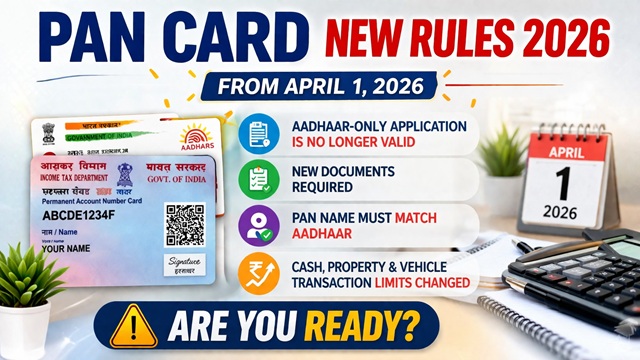
If you have been planning to apply for a new PAN card or update your existing one, there is something important you need to know. From April 1, 2026, the rules around PAN card have changed in a big way. The Central Board of Direct Taxes (CBDT) has notified the Income Tax Rules 2026 under the new Income-tax Act 2025, which replaces the six-decade-old Income Tax Act of 1961.
These changes affect how you apply for PAN, what documents you need to submit, what name appears on your card, and when you must quote your PAN during financial transactions. Let us break it all down simply.
Why Are These Changes Happening?
The government introduced the Income-tax Act 2025 to simplify India's tax system. The old 1961 Act had become complicated over decades of amendments. The new law aims to reduce legal complexity, make compliance easier, and improve transparency in high-value financial transactions. PAN is now positioned as a key financial identifier, and its rules are being tightened to match that role.
PAN is no longer just a tax document. You need it for banking, investing, buying property, purchasing vehicles, and several other large transactions. That is exactly why the government is making identity verification stricter when you apply for one.
1. Aadhaar-Only PAN Application Is Over
Until March 31, 2026, you could get a PAN card by simply using your Aadhaar number. That single-document process is now closed.
From April 1, 2026 onwards, you must submit additional proof of date of birth along with your Aadhaar when applying for a new PAN or updating an existing one. The accepted documents include:
- Birth Certificate
- Voter ID Card
- Passport
- Driving Licence
- Class 10 Marksheet (matriculation certificate)
- Magistrate-issued affidavit declaring date of birth
This change aims to improve identity verification quality and reduce errors and misuse in PAN issuance. The process is still accessible — you just need to keep your documents ready before you apply.
2. Old PAN Forms Are No Longer Valid
The Income Tax Department has introduced new category-specific PAN application forms under Income Tax Rules 2026. Old forms will not be accepted from April 1, 2026.
Here is how the new forms are structured:
| Applicant Category | New Form Number |
|---|---|
| Indian Individuals | Form No. 93 |
| Indian Companies and Entities | Form No. 94 |
| Foreign Individuals | Form No. 95 |
| Foreign Entities | Separate form (as notified) |
You can access these new forms through Protean (formerly NSDL eGov), UTIITSL, or the Income Tax Department's official e-filing portal at incometax.gov.in.
3. Your PAN Name Must Match Your Aadhaar
This is one of the most important changes for existing PAN holders. From April 1, 2026, the name printed on your PAN card must exactly match the name in your Aadhaar database.
The Income Tax Department has removed the option to customise your name on the PAN card. Whatever name is in your Aadhaar - including shortened names, old spellings, or names without a surname — that is what will appear on your PAN card.
If your Aadhaar has an incorrect or outdated name, you must correct it first at the UIDAI portal (uidai.gov.in) before applying for a new PAN or updating your existing one. This ensures consistency across all your government-issued identity documents.
4. Transaction Thresholds for Quoting PAN Have Changed
Earlier, you had to quote your PAN for relatively small transactions — like depositing ₹50,000 in a single day at a bank. The new rules have revised these thresholds significantly. For most transactions, the limit is now calculated on an annual basis rather than per transaction.
Here is a complete comparison of old and new thresholds:
| Transaction Type | Old Threshold | New Threshold (from April 2026) |
|---|---|---|
| Cash Deposit or Withdrawal (Bank) | ₹50,000 per day | ₹10 lakh per financial year |
| Motor Vehicle Purchase (including motorcycles) | All vehicles | Only if price exceeds ₹5 lakh |
| Hotel / Restaurant / Event Payment | ₹50,000 | ₹1 lakh |
| Immovable Property Transaction | ₹10 lakh | ₹20 lakh (proposed) |
The revised thresholds give relief for everyday and small transactions while making it easier for authorities to track genuinely high-value financial activity. The focus is clearly on transparency in large cash movements and significant asset purchases.
5. PAN Becomes Even More Important Under the New Law
Under the Income-tax Act 2025, PAN is positioned as the primary financial identifier across major transactions. The government wants to make high-value activity easier to track and report. This means:
- Banking and investment activities require accurate PAN details
- Any mismatch between PAN and Aadhaar details can cause problems during tax filings
- Inoperative PAN (not linked to Aadhaar) cannot be used for financial transactions
- The new concept of a single "Tax Year" replaces the old "Assessment Year" and "Previous Year" terminology, making tax compliance more straightforward
What Should You Do Right Now?
Here is a simple checklist to make sure you are ready:
- Check your Aadhaar details — especially your name, date of birth, and address. Correct any errors at uidai.gov.in before applying for PAN.
- Link your PAN with Aadhaar — if not already done. You can do this at incometax.gov.in. An inoperative PAN creates problems across banking and tax-related activities.
- Do not use old PAN forms — if you need to apply or update, use the new forms available on incometax.gov.in, Protean, or UTIITSL.
- Keep your documents ready — birth certificate, voter ID, passport, driving licence, or Class 10 marksheet for any new PAN application.
- Know the new transaction limits — so you are not caught off guard when making large cash deposits or buying a vehicle or property.
Where Can You Apply for PAN Under the New Rules?
You can apply for a new PAN or update your existing PAN through the following official channels:
- Income Tax e-Filing Portal: incometax.gov.in.
- Protean (formerly NSDL eGov): onlineservices.nsdl.com
- UTIITSL: pan.utiitsl.com
- Offline: PAN Service Agents authorised by the Income Tax Department
Frequently Asked Questions
-
Does my existing PAN card become invalid from April 1, 2026?
No. Your existing PAN card remains valid. However, your details must match your Aadhaar to avoid issues with tax filings and financial transactions. -
Can I still apply for PAN using only Aadhaar?
No. From April 1, 2026, the Aadhaar-only route is closed. You must submit additional documents like a birth certificate, voter ID, or passport along with your application. -
What if I submitted my PAN application before April 1, 2026?
Your application is valid and will be processed. You do not need to reapply under the new rules. -
What happens if my PAN name does not match my Aadhaar name?
You may face problems during banking transactions and tax filings. You should correct your Aadhaar details first at uidai.gov.in and then apply for a PAN update. -
Where can I find the new PAN application forms?
The new forms are available on the Income Tax Department's official e-filing portal at incometax.gov.in. You can access them via: e-File → Income Tax Forms → File Income Tax Forms → Forms under Income Tax Act, 2025. You can also find them on Protean and UTIITSL portals. -
How do I verify my current PAN status?
You can verify your PAN details anytime on the Income Tax Department's official portal at incometax.gov.in
Add new comment